
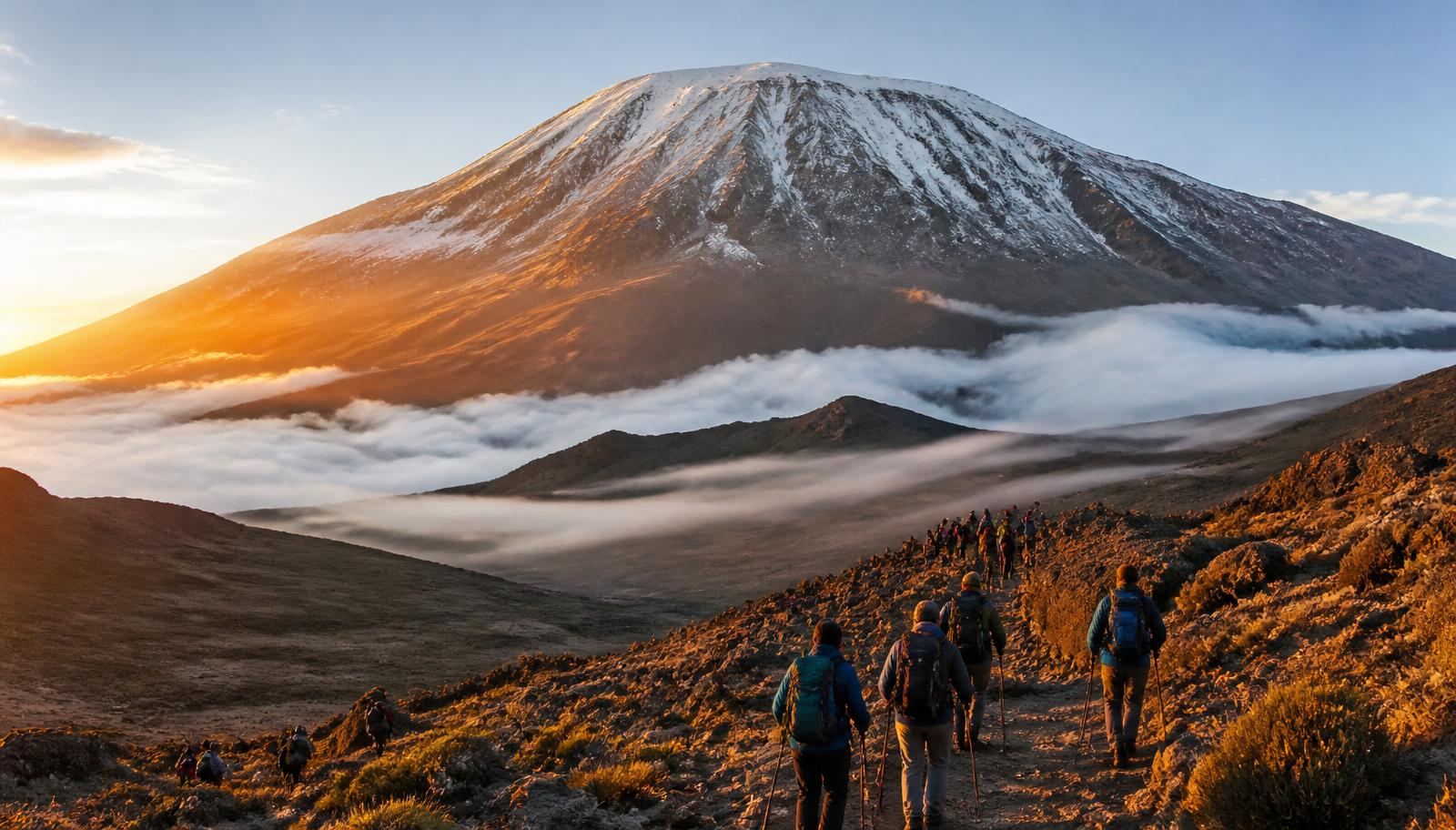
Kilimanjaro Climbing
Kilimanjaro Routes Comparison: Which Route Should You Choose?
Machame, Marangu, Lemosho, Rongai, Northern Circuit and Umbwe — compared honestly on difficulty, scenery, success rates, crowds and cost by guides who climb all six.

Introduction
Almost every Kilimanjaro conversation we have in our Arusha office starts the same way. Someone has read three blog posts, watched a YouTube video, and arrived convinced that one route is "the best." Usually it's Machame, because Machame is what the internet talks about. Then they ask us to confirm it, and we end up spending twenty minutes unpicking the question instead of answering it.
Here's why. Kilimanjaro has seven official routes to the summit, and six of them get climbed in any real volume: Machame, Marangu, Lemosho, Rongai, the Northern Circuit and Umbwe. They differ in length, in gradient, in scenery, in how many people you'll share camp with, and in price. What they don't differ in is the thing that actually stops people summiting. Nobody fails on Kilimanjaro because a trail was too steep. They fail because they climbed too high, too fast, with too few days to adapt.
So the real question isn't "which route is best?" It's "which route, at which length, suits my fitness, my altitude history, my budget and my dates?" A seven-day Machame and a five-day Machame are two entirely different mountains. An eight-day Lemosho will summit a nervous first-timer who would have turned back on a six-day Marangu, even though Marangu's trail is the gentler walk.
This guide compares all six routes properly. You'll get an honest profile of each one — what the days actually feel like, where the hard sections are, who it suits and who it doesn't — plus a full comparison table, a recommendation chart matched to climber profiles, and straight answers on beginners, success rates, scenery and value. It pairs with our Mount Kilimanjaro climbing guide for the wider planning picture, and with our best time to climb Kilimanjaro guide for choosing your dates.
Understanding Kilimanjaro Routes
Before comparing individual trails, it helps to understand what a Kilimanjaro route actually is. Every route is a combination of three things: the gate you start from, the path you take across the mountain's flanks, and the camp you launch your summit attempt from. Only two of those really vary. By the final night, almost everyone on the southern side is sleeping at Barafu (4,673m) or the higher Kosovo camp, and almost everyone on the northern side is at School Hut or Kibo Hut. From there the summit push is essentially the same walk: six to seven hours of switchbacks up frozen scree in the dark, then the crater rim at Stella Point or Gilman's Point, then the last forty-five minutes along the rim to Uhuru Peak.
What separates the routes is everything that happens before that night. Kilimanjaro rises through five ecological zones — cultivation, montane rainforest, heath and moorland, alpine desert, and the arctic summit zone — and each route crosses them at a different angle, at a different speed, with a different amount of up-and-down built in. That up-and-down matters more than most people expect. Trails that take you high during the day and bring you back down to sleep are training your body to produce more red blood cells while letting you recover overnight. Trails that climb in a steady, tidy line to the summit look efficient on paper and quietly ruin people.
The Four Things That Actually Differ
- Acclimatization profile. How much time you spend above 3,500m, and whether the route includes real climb-high, sleep-low days. This is the single biggest driver of summit success.
- Scenery and variety. Whether you cross multiple aspects of the mountain or walk up and down the same corridor.
- Traffic. Machame and Marangu carry the majority of climbers. Rongai, Umbwe and the Northern Circuit are quiet enough that you can walk half a day without seeing another group.
- Cost. Driven almost entirely by duration. Every extra day adds park fees, camping fees, crew wages and food — roughly $200 to $350 per climber per day depending on the operator.
Route Comparison Overview
Here's the short version before we go route by route. Use it to shortlist two or three candidates, then read their profiles below.
| Route | Also known as | Typical days | Approach | Sleeping | Traffic |
|---|---|---|---|---|---|
| Machame | The Whiskey Route | 6 – 7 days | South | Camping | Highest — about a third of all climbers |
| Marangu | The Coca-Cola Route | 5 – 6 days | Southeast | Huts | High, concentrated in peak months |
| Lemosho | The Scenic Route | 7 – 8 days | West | Camping | Moderate, busier after Shira |
| Rongai | The Dry Route | 6 – 7 days | North / northeast | Camping | Low |
| Northern Circuit | The Grand Traverse | 8 – 9 days | West, looping north | Camping | Lowest of the established routes |
| Umbwe | The Direct Route | 6 days | South, very steep | Camping | Very low — experienced climbers only |
Machame Route
Machame is the most climbed route on Kilimanjaro and the one most people picture when they imagine the mountain. It starts at Machame Gate on the southern slopes, at around 1,800m, and the first day is a long, humid walk through thick montane rainforest — tree ferns, hanging moss, black-and-white colobus monkeys in the canopy and, if you're unlucky, four hours of steady drizzle. You emerge at Machame Camp at 3,000m, and from there the mountain opens up.
Day two crosses the heath and moorland to Shira Camp at 3,840m, with Kibo suddenly filling the horizon. Day three is the one that makes this route work: you climb to the Lava Tower at 4,630m for lunch, then descend nearly 600 metres to sleep at Barranco Camp. Climbers hate that descent — it feels like throwing away hard-won altitude — but it is the most valuable single day of acclimatization available anywhere on Kilimanjaro. Almost everyone gets a headache at the Lava Tower and almost everyone feels dramatically better by dinner at Barranco.
Day four opens with the Barranco Wall, a 250-metre rock face that looks impossible from camp and turns out to be a straightforward scramble with hands, no ropes and one famous exposed step called the Kissing Rock. It's the most photographed hour on the mountain. From there you traverse to Karanga, then to Barafu, and go for the summit that night — or, on the seven-day version, you sleep at Karanga first, which is exactly the extra day we recommend everyone take.
Machame's nickname, the Whiskey Route, was coined to contrast it with Marangu's Coca-Cola: tougher, rougher, more of a proper mountain. It's an accurate description. The daily terrain is genuinely harder than Marangu or Rongai, with steeper sections and more up-and-down, and there's no hut to retreat into if the weather turns. In exchange you get one of the best acclimatization profiles on the mountain, spectacular scenery through four ecological zones, and — because so many operators run it — competitive pricing and frequent departures.
Machame: Who It Suits
- Reasonably fit hikers comfortable with six to eight hours of walking on consecutive days.
- Climbers who want the classic Kilimanjaro experience — Lava Tower, Barranco Wall, Barafu — without paying for a nine-day itinerary.
- Anyone on a mid-range budget: the volume of Machame departures keeps prices sharper than on the quieter routes.
- Not ideal for people who need solitude, or who are climbing in April, May or November when the southern rainforest is at its wettest.
Marangu Route
Marangu is the oldest route on Kilimanjaro and the only one with permanent sleeping huts. You start at Marangu Gate on the southeastern slopes and walk a wide, well-graded forest path to Mandara Huts at 2,700m — an easy first day, three or four hours, and the gentlest introduction the mountain offers. Day two crosses open moorland with giant groundsels and lobelias to Horombo Huts at 3,720m, and day three crosses the Saddle, a wide high-altitude desert between Mawenzi and Kibo, to Kibo Hut at 4,700m. You summit that night via Gilman's Point.
The appeal is obvious. Dormitory-style A-frame huts with mattresses and a communal dining hall, no tent to crawl into after a wet day, and the easiest walking surface on the mountain. For climbers in their sixties and seventies, for people who genuinely cannot sleep on a camping mat, and for anyone climbing in the rainy season, that comfort is worth something real.
The problem is the itinerary. Marangu is normally sold as five days, and five days is simply not enough for most bodies to adjust to 5,895 metres. There is no built-in climb-high, sleep-low day, and because you ascend and descend the same trail, you never get the natural altitude oscillation that Machame and Lemosho provide. Summit success on the five-day version is commonly quoted between 50 and 65 percent, the lowest of any route, and that number is not the trail's fault. Add the acclimatization day at Horombo — a half-day hike toward the Mawenzi Hut and back — and success rates climb toward 75 percent.
The other honest drawback is scenery. Marangu is the least visually varied route on Kilimanjaro because you see the same ground twice. The Saddle is a genuinely striking landscape, wide and lunar with Mawenzi's spires to your right, but you won't cross the Shira Plateau, you won't stand under the Lava Tower, and you won't scramble the Barranco Wall. If photographs matter to you, this is the wrong route.
Marangu: Who It Suits
- Climbers who want beds and hot meals indoors rather than tents.
- Wet-season climbs where sleeping dry every night is a meaningful advantage.
- Older climbers or anyone who wants the gentlest daily terrain.
- Not suitable for anyone chasing high summit odds on a short itinerary, or for climbers who came for the scenery.
Lemosho Route
Lemosho is the route most of our guides would choose if they were paying for their own climb. It starts on the far western side at Londorossi Gate, in forest wild enough that you're driven in with a ranger and occasionally see elephant and buffalo sign on the first day's trail. That opening section — quiet, green, almost nobody around — is completely different in character from the busy Machame Gate morning.
Days two and three cross the Shira Plateau, a vast collapsed caldera at around 3,500 to 3,900 metres. It's flat, open, exposed and enormous, with Kibo sitting directly ahead of you the whole way and Mount Meru rising out of the clouds behind. Sunrise on Shira is, in my honest opinion, the single best view on Kilimanjaro that isn't from the summit. Because the plateau sits high and the days there are relatively short, it also does excellent acclimatization work while you barely notice.
From Shira, Lemosho joins the southern circuit and follows the same magnificent line Machame does — Lava Tower, Barranco, Karanga, Barafu — which means you get the Wall and the Lava Tower acclimatization day as well. The difference is that you arrive at that junction already acclimatized from three days above 3,400m, rather than two days out from the gate. That's why an eight-day Lemosho consistently posts summit rates in the high eighties.
The trade-offs are cost and length. Lemosho is a longer itinerary with a longer transfer to the gate, so it's typically 15 to 25 percent more expensive than an equivalent Machame climb. Seven-day versions exist and are perfectly good, but the eighth day is where the route earns its reputation. It's also worth noting that Lemosho is no longer a secret — the section after Shira merges with Machame traffic, so your last three days are as busy as anyone else's.
Lemosho: Who It Suits
- First-time climbers who want the strongest realistic chance of the summit without committing to nine days.
- Photographers and anyone who cares about landscape variety.
- Climbers who want quiet opening days before joining the main circuit.
- Less suitable if your budget is tight — Machame delivers most of the same experience for less.
Rongai Route
Rongai is the only route that approaches Kilimanjaro from the north, starting near the Kenyan border at Nalemuru. That geography is the whole story. Kibo blocks the moist air coming off the Indian Ocean, so the northern slopes sit in a permanent rain shadow and stay dramatically drier than Machame or Lemosho. In April, when southern climbers are wading through mud in the rainforest, Rongai climbers are often walking on dust.
The route itself is gentle. Gradients are consistently kinder than on the southern trails, the forest section is short and open rather than dense and dripping, and much of the middle of the climb crosses high moorland with long views north across the plains into Kenya. It's genuinely remote — you can walk for hours without meeting another group — and there's something quietly special about that on a mountain as popular as this one. Wildlife sightings are also better here than anywhere else on Kilimanjaro: colobus monkeys, blue monkeys, and occasionally elephant tracks near the lower camps.
Rongai's weakness is acclimatization architecture. Because the northern approach is a relatively steady ascent, it lacks the strong climb-high, sleep-low days built into Machame and Lemosho. Good operators solve this by routing via Mawenzi Tarn — a stunning camp at 4,330m beneath Mawenzi's shattered spires — and spending an acclimatization day there before crossing the Saddle to School Hut or Kibo Hut. Booked that way, over seven days, Rongai performs well. Booked as a rushed six-day trip, it doesn't.
The other consideration is the drive. Getting to Nalemuru Gate takes four to five hours from Moshi, around the eastern side of the mountain, which eats most of your first morning. And because Rongai climbs the north and descends Marangu on the south, you see two very different faces of Kilimanjaro — a nice bonus that also means your gear and transport logistics are slightly more involved.
Rongai: Who It Suits
- Anyone climbing in April, May or November — this is the dry-side route.
- Climbers who want solitude and wilderness over famous landmarks.
- Older climbers or those who prefer steady gradients to steep scrambling sections.
- Less ideal if you want the Barranco Wall, the Lava Tower and the classic southern circuit scenery.
Northern Circuit Route
The Northern Circuit is the newest route on Kilimanjaro and the most effective. It begins exactly like Lemosho — Londorossi Gate, western rainforest, the Shira Plateau — and then, instead of turning south with everyone else, it swings north and traces a long arc right around the back of Kibo before rejoining the summit approach at School Hut on the northeast side. Eight or nine days total, and the highest summit success rate on the mountain.
The reason it works is simple arithmetic. You spend more nights above 3,500 metres than on any other itinerary, with gentle daily elevation changes and multiple natural climb-high, sleep-low patterns built into the traverse. By the time you reach School Hut at 4,800m, your body has had the better part of a week to build red blood cells. Our own Northern Circuit clients summit at well over 90 percent, and the ones who don't are almost always dealing with something unrelated to altitude.
It's also the most beautiful route on the mountain, and I don't say that lightly. The northern slopes are the emptiest terrain on Kilimanjaro — wide alpine desert, strange light, nobody in sight, and long views out over the Amboseli plains toward Kenya where you can sometimes see dust from the herds far below. You circle the entire summit cone, so you see Kibo from every angle across the week. Combined with the Shira Plateau opening, no other route gives you this much variety.
The cost is the obvious catch. Nine days means nine days of park fees, crew wages and food, and the Northern Circuit typically runs 30 to 45 percent more than a seven-day Machame. You also need the annual leave, and you need patience: the middle days are deliberately gentle, and climbers who are used to pushing hard sometimes find the pace frustrating. That pace is the point.
Northern Circuit: Who It Suits
- Climbers for whom reaching the summit matters more than the price of the trip.
- Anyone with a history of altitude problems, or who has failed on a shorter route before.
- Travellers who want genuine remoteness on a busy mountain.
- Not suitable if you have fewer than ten days in Tanzania or a tight budget.
Umbwe Route
Umbwe is Kilimanjaro's hard route, and reputable operators are careful about who they sell it to. It rises from Umbwe Gate on the southern slopes and climbs a narrow forested ridge almost straight upward — roots, rock steps, tree branches used as handholds and genuine exposure in a couple of places. Where Machame takes two comfortable days to reach 3,800m, Umbwe gets you to Barranco Camp at 3,960m in two very hard ones.
The trail is beautiful in a claustrophobic sort of way. The ridge is tight, the forest is dense and moss-hung, and you climb with a drop on either side and no view until you break out of the canopy near Umbwe Cave Camp. Then the mountain opens all at once and you're staring at the Southern Icefields. It's dramatic, and it's completely deserted — Umbwe carries a tiny fraction of Kilimanjaro's traffic.
But the altitude profile is brutal by Kilimanjaro standards. You gain height faster than on any other route, with no acclimatization day before you reach Barranco, and success rates sit around 50 to 60 percent for that reason. The people who do well on Umbwe are those who already know how their bodies respond above 4,500 metres — climbers who've done Aconcagua, Elbrus, high Himalayan trekking or a previous Kilimanjaro summit. For a first-timer with no altitude history, it's the wrong choice regardless of how fit they are at sea level.
Once Umbwe joins the southern circuit at Barranco, it follows the standard line to Karanga and Barafu, so the second half of the climb is familiar territory. Adding a seventh day at Karanga helps considerably, and we'd recommend it to anyone taking this route. We will run Umbwe for the right climber — but we'll ask about your altitude history first, and we'll say no if the answer worries us.
Umbwe: Who It Suits
- Experienced high-altitude trekkers with proven acclimatization history.
- Climbers who want a physically demanding route and total solitude.
- Absolutely not suitable for first-time high-altitude climbers, regardless of gym fitness.
Route Comparison Table
Everything side by side. Success rates below reflect the recommended itinerary length in each row — shorten the trip and the number falls sharply.
| Route | Difficulty | Scenic beauty | Success rate | Crowd levels | Camping or huts | Recommended days | Best for |
|---|---|---|---|---|---|---|---|
| Machame | Moderate to hard underfoot | Excellent | 85 – 90% on 7 days; ~70% on 6 | High | Camping | 7 days recommended | Fit climbers who want the classic Kilimanjaro experience |
| Marangu | Easiest walking, hardest acclimatization | Fair — same trail up and down | 50 – 65% on 5 days; ~75% on 6 | High | Huts | 6 days minimum | Climbers who want beds, and wet-season trips |
| Lemosho | Moderate, well paced | Outstanding | 85 – 90% on 8 days | Moderate | Camping | 8 days recommended | First-timers who want the best odds and the best views |
| Rongai | Moderate, gentle gradients | Good — wilderness and Kenya views | 75 – 85% on 7 days | Low | Camping | 7 days recommended | Rainy-season climbs and people who want quiet trails |
| Northern Circuit | Moderate, longest but gentlest daily gain | Outstanding and the most varied | 90%+ — highest on the mountain | Very low | Camping | 9 days recommended | Climbers who want the strongest possible chance of the summit |
| Umbwe | Hard — steep, exposed, fast altitude gain | Dramatic but narrow | 50 – 60% | Very low | Camping | 6 – 7 days | Experienced high-altitude trekkers only |
Which Route Is Best For Beginners?
For a first-time climber with no high-altitude experience, the answer is an eight-day Lemosho. It gives you the longest gradual build-up of the mainstream routes, it includes the Lava Tower climb-high day, the scenery keeps morale high through the hard middle section, and — critically — the extra day means one bad night doesn't derail your whole climb. Almost every beginner who reaches Uhuru with us did it on an itinerary of seven days or more.
A seven-day Machame is the strong runner-up and usually costs less. The terrain is a little harder day to day, and you'll share the trail with more people, but the acclimatization profile is nearly as good and the value is excellent. If your budget won't stretch to Lemosho, take Machame with the Karanga night and don't think twice.
What beginners should avoid is any five-day itinerary, and Umbwe entirely. Being fit does not protect you from altitude — we've watched marathon runners turn back at 5,000m while a sixty-eight-year-old walking at half their pace kept going. Altitude sickness doesn't care about your VO2 max; it cares about how fast you ascended.
Beginners should also prepare beyond the route choice: get a medical check-up, discuss acetazolamide with your doctor, and read our Tanzania safari health guide for vaccination and altitude advice. Make sure your travel insurance explicitly covers trekking to 6,000 metres and helicopter evacuation — standard policies usually don't.
Which Route Has the Highest Success Rate?
The Northern Circuit, at above 90 percent on the nine-day itinerary. Behind it, eight-day Lemosho and seven-day Machame both sit in the 85 to 90 percent range, seven-day Rongai runs 75 to 85 percent, six-day Marangu around 75 percent, five-day Marangu between 50 and 65 percent, and Umbwe around 50 to 60 percent.
But look at what those numbers really show. Marangu appears at both 75 percent and 55 percent depending only on whether you added a day. Machame drops from roughly 88 percent to roughly 70 percent for the same reason. The route matters; the length matters more. Park-wide, the overall summit rate across all routes and all itineraries hovers around 65 percent, and the single biggest contributor to the failures is short, cheap itineraries sold to people who didn't know the difference.
Three other factors move the needle: pace on the mountain (a good guide will hold you to a pace that feels absurdly slow on day one and saves you on day six), hydration — four litres a day, not two — and the quality of your crew. Guides who monitor oxygen saturation twice daily, carry a pulse oximeter and a portable altitude chamber, and are willing to have a hard conversation at 5,000m are worth paying for.
| Itinerary length | Typical summit rate | What's happening |
|---|---|---|
| 5 days | 50 – 65% | Too fast for most bodies. No acclimatization day, no margin for a bad night. |
| 6 days | 65 – 75% | Workable for strong walkers on the right route, still tight on the summit push. |
| 7 days | 85 – 90% | The sweet spot. Enough time above 3,500m and one full recovery night. |
| 8 – 9 days | 90%+ | Maximum acclimatization; summit night becomes an endurance problem, not an altitude one. |
Which Route Has the Best Scenery?
Lemosho for eight days, Northern Circuit for nine. Both start in the wild western rainforest and cross the Shira Plateau, which is the most spectacular walking on the mountain outside the summit itself: an enormous high-altitude plain with Kibo standing in front of you and the clouds far below. Lemosho then delivers the southern circuit classics — the Lava Tower, the Barranco Wall, the traverse under the Southern Icefields with the glaciers hanging directly above you. The Northern Circuit trades the Barranco Wall for the empty northern slopes and the long views into Kenya, and adds the satisfaction of circling the peak completely.
Machame is the best short-itinerary option for scenery. You miss the Shira Plateau approach but keep everything from the Lava Tower onward, which is the most dramatic part of the mountain anyway. Rongai offers something different — quieter, wilder, with Mawenzi Tarn beneath those shattered volcanic spires ranking as one of the most beautiful camps on Kilimanjaro, and better wildlife than anywhere else on the mountain. Umbwe is intensely atmospheric but visually narrow until you break out of the forest. Marangu comes last for the simple reason that you walk the same corridor twice.
Which Route Offers the Best Value?
Machame over seven days, comfortably. Because it's the most-climbed route, operators run it constantly, group departures fill easily and per-person costs stay competitive. You get one of the best acclimatization profiles on the mountain, the iconic scenery, an 88-ish percent success rate, and you pay meaningfully less than for Lemosho or the Northern Circuit.
To understand pricing, you need to know where the money goes. Kilimanjaro park fees run roughly $70 conservation fee per day plus camping or hut fees, rescue fees and crew entry costs — around $900 to $1,200 per climber for a typical week. Then there's the crew. A single climber needs a lead guide, an assistant guide, a cook and three to five porters, and fair wages plus tipping add several hundred dollars more. Food, equipment, transfers, pre- and post-climb hotels and operator margin make up the rest.
| Route & length | Typical quality range, per person | Value verdict |
|---|---|---|
| Marangu, 6 days | $1,900 – $2,600 | Cheapest credible option; weakest summit odds |
| Machame, 7 days | $2,200 – $3,100 | Best overall value on the mountain |
| Rongai, 7 days | $2,300 – $3,200 | Good value in the wet months; quiet trails |
| Lemosho, 8 days | $2,700 – $3,800 | Premium experience, excellent odds |
| Northern Circuit, 9 days | $3,200 – $4,500 | Highest cost, highest success rate |
| Umbwe, 6 – 7 days | $2,200 – $3,000 | Only value if you're genuinely experienced |
Be very cautious with quotes below about $1,800. Kilimanjaro has a fixed cost floor set by park fees and crew wages, and operators who undercut it are taking the difference out of porter pay, food quality, guide ratios or safety equipment. That's a moral problem and a practical one — underfed, underpaid crews are not the people you want making decisions about your health at 5,000 metres. Our guide on choosing a Tanzanian operator explains the licensing and vetting checks worth running before you pay a deposit.
Expert Route Recommendations
Here's how we actually match routes to people when someone calls the office. Find the profile closest to yours.
| If you are… | We recommend | Why |
|---|---|---|
| First Kilimanjaro climb, no altitude history | Lemosho, 8 days | Longest gentle build-up of the mainstream routes, with a Lava Tower acclimatization day and enough spare time to absorb one bad night. |
| Fit hiker on a moderate budget | Machame, 7 days | The best value on the mountain: strong acclimatization profile, great scenery, and more departures than any other route. |
| Maximum chance of reaching Uhuru | Northern Circuit, 9 days | More time above 3,500m than any other itinerary and the quietest camps, which means better sleep and better recovery. |
| Climbing in April, May or November | Rongai, 7 days | The northern approach sits in Kibo's rain shadow and stays far drier than the southern trails in the wet months. |
| Doesn't want to camp | Marangu, 6 days | The only hut route on the mountain. Take the six-day version with the Horombo acclimatization day, never the five-day. |
| Short on days, high on experience | Umbwe, 6 – 7 days | Fast, steep and quiet — only appropriate if you have already been comfortable above 4,500m. |
| Older climbers or slower walkers | Rongai or Lemosho, extended | Gentle daily gradients and the option to add a rest day without changing the overall structure of the climb. |
| Photographers | Lemosho or Northern Circuit | Shira Plateau sunrises, the Barranco Wall and, on the Circuit, the empty northern slopes with the Kenyan plains behind. |
Three Rules We Give Every Client
- Buy days before you buy comfort. An extra night on the mountain does more for your summit chances than any upgrade in tents, food or gear.
- Match the route to the season. Southern routes in the dry months, Rongai in the wet ones. It's the cheapest weather insurance available.
- Be honest about your altitude history. If you've been sick at 4,000m before, tell us. It changes the route we recommend and may be the difference between summiting and turning back.
Once your route is settled, the rest of the trip is straightforward planning. Sort your Tanzania visa at least a month before departure, and if you're combining the climb with a safari or Zanzibar, our guide on how to book a Tanzania safari walks through sequencing, deposits and what to confirm in writing before you pay.
Common Questions
Frequently Asked Questions
Marangu is the easiest route to walk. It follows a steady, well-graded path with no scrambling, no steep gullies and sleeping huts instead of tents, which makes it appealing to people who dislike camping or are climbing in the wet months. What makes Marangu deceptive is that easy walking and easy summiting are not the same thing. It is normally sold as a five-day trip, and five days is not enough time for most people to acclimatize to 5,895 metres. Its success rate is the lowest of the major routes for exactly that reason. If you want the gentlest walking on the mountain, take Marangu but insist on the six-day version with the extra acclimatization day at Horombo. If you want the highest chance of standing on Uhuru Peak, the honest answer is that a seven- or eight-day Lemosho or Machame is easier on your body overall, even though the daily terrain is harder.
The Northern Circuit, by a clear margin. It is the longest route on Kilimanjaro at eight to nine days, it approaches from the west, loops right around the quiet northern slopes and gives your body more time above 3,500 metres than any other itinerary. Across our own climbs it summits well over 90 percent of clients, and industry-wide figures put it in a similar range. Behind it sit eight-day Lemosho and seven-day Machame, both consistently in the 85 to 90 percent range. Five-day Marangu and six-day Umbwe sit at the bottom, often quoted between 50 and 65 percent. Read those numbers carefully though — the route is not really what changes the outcome. Days on the mountain are. Add a day to almost any route and its success rate climbs into the high eighties.
Lemosho is the scenic route most guides would pick for themselves. It starts in dense western rainforest where you can still see colobus monkeys and, occasionally, elephant sign, crosses the vast open Shira Plateau — an old collapsed caldera with uninterrupted views of Kibo — and then joins the southern circuit past the Lava Tower and the Barranco Wall, which is the most photographed piece of trail on the mountain. The Northern Circuit shares Lemosho's opening days and then adds the remote northern slopes with views across the plains toward Kenya, so if you have nine days it is arguably the most varied of all. For pure drama in a shorter package, Machame's Barranco and Karanga sections are hard to beat. Marangu is the least scenic of the six because you climb and descend the same corridor.
Umbwe is the shortest and steepest route in terms of terrain, reaching the southern circuit in just two days of very direct climbing, and it is usually sold as a six-day trip. Marangu is the shortest in scheduled days, commonly offered as a five-day round trip, which makes it the cheapest and the fastest way on and off the mountain. Both are short for the wrong reasons. Umbwe gains altitude so quickly that it suits only experienced high-altitude trekkers, and five-day Marangu gives most climbers no realistic chance to acclimatize. If your holiday is genuinely limited to five or six days on the mountain, we would rather put you on a six-day Machame or a six-day Rongai than on either of the short options, and we would tell you plainly that your odds improve substantially with a seventh day.
The Northern Circuit and Rongai are the quietest of the established routes. Rongai starts on the far northern side near the Kenyan border and sees a small fraction of Kilimanjaro's traffic; the Northern Circuit shares its first days with Lemosho but then peels off around the back of the mountain where you can walk for hours without meeting another group. Umbwe is quieter still, but only because so few climbers are equipped for it. Machame carries roughly a third of everyone who climbs Kilimanjaro and feels it, particularly at Barranco camp in July and August. One practical note: every southern route converges on Barafu or Kosovo for summit night, so even a quiet route shares the final push. If solitude matters to you, choose Rongai or the Northern Circuit and start on a non-standard gate day.
For a fit beginner with no altitude experience, an eight-day Lemosho is the best route on the mountain. It gives you the longest gentle build-up of the popular routes, a genuine climb-high-sleep-low day at the Lava Tower, spectacular and varied scenery to keep morale up, and enough spare time that a bad night doesn't wreck your climb. A seven-day Machame is the close alternative and usually costs a little less. If you dislike camping or you are climbing in the rainy season, six-day Marangu with the extra Horombo day is a reasonable third choice. What a beginner should avoid is any five-day itinerary and the Umbwe route entirely. Beginners fail on Kilimanjaro because of altitude and fatigue, not because of technical difficulty — the fix is always more days, not a flatter trail.
Umbwe, without much debate. It climbs a narrow forested ridge with roots, rock steps and exposure in places, gains altitude faster than any other approach, and reaches the southern circuit in two hard days. It is a genuinely steep, physical route that rewards people who already know how their body handles 4,000 metres and punishes people who don't. After Umbwe, the hardest days on the mountain are Machame's Barranco Wall — which looks alarming and is actually a straightforward scramble with hands — and the long summit push from Barafu to Uhuru, which is the same on every southern route. None of Kilimanjaro's routes require ropes, crampons or technical climbing skills. The difficulty is altitude, cold and duration rather than mountaineering.
Yes, and on Kilimanjaro it is usually the smartest money you spend. Every route we run can be extended by a day or two, and we do it constantly: an extra night at Karanga on Machame, a Crater Camp night for climbers who want to sleep at 5,700 metres and see the Furtwängler Glacier at dawn, an added acclimatization day on Shira for anyone who has struggled at altitude before, or a slower Rongai for older climbers. We can also combine a climb with a Serengeti safari or Zanzibar beach days, arrange private single tents, or run a fully private climb with your own crew rather than joining a group. Tell us your fitness, altitude history, dates and budget, and we'll build the itinerary around them rather than selling you a fixed package.
Conclusion
If you want one sentence to take away: pick Lemosho over eight days if you want the best balance of scenery and summit odds, Machame over seven if you want the best value, the Northern Circuit over nine if reaching the top is the only thing that matters, Rongai if you're climbing in the rain, Marangu if you truly can't camp, and Umbwe only if you already know what 5,000 metres feels like.
But hold that lightly, because the route is the second decision. The first one is how many days you're willing to give the mountain. Kilimanjaro is not a technical climb — no ropes, no crampons, no mountaineering skills required. It's a test of patience at altitude, and every extra night you spend acclimatizing buys you a better chance than any change of trail ever will. The climbers who reach Uhuru Peak at sunrise are, almost without exception, the ones who walked slower and stayed longer than they thought they needed to.
There is no single best Kilimanjaro route — there is the route that matches your fitness, your altitude history, your budget and the number of days you can give the mountain. Get those four things right and Uhuru Peak stops being a gamble.
Call To Action: Let's Choose Your Route Together
We're based in Arusha, two hours from the gates, and we run every route on this page in every month of the year. Tell us your fitness level, your altitude history, your budget and the dates you can travel, and we'll tell you honestly which route gives you the best chance — including when the answer is "wait for a better window" or "add two days instead of upgrading your tent."
Start with a free Kilimanjaro route consultation, or browse our climbing and safari packages to see how a climb pairs with the Serengeti, Ngorongoro or Zanzibar. No cost, no obligation, and you'll be talking to people who have stood on that summit on all six of these trails.
Plan Your Journey
Not sure which Kilimanjaro route is right for you?
Arusha-based, licensed and climbing Kilimanjaro every month of the year. Send us your fitness, dates and budget and we'll recommend the route and itinerary length that give you the best real chance of Uhuru Peak.
- TALA Licensed Operator
- 4.9 ★ Guest Rating
- No Booking Fees
Keep Reading
More Kilimanjaro Guides
Kilimanjaro
Mount Kilimanjaro Climbing Guide: Everything You Need Before Your Adventure
Kilimanjaro
Kilimanjaro Success Rate by Route: Choosing the Route That Maximizes Your Chances
Kilimanjaro
Best Time to Climb Mount Kilimanjaro: Complete Month-by-Month Guide
Kilimanjaro
How Difficult Is Mount Kilimanjaro? A Realistic Guide for First-Time Climbers
Kilimanjaro