
Kilimanjaro Climbing
Mount Kilimanjaro Climbing Guide: Everything You Need Before Your Adventure
Routes, costs, altitude, training, packing and summit night — the complete 2026 guide, written in Arusha by the people who walk this mountain for a living.
Introduction
On a clear morning in Arusha you can look north and see the whole thing: a flat-topped, snow-streaked dome floating above the haze, so large that your brain refuses to accept it as a single mountain. That's Kilimanjaro. I've lived in its shadow my entire adult life, and I still stop the car for it.
Every year around 50,000 people set out to climb Africa's highest mountain. Roughly two out of three make it to Uhuru Peak at 5,895 metres. The third who don't are almost never beaten by fitness — they're beaten by a five-day itinerary someone sold them, by walking too fast on day two, by boots they bought the week before, or by an outfitter who cut corners on guides, food and oxygen to hit a price point.
This Mount Kilimanjaro climbing guide is the conversation I have with clients in our Arusha office before they commit. It covers every route honestly, including the ones we rarely recommend; what altitude actually does to your body and how we manage it; what to train, what to pack, what you'll eat, where you'll sleep, and what a fair price includes. Nothing here is brochure language. If a route has a 50 percent success rate, I'll say so.
Why Climb Mount Kilimanjaro?
There are higher mountains and harder ones, but very few give an ordinary person a genuine shot at standing on the roof of a continent. That's Kilimanjaro's rare gift: it is enormous, it is famous, and it is walkable. You don't need ropes, ice axes, crampons or a decade of alpine apprenticeship. You need time, patience, decent legs and a good crew.
What surprises most of our climbers is that the summit is only part of it. In under a week you walk from equatorial rainforest — dripping moss, colobus monkeys crashing through the canopy — into heath and moorland where giant groundsels stand like something out of a fever dream, then into a high alpine desert where nothing grows and the sky turns an impossible dark blue, then onto glacier ice a few degrees south of the equator. People describe it as walking from the tropics to the Arctic in five days. That's not marketing; it's geography.
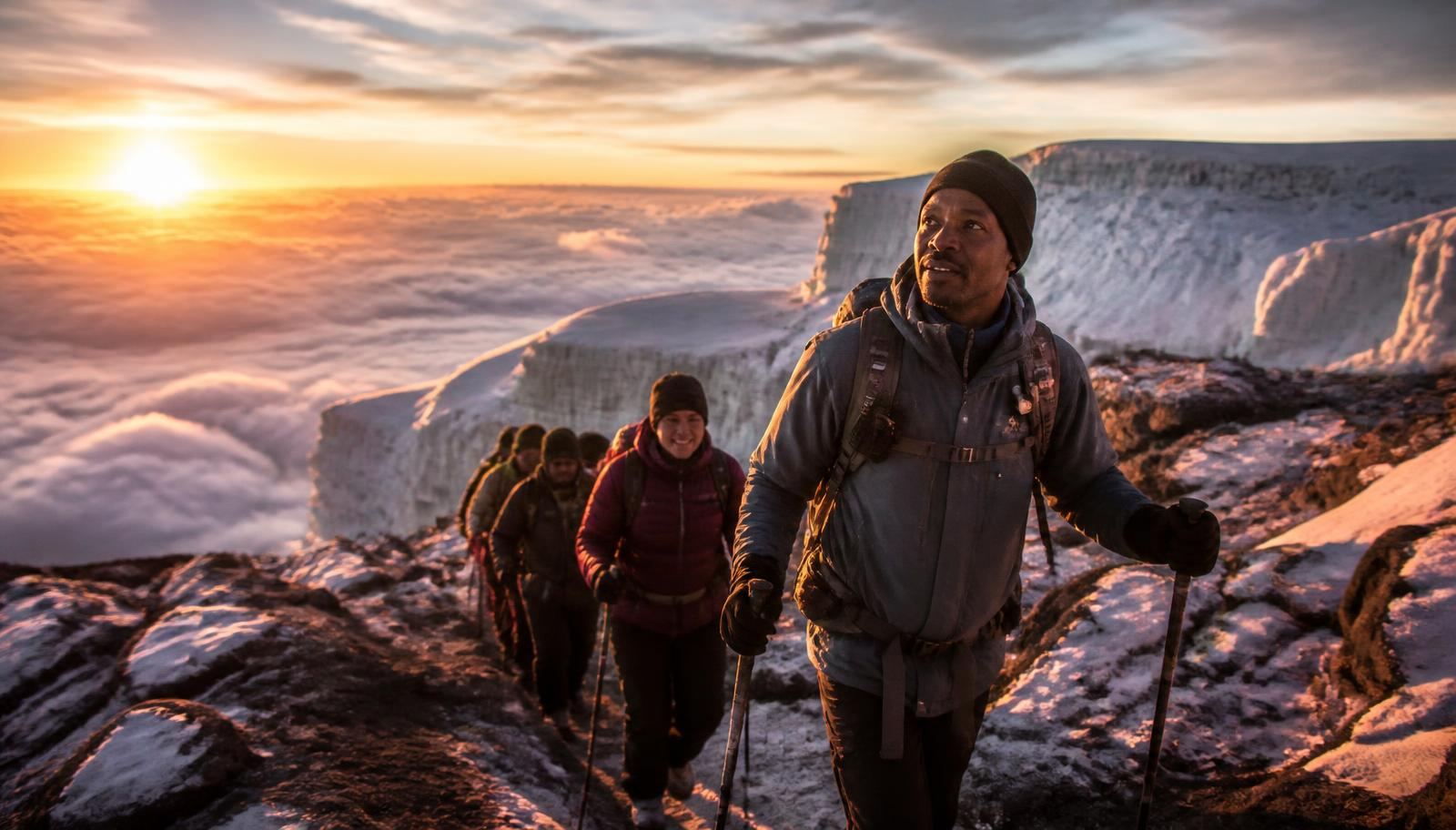
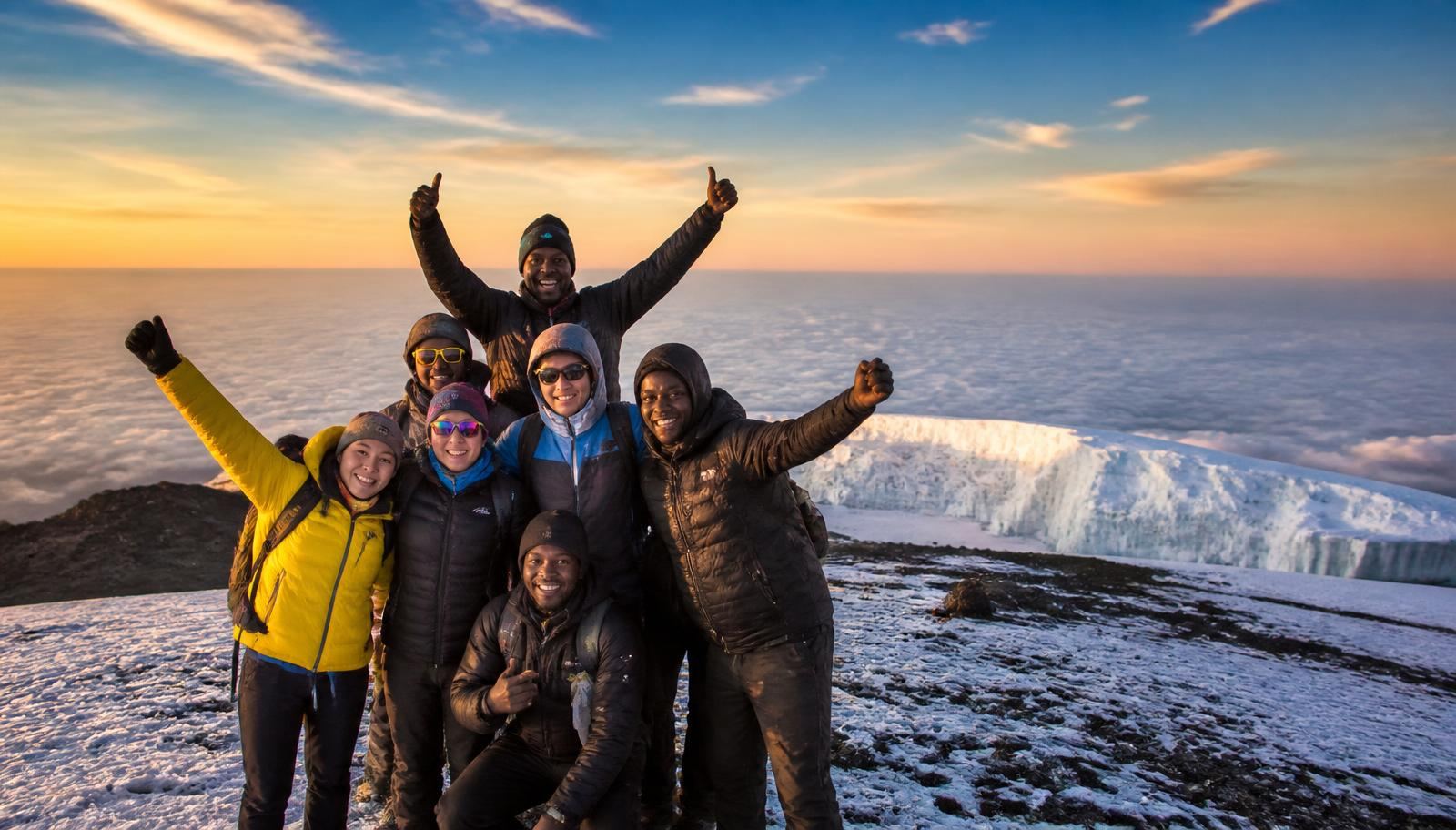
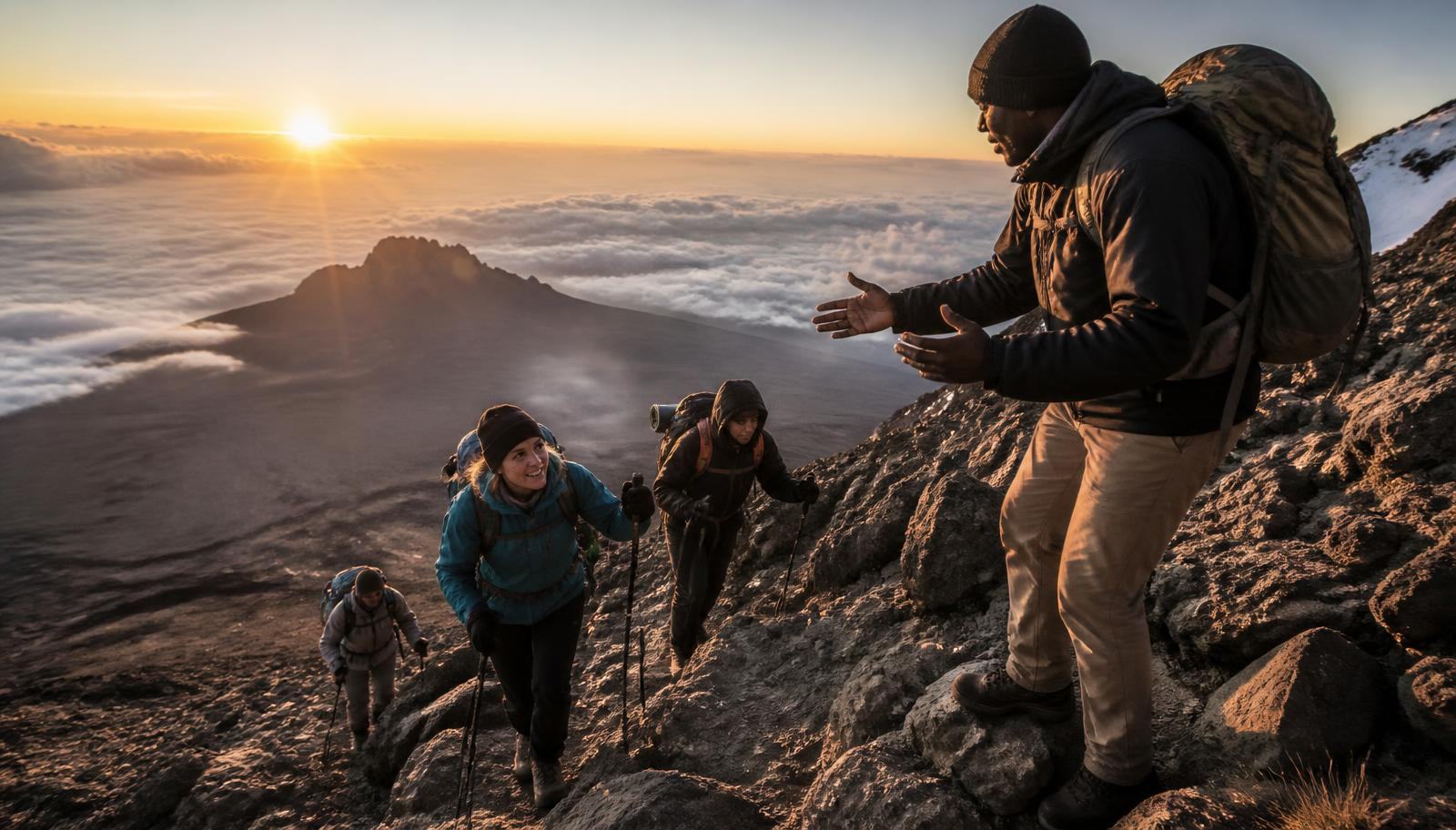
And there's the part nobody puts in the brochure. Around 3am on summit night, somewhere above 5,400m, you'll be moving at the pace of a slow shuffle, your world reduced to a headlamp beam and the boots in front of you, and your guide will start singing quietly in Swahili. Then the sky behind Mawenzi turns orange, and you realize you're above the clouds, above the weather, above an entire continent. Clients cry up there. Most of them didn't expect to.
Where Is Mount Kilimanjaro?
Kilimanjaro stands in northeastern Tanzania, about 340 kilometres south of the equator and roughly 50 kilometres from the Kenyan border. Despite what half the internet suggests, the mountain is entirely inside Tanzania — the famous photographs of Kilimanjaro looming over elephants are usually taken from Amboseli in Kenya, looking south across the frontier at our mountain.
The whole massif sits inside Kilimanjaro National Park, a UNESCO World Heritage Site covering about 1,688 square kilometres. Two towns serve it. Moshi is the closer of the two, a relaxed coffee town about an hour from most trailheads and the traditional base for climbers. Arusha is around two hours away, larger, and the natural choice if you're combining your climb with a safari — which most of our clients do, because you're already here and the Serengeti is a short flight away.
You'll fly into Kilimanjaro International Airport (JRO), which sits neatly between the two towns, about 45 minutes from Moshi and 50 from Arusha. Direct connections come through Doha, Amsterdam, Istanbul, Addis Ababa and Nairobi. Some travellers route via Dar es Salaam or Nairobi and take a short hop; that's fine, just leave buffer time — missing a climb start because of a delayed connection is a genuinely expensive mistake.
Before you book flights, check the entry requirements carefully. Tanzania's eVisa system is straightforward but has traps, particularly for US passport holders who need the multiple-entry visa. Our Tanzania visa guide walks through the whole application, fees and what immigration will ask for at JRO.
Facts About Mount Kilimanjaro
Some of these come up constantly in our office, and a few of them will genuinely change how you plan.
- It's the tallest free-standing mountain on earth. Kilimanjaro isn't part of a range. It rises roughly 4,900m straight off the surrounding plains, which is why it looks so absurdly large from Arusha.
- Uhuru means "freedom" in Swahili. The summit was renamed in 1961 to mark Tanganyika's independence.
- First recorded summit: 1889. German geographer Hans Meyer and Austrian climber Ludwig Purtscheller reached the top with Tanzanian guide Yohani Kinyala Lauwo, who was around 18 at the time and went on to climb it for decades.
- The glaciers are disappearing. Kilimanjaro has lost over 80 percent of its ice cover since 1912. Current projections suggest the remaining glaciers may be gone within a few decades. The ice you photograph at Stella Point is genuinely finite.
- Air at the summit holds about 49 percent of sea-level oxygen. That single number explains almost everything difficult about this climb.
- Records are absurd. The fastest ascent and descent stands around 6 hours 42 minutes. The oldest summiteer was 89. None of this is relevant to your climb — go slowly.
- Around 30,000 porters and guides work here. Kilimanjaro is one of the largest employers in northern Tanzania, which is precisely why the ethics of your operator matter.
Kilimanjaro Climate: Five Worlds in One Week
Because the mountain is so tall and sits on the equator, it creates its own weather. You pass through five distinct ecological zones on the way up, each roughly 1,000 metres thick, and each with a completely different climate. Understanding them is how you pack intelligently instead of hauling the wrong clothing 40 kilometres.
| Zone | Elevation | What it feels like | Notes |
|---|---|---|---|
| Cultivation & farmland | 800 – 1,800 m | Warm, humid, banana and coffee shambas | Where the gates sit; you drive through this on day one. |
| Montane rainforest | 1,800 – 2,800 m | Hot, muggy, muddy underfoot, 2,000mm of rain a year | Colobus monkeys, giant heather, the wettest day of the trek. |
| Heath & moorland | 2,800 – 4,000 m | Cool days, freezing nights, giant lobelia and senecio | Where mild altitude symptoms usually begin. |
| Alpine desert | 4,000 – 5,000 m | Brutal sun by day, -5 to -10°C at night, almost no plants | Barafu and Kibo camps. Sleep is poor. This is normal. |
| Arctic summit zone | 5,000 – 5,895 m | Glaciers, scree, -10 to -20°C, ~49% of sea-level oxygen | Stella Point, Gilman's Point and Uhuru Peak. |
Two rainy seasons shape the calendar. The long rains run from late March through May and turn the rainforest sections into ankle-deep mud while dumping snow above 4,500m. The short rains fall in November and early December, usually as afternoon showers rather than all-day downpours, which makes November perfectly climbable on the drier northern side of the mountain.
One thing that catches people out: the mountain generates cloud in the middle of the day almost year-round. Mornings are usually clear, cloud builds from late morning, and it often clears again at sunset. That's why summit attempts start at midnight — you get the clearest, calmest air of the entire 24-hour cycle.
Best Time to Climb Kilimanjaro
You can climb Kilimanjaro in any month. But conditions, crowds and prices vary enormously, and choosing well makes the difference between a hard-but-glorious week and a genuinely miserable one.
| Period | Conditions | Our verdict |
|---|---|---|
| January – mid-March | Warm, clear mornings, occasional afternoon cloud | Excellent — quieter than July, great summit views |
| Late March – May | Long rains, heavy mud in the rainforest, snow up high | Avoid unless you're experienced and want solitude |
| June – October | Dry, cold, stable, the classic trekking season | Best overall — book 6–9 months ahead |
| November – mid-December | Short rains, showers mostly in the afternoon | Workable on Rongai; good value and empty trails |
| Late December – early January | Dry and busy — holiday peak | Great conditions, highest prices, full camps |
The two prime windows
June through October is the classic season. Cold, dry, stable, with the clearest summit views and the most reliable weather on the mountain. It also coincides with the northern hemisphere summer and the Great Migration in the Serengeti, so it's busy — Machame and Marangu can feel crowded at camps, and good operators sell out six to nine months ahead.
January to mid-March is my personal favourite and the one I push clients toward when they're flexible. Warmer than the June–October window, noticeably quieter, with beautiful clear mornings and a decent chance of fresh snow on the summit cone for photographs. It pairs perfectly with the calving season in Ndutu if you're adding a safari.
Kilimanjaro Routes Overview
Seven official routes lead up Kilimanjaro; six are used regularly. They differ in length, scenery, sleeping arrangements, difficulty and — most importantly — success rate. Here's the honest comparison first, then the detail on each.
| Route | Days | Success rate | Scenery & traffic | Best for |
|---|---|---|---|---|
| MachameThe Whiskey Route | 6 – 7 days | 85 – 90% (7 days) | Excellent — five ecological zones, Barranco Wall, Lava TowerBusiest route (~35% of all climbers) · Sleep: Tents | Fit first-timers who want the classic Kilimanjaro experience |
| MaranguThe Coca-Cola Route | 5 – 6 days | 45 – 65% | Good but repetitive — same trail up and downHigh, especially in peak season · Sleep: Permanent huts with bunks | Climbers who need a bed, a roof and a shorter budget trip |
| LemoshoThe Scenic Route | 7 – 8 days | 90 – 95% (8 days) | The best on the mountain — remote western approachModerate; quiet for the first two days · Sleep: Tents | Anyone who wants the highest realistic chance of summiting |
| RongaiThe Northern Route | 6 – 7 days | 80 – 85% | Drier, wilder, views into Kenya; best wildlife oddsLow — the quietest of the popular routes · Sleep: Tents | Rainy-season climbs and hikers who dislike steep scrambling |
| Northern CircuitThe Grand Traverse | 9 days | 95%+ | Full 360° circuit of the mountain, huge and emptyVery low · Sleep: Tents | Older climbers, poor altitude history, one-shot bucket-list trips |
| UmbweThe Whiskey-and-Ice Route | 6 days | 60 – 70% | Dramatic ridge walking, steep and forestedVery low — the least used route · Sleep: Tents | Experienced, altitude-tested trekkers only |
Machame Route — "The Whiskey Route"
Machame is the most popular route on the mountain and, for a fit first-timer taking seven days, a genuinely excellent choice. It approaches from the south, climbs through thick rainforest on day one, then opens onto the Shira Plateau with the summit cone filling the sky ahead of you.
Its great strength is the acclimatization profile. On day three you climb to Lava Tower at 4,630m and then descend to sleep at Barranco at 3,960m — textbook "climb high, sleep low." Day four takes you up the Barranco Wall, a 257m scramble that looks terrifying from camp and turns out to be the most fun hour of the trek. It got the nickname "Whiskey Route" because it's tougher than Marangu, the "Coca-Cola Route" — nothing to do with what's in your flask.
The downsides are traffic and steepness. Roughly a third of all Kilimanjaro climbers use Machame, so camps are busy in July and August, and the daily gradients are noticeably steeper than Rongai or Lemosho. Six-day Machame exists and we'll run it, but the seventh day is worth every dollar.
Marangu Route — "The Coca-Cola Route"
Marangu is the oldest route and the only one with permanent huts: dormitory-style A-frame buildings with bunks, mattresses, and a shared dining hall. For travellers who genuinely can't face six nights in a tent, or who are climbing in the shoulder season and want a roof, that's a real advantage.
I have to be straight about the rest. Marangu is almost always sold as a five-day climb because it's the cheapest package on the mountain, and five days is not enough acclimatization for most people. It also ascends and descends by the same trail, so there's no climb-high-sleep-low benefit and you see the same scenery twice. Park-wide data and our own records both put five-day Marangu well under 50 percent summit success.
If you want Marangu, take it over six days with the extra acclimatization day at Horombo — that single change lifts your odds dramatically.
Lemosho Route — "The Scenic Route"
If a client asks me to pick one route for them and cost isn't the deciding factor, it's eight-day Lemosho. It starts on the remote western side, and for the first two days you often see nobody at all — just montane forest with genuine wildlife (buffalo, elephant tracks, occasionally colobus) before crossing the vast Shira Plateau.
Lemosho joins the Machame trail around Lava Tower, so you get the Barranco Wall and the same summit approach via Barafu, but with two extra days of altitude exposure banked beforehand. Eight-day Lemosho consistently returns 90–95 percent summit rates for us. It costs more, and it's worth it.
Rongai Route — "The Northern Route"
Rongai is the only route that approaches from the north, near the Kenyan border, and it's the quiet one. The northern slopes sit in the mountain's rain shadow, which makes Rongai the best choice during the shoulder and rainy months when the southern routes turn to mud.
The gradient is gentle and consistent — no Barranco Wall, no long scrambles — which suits hikers who are worried about exposure or steep ground. It's also the best route for wildlife; we regularly see colobus, blue monkeys and elephant sign in the lower forest. The trade-off is that the scenery is drier and less varied than Lemosho, and the acclimatization profile is slightly weaker, so take it over seven days rather than six.
Northern Circuit — "The Grand Traverse"
Nine days, the longest route on the mountain, and the one with the highest success rate of all — comfortably above 95 percent. It starts like Lemosho, then instead of turning south it swings all the way around the northern slopes, circling the peak before approaching the summit from the east.
You get almost a full week above 3,500m before summit night, which is as close to guaranteed acclimatization as this mountain allows. You also get the emptiest trails on Kilimanjaro and a genuine 360-degree circuit of the massif. I recommend it to climbers over 55, anyone who's had altitude problems before, and anyone treating this as a once-in-a-lifetime trip they cannot afford to fail.
Umbwe Route — "The Steep One"
Umbwe is the shortest, steepest and least-used route on Kilimanjaro. It climbs a narrow forested ridge with real exposure in places, gains altitude alarmingly fast, and joins the southern circuit at Barranco. The ridge walking is spectacular and you'll have it almost entirely to yourself.
I don't recommend it to first-timers, and I say so plainly when people ask. The rapid ascent profile gives your body almost no time to adapt, which is why success rates sit around 60–70 percent even among strong hikers. Take Umbwe only if you've been above 4,500m before, know how you respond to altitude, and want a physical challenge more than a summit certificate.
Which Kilimanjaro Route Is Best?
There's no universal answer, but there is a decision tree, and it's shorter than people expect.
- Highest chance of summiting: Northern Circuit (9 days), then Lemosho (8 days).
- Best balance of cost, scenery and success: Machame (7 days). This is what most of our clients book.
- Rainy season or you dislike scrambling: Rongai (7 days).
- You need a bed and a roof: Marangu — but take 6 days, not 5.
- You want solitude and you're altitude-tested: Umbwe (6 days).
- Tight budget: 7-day Machame, not 5-day Marangu. Same money in the wrong place buys a much worse trip.
And here's the underlying rule that outranks all of the above: the number of days matters more than which route you pick. Seven-day Machame beats six-day Lemosho. Eight-day Lemosho beats seven-day anything. If you're deciding between a fancier route and an extra day, buy the day.
How Difficult Is Kilimanjaro, Really?
Kilimanjaro is a non-technical trek that is genuinely hard for reasons that have nothing to do with climbing skill. Let me break the difficulty into its actual parts.
The walking itself is moderate. Days one through five are typically four to seven hours of hiking on well-defined trails, with gradients most regular hikers handle comfortably. If you can do a six-hour hill walk with a small pack and feel fine the next morning, you can do the trail sections.
The cumulative fatigue is significant. It's not one hard day; it's five or six in a row, with broken sleep, thin air, cold nights and no shower. Day four is where most people hit a wall mentally — the novelty has worn off, the summit still feels abstract, and everything is slightly damp.
Summit night is a different category. You wake around 11pm, eat something you don't want, and start walking at midnight in -10°C to -20°C. Six to eight hours of steep, frozen scree brings you to Stella Point (5,756m) around sunrise, and another 45 minutes along the crater rim to Uhuru. Then you descend nearly 2,000 metres to camp, and often another 1,000 after lunch. It is a 16-to-18-hour day at the highest altitude of your life. Nobody finds it easy. Everybody who makes it says it was worth it.
The Barranco Wall deserves its own paragraph because it worries people more than anything else. It's a 257m rock face on the Machame and Lemosho routes that you scramble up using your hands for balance. There's one famous move — the "Kissing Rock" — where you hug the rock to edge around a corner. No ropes, no harness, guides positioned at every awkward step, and porters carrying full loads passing you cheerfully. It takes about 90 minutes and most clients rate it the highlight of the trek.
Altitude Sickness on Kilimanjaro
Altitude is the reason people don't summit. Not fitness, not terrain — altitude. It's worth understanding properly, because the countermeasures are simple and they work.
As you ascend, air pressure drops and each breath carries less oxygen. At Uhuru Peak you're taking in roughly half the oxygen you would at sea level. Your body compensates by breathing faster and producing more red blood cells, but that adaptation takes days — which is exactly why itinerary length dominates every other variable.
What you'll probably feel (and it's fine)
Acute mountain sickness (AMS) in its mild form affects most climbers somewhere above 3,500m: headache, poor appetite, mild nausea, breathlessness on exertion, strange dreams and broken sleep. It's uncomfortable, it's normal, and it usually settles as you acclimatize. Guides monitor it with the Lake Louise scoring system twice a day.
What is not fine
- HAPE (high altitude pulmonary edema): fluid in the lungs. Breathlessness at rest, persistent wet cough, chest tightness, gurgling breath sounds, blue lips. Immediate descent.
- HACE (high altitude cerebral edema): swelling of the brain. Confusion, loss of coordination, severe headache unresponsive to painkillers, behavioural change. Immediate descent. This is a medical emergency.
- Any symptom you're hiding. The most dangerous climber on the mountain is the one who doesn't tell the guide because they're afraid of being turned around.
How we prevent it
- Long itineraries — seven days minimum, nine if you have any doubt.
- Deliberately slow walking, enforced by the guide, from the first hour.
- Three to four litres of water daily; guides check hydration and output.
- Climb-high-sleep-low acclimatization walks built into the route.
- Twice-daily pulse oximetry and Lake Louise health checks, recorded in writing.
- Bottled supplementary oxygen and a portable altitude chamber carried on every climb.
- Eating properly even when your appetite has vanished — calories drive adaptation.
Many climbers also take acetazolamide (Diamox), typically 125mg twice daily starting a day before the climb. It genuinely helps by speeding acclimatization, with side effects including tingling fingers and increased urination. Talk to your own doctor — we can't prescribe it, and we won't pretend it substitutes for a sensible itinerary. Our Tanzania safari health guide covers vaccinations, malaria prophylaxis and altitude medication in full.
Physical Preparation: How to Train
You don't need to be an athlete. You need to be able to walk uphill for six hours, recover overnight, and do it again five days running. Start three to four months out.
The training that actually transfers
- Long hikes, weekly. The single most useful session. Build to a 6–8 hour hike with 800–1,000m of ascent, wearing your Kilimanjaro boots and carrying an 8kg daypack. Do at least six of these.
- Back-to-back weekends. Once a month, hike hard on Saturday and again on Sunday. This teaches your body — and your head — what day four feels like.
- Stairs and hill repeats. Three sessions a week, 30–45 minutes. If you live somewhere flat, a stair machine or a loaded pack on a treadmill incline is a fair substitute.
- Legs and core, twice a week. Squats, lunges, step-ups, calf raises, planks. Strong quads protect your knees on the massive descent, which injures more people than the ascent does.
- Cardio base. Running, cycling or swimming two to three times weekly to build aerobic capacity. Useful, but secondary to hiking.
What training won't do
Fitness does not prevent altitude sickness. This surprises people every single season. Elite marathon runners get AMS; sedentary retirees sometimes sail up. What fitness buys you is margin — you arrive at each camp less depleted, you sleep and eat better, and you have reserves left for summit night. But no amount of training replaces a long itinerary and a slow pace.
If you can get to altitude before the trip, do. Two or three nights above 2,500m in the weeks before you fly makes a measurable difference. If you can't, we sometimes suggest adding a Mount Meru trek (4,562m) in Arusha National Park as a three-day warm-up — it's beautiful, wildlife-rich, and an outstanding acclimatization tool.
What to Pack for Kilimanjaro
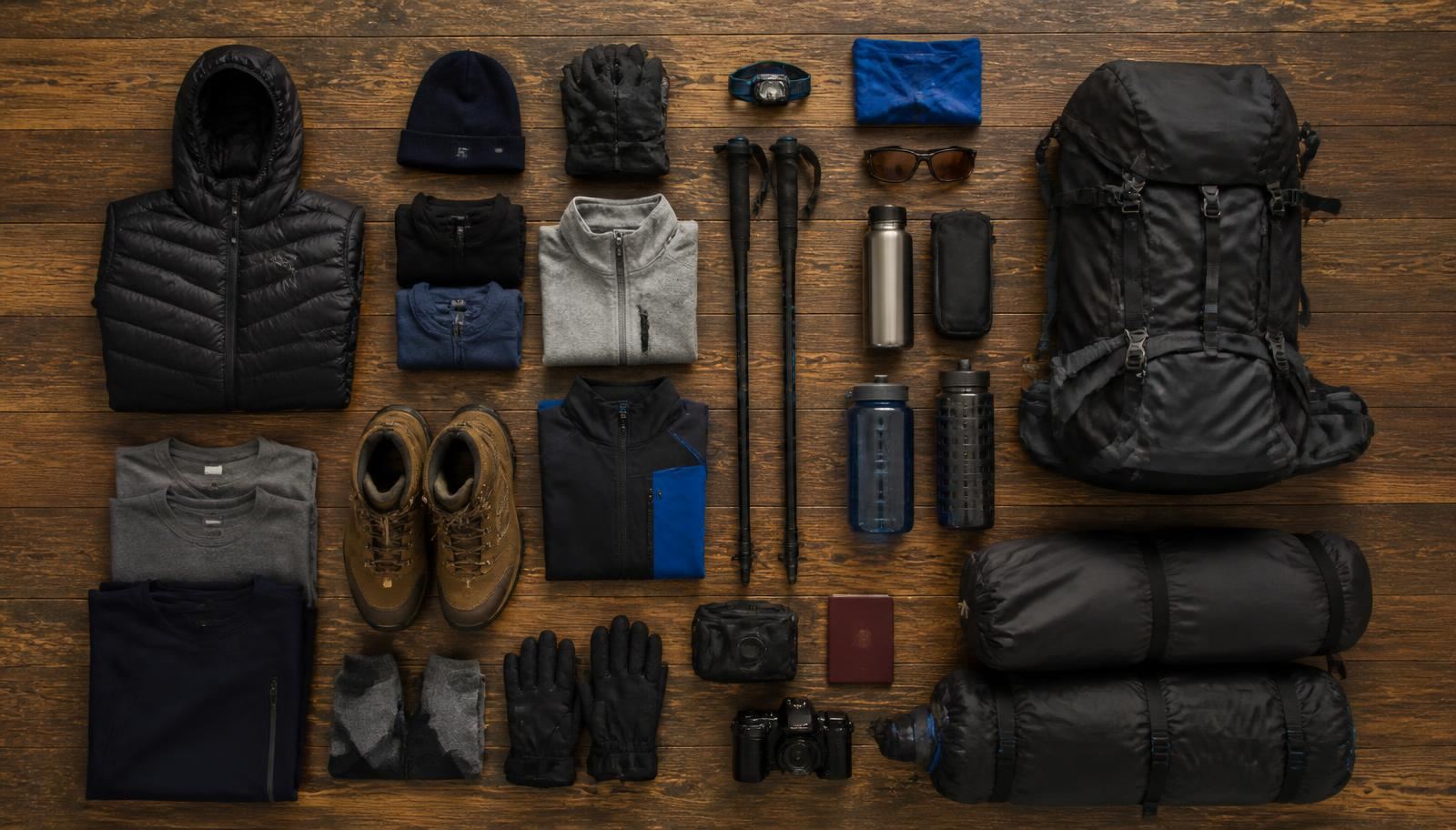
Porters carry up to 15kg of your gear in a duffel; you carry a daypack with water, layers, snacks and camera. The park enforces the weight limit at the gate, so pack deliberately. Almost everything on this list can be rented in Moshi if you'd rather not buy it — down jackets, sleeping bags and poles especially.
Base & mid layers
- 3 × moisture-wicking thermal tops (merino or synthetic — never cotton)
- 2 × thermal bottoms for camp and summit night
- 2 × fleece or lightweight insulated mid layers
- 4 – 5 × hiking t-shirts, 3 × hiking trousers (one convertible)
Outer shell & summit kit
- Expedition-weight down jacket (comfort-rated to -20°C)
- Waterproof, breathable hard-shell jacket and trousers
- Insulated summit mittens plus liner gloves
- Balaclava or buff, warm beanie, wide-brim sun hat
Footwear
- Waterproof mid- or high-cut hiking boots, broken in over 50+ miles
- Camp shoes or trail runners for the evenings
- 4 – 5 pairs wool hiking socks plus 2 thick summit-night pairs
- Gaiters for scree and mud
Sleep & carry
- Sleeping bag rated -10°C or colder (rentable in Moshi)
- Inflatable sleeping mat if you want more than the standard foam
- 30 – 35L daypack with rain cover and hip belt
- 90L soft duffel for the porters — 15kg park limit, strictly enforced
Health & hydration
- 3L hydration bladder plus 1L wide-mouth bottle (bladders freeze on summit night)
- Personal first aid: blister plasters, ibuprofen, rehydration salts, anti-diarrhoeal
- Prescription medication, plus Diamox if your doctor advises it
- SPF 50 sunscreen, SPF lip balm, category 4 sunglasses
Electronics & extras
- Headlamp with fresh batteries plus a full spare set
- 20,000mAh power bank (no mains power above the gate)
- Trekking poles — they save your knees on the 2,000m descent
- Wet wipes, quick-dry towel, hand sanitizer, snacks you actually like
If you're combining the climb with a safari, you'll need a second, much lighter kit for the game-drive days. Our Tanzania safari packing list covers that side of the trip, and we're happy to store your mountain duffel at our office while you're in the parks.
Accommodation During the Climb
With one exception, Kilimanjaro is a camping trek. Here's what that actually looks like on a well-run climb, because the gap between operators is enormous.
Sleeping tents are four-season mountain tents, pitched by the porters who run ahead of you and have camp standing by the time you arrive. Standard is two climbers per three-person tent; single supplements for a private tent are inexpensive and, honestly, worth it if you sleep badly. You get a foam mattress; bring or rent an inflatable mat if you want real comfort.
The mess tent is where the trip's social life happens — a standing-height tent with a table, chairs and a tablecloth, where hot meals are served and the guide runs the evening briefing and health checks. On cheap climbs there's no mess tent and you eat in your sleeping tent in the cold. That's a red flag.
Toilets. Public long-drop toilets exist at every camp and are exactly as grim as you're imagining. A private portable toilet tent costs roughly $150–$200 for the trek, split across your group, and is the single best-value upgrade on this mountain. Nearly every client who books it tells us so.
Marangu huts are the exception: A-frame dormitory buildings with bunk beds, mattresses, solar lighting and a communal dining hall. Warmer and drier than tents, but you're sharing with strangers and there's no privacy.
Camps have no showers and no electricity. You get a bowl of warm washing water morning and evening, which is more civilized than it sounds. Bring wet wipes and a power bank. Before and after the climb you'll stay in a comfortable hotel in Moshi or Arusha — included in every itinerary we run — where the first hot shower after summit day ranks among life's genuinely great experiences.
Food on the Mountain
Mountain cooks are the unsung heroes of Kilimanjaro. Working on a paraffin stove at 4,000 metres, ours produce three hot meals and two tea services a day for the entire week.
- Breakfast: porridge, eggs, toast, sausage or bacon, fresh fruit, tea and Tanzanian coffee.
- Lunch: either a hot lunch at camp — soup, pasta, rice, vegetables, chicken or fish — or a packed box on long trekking days.
- Afternoon tea: hot drinks with popcorn, peanuts and biscuits when you reach camp. Small ritual, enormous morale value.
- Dinner: three courses — soup first (always; it's the easiest way to get fluid and salt into people), then a main of stewed meat, rice, ugali, pasta or vegetables, then fruit.
Vegetarian, vegan, gluten-free, halal and allergy requirements are handled routinely if you tell us at booking. Drinking water is collected from mountain streams and either boiled or filtered and treated, with about four litres a day supplied per climber.
The real challenge is appetite. Above 4,000m most people simply stop wanting food, and at Barafu the night before the summit you may feel actively repelled by dinner. Eat it anyway. Bring snacks from home that you genuinely enjoy — chocolate, energy bars, nuts, dried mango, salty crisps — because those are what you'll manage when nothing else appeals.
Safety on Kilimanjaro
Kilimanjaro is safe when it's run properly and dangerous when it isn't. That's not a cliché — the difference between a good operator and a cheap one is measured in oxygen cylinders, guide-to-client ratios and evacuation planning.
Here's what should be non-negotiable on any climb you book:
- Twice-daily health checks using a pulse oximeter and the Lake Louise AMS score, recorded on a written form you can see.
- Bottled supplementary oxygen carried on every climb — for emergency descent, not to help you summit.
- A portable hyperbaric chamber (Gamow bag) on the mountain with your group.
- A comprehensive first aid kit and guides with current wilderness first aid certification.
- A guide-to-client ratio of at least 1:2–1:3, so a sick climber can descend with a qualified guide while the group continues.
- A written evacuation plan covering stretcher descent, park rescue vehicles and helicopter evacuation to Kilimanjaro Christian Medical Centre in Moshi, which has an excellent altitude-medicine record.
You also need insurance that specifically covers trekking to 6,000 metres and helicopter evacuation. Standard travel policies exclude high-altitude trekking, and people discover this at the worst possible moment. We explain exactly what to look for in our Tanzania safari travel insurance guide, and we ask every Kilimanjaro client to send us their policy number before departure.
For general safety in Tanzania — cities, transport, money, scams — our honest assessment is in is Tanzania safe for tourists.
Guides and Porters: The People Who Get You Up
You cannot climb Kilimanjaro independently. Tanzanian law requires every climber to be accompanied by a licensed guide, and that's a good rule — it keeps people alive and it keeps money in the local economy.
A typical two-person climb employs around eight to eleven crew: a lead guide, an assistant guide, a cook, and five to seven porters carrying tents, food, water, cooking equipment and your duffels. That ratio startles first-timers. It's what makes a week-long trek at altitude feel manageable.
Your lead guide is licensed by Kilimanjaro National Park, certified in wilderness first aid, and will typically have summited somewhere between 100 and 400 times. Ours are all from communities around the mountain — several are Chagga men who grew up on its lower slopes. They set the pace, run health checks, make the call on summit night, and are the reason most of our clients cry at the airport when they say goodbye.
Porters carry up to 20kg total (15kg of your gear plus their own kit) and are limited by park regulation and KPAP guidelines. They leave camp after you, pass you on the trail carrying three times your load, and have your tent standing and tea brewing when you arrive.
Tipping — plan for it properly
Tipping is customary and forms a meaningful part of crew income. Budget roughly $250–$350 per climber for a seven-day trek, pooled across the group and distributed at a tipping ceremony on the last morning. As a rough guide per group per day: $20–$25 for the lead guide, $15–$20 for the assistant guide, $12–$15 for the cook, and $8–$10 per porter. Bring clean, undamaged US dollars in small denominations, or Tanzanian shillings — there are no ATMs on the mountain.
Responsible Tourism on Kilimanjaro
This section matters to me more than any other, so I'll be direct. Kilimanjaro has a porter welfare problem, and the reason is price competition. When a company sells a climb at $1,300, the savings don't come from the park fees — those are fixed, around $1,000 per climber for a seven-day trek. They come from wages, food, and gear for the crew.
The Kilimanjaro Porters Assistance Project (KPAP) exists to fix this, and its standards are the clearest benchmark travellers can use:
- Fair, transparent wages paid on time and in full — no deductions.
- Load limits of 20kg total, weighed at the gate and enforced.
- Three proper meals a day for porters, not leftovers.
- Adequate sleeping tents, sleeping bags, boots and waterproof jackets.
- Proper treatment and evacuation for sick or injured crew.
Ask any operator you're considering whether they're a KPAP partner, what they pay porters per day, and how many crew they'll assign. A good company answers instantly with numbers. An evasive answer tells you everything.
Environmental responsibility matters too. Kilimanjaro National Park operates strict carry-in, carry-out rules: everything that goes up comes down, including waste. Bring a reusable bottle rather than single-use plastic — plastic bags are banned in Tanzania outright. Stay on marked trails; the moorland vegetation takes decades to recover from trampling. And leave the rocks and plants where they are.
Finally, the money. Choosing a locally owned Tanzanian operator keeps far more of your payment in the region — in guide and porter households, in Moshi and Arusha businesses, in local supply chains — than booking through an overseas reseller who subcontracts the work anyway.
What Does It Cost to Climb Kilimanjaro?
Park fees alone — conservation, camping, rescue and crew fees, plus VAT — come to roughly $1,000–$1,200 per climber for a seven-day route. That's before a single wage, meal, tent or transfer. It's the number that makes budget quotes suspicious.
- Under $1,700: something is being cut — usually porter wages, food quality, guide ratios or safety equipment. Avoid.
- $2,000 – $2,600: the realistic range for a reputable, well-equipped seven-day climb with a licensed local operator.
- $2,800 – $4,500+: premium operators, longer routes, private climbs, better tents, private toilets, higher guide ratios and supplementary comforts.
A fair all-inclusive price should cover park fees, all camping equipment, all meals on the mountain, drinking water, guides and porters, airport transfers, two hotel nights in Moshi or Arusha, and emergency oxygen. It normally excludes flights, visa, insurance, personal gear, tips and any hotel extras. If you want the full mechanics of deposits, payment schedules and what to confirm in writing, read how to book a Tanzania safari — the process is identical for a climb.
Adding a Safari or Zanzibar After the Climb
Roughly three-quarters of our Kilimanjaro clients add something afterwards, and I'd encourage it. You've already made the long flight, you're already in northern Tanzania, and the contrast is spectacular: from glacier ice to the Serengeti plains in a single day's travel.
The practical advice is to schedule at least one full rest day after descent before a safari begins. Summit day empties you completely, and a 6am game drive the next morning is not the celebration you're imagining. Three to four safari nights in Tarangire, Ngorongoro and the Serengeti is the classic add-on; five to seven nights on Zanzibar's east coast is the other, and after six days of freeze-dried cold, the Indian Ocean feels medicinal.
Common Questions
Frequently Asked Questions
Kilimanjaro is a hard, long, high-altitude hike rather than a technical climb. There is no rope work, no ice axe, no crampons and no rock climbing on any of the normal routes — if you can walk uphill on a rough path for six to eight hours a day, you have the movement skills you need. The difficulty comes from three other places. First, altitude: Uhuru Peak sits at 5,895m, where each breath carries roughly half the oxygen it does at sea level. Second, duration: five to nine consecutive days of walking, sleeping poorly, eating at altitude and not showering. Third, summit night, which starts around midnight, lasts six to eight hours to the crater rim in temperatures between -10°C and -25°C, and then asks you to descend 2,000m the same day. Most reasonably fit adults who choose a long route and walk slowly succeed. Most people who fail did so because they chose a five-day itinerary, rushed the acclimatization, or hiked too fast in the first three days.
Between five and nine days on the mountain, plus a night before and after in Moshi or Arusha. Five-day Marangu is the shortest legal option and has the worst success rate — well under 50 percent on our own historical data and consistent with park-wide figures. Six days is a workable minimum on Machame or Rongai. Seven days is what we recommend to almost everyone and it is what most of our clients book: it adds an acclimatization day exactly where the body needs it and typically pushes summit success above 90 percent. Eight-day Lemosho and nine-day Northern Circuit are the strongest choices for older climbers, anyone with a poor altitude history, and travellers who only get one attempt at this. The rule is very simple and it has no exceptions: extra days buy summits.
Marangu is the easiest underfoot. It follows a broad, steady path with no scrambling, and it is the only route with permanent sleeping huts, dormitory bunks, mattresses and a dining hall, so you never sleep in a tent. That comfort is exactly why it is misleading. Marangu is usually sold as five days, ascends and descends by the same trail so you get no 'climb high, sleep low' benefit, and consequently has the lowest summit rate on the mountain. If you want easy walking with real acclimatization, take Marangu over six days, or better, take Rongai — the gradient is gentle, the route approaches from the quiet northern side, and it is genuinely kind to first-time high-altitude hikers.
The Northern Circuit, at roughly 95 percent or above on nine-day itineraries, followed closely by eight-day Lemosho at around 90 to 95 percent and seven-day Machame at around 85 to 90 percent. The reason is time rather than terrain. The Northern Circuit is the longest route on the mountain, loops around the quiet northern slopes and gives your body the better part of a week above 3,500m before summit night, which is precisely what acclimatization requires. Route choice matters far less than itinerary length: seven-day Machame beats six-day Lemosho, and both crush any five-day option. If summiting matters more than saving three hundred dollars, buy the extra days.
No. Kilimanjaro is a walking mountain and the standard routes require zero mountaineering experience, no technical gear and no prior high-altitude record. What genuinely helps is hiking experience — specifically multi-day hiking with consecutive long days, because knowing how your feet, knees and mood behave on day four is worth more than raw fitness. The one section that gives people pause is the Barranco Wall on the Machame and Lemosho routes, a 257m rock face that looks intimidating from camp. It is a scramble using your hands for balance, not a climb, and porters carrying 15kg loads go up it every morning. Guides position themselves at each awkward step. If you have real concerns about exposure, take Rongai or Marangu and avoid the wall entirely.
Yes, and beginners do it every week. We have taken 12-year-olds (the park minimum with special permission is 10), climbers in their seventies, complete first-time hikers and people who had never slept in a tent before to Uhuru Peak. What separates the beginners who summit from the ones who turn back is preparation rather than talent: three to four months of consistent hill walking with a loaded daypack, a seven-day or longer itinerary, properly broken-in boots, an honest conversation with a doctor if you have any heart, lung or blood pressure history, and the discipline to walk slower than feels natural. Beginners actually have one advantage over athletic clients — they take the pace advice seriously. Fit young men are, statistically, among the likeliest to be evacuated, because they charge the first three days and pay for it at 4,600m.
At the trailhead in the rainforest it is warm and humid, often 25 to 30°C during the day. Camps between 3,000m and 4,000m run roughly 5 to 15°C by day and drop to around freezing overnight. At Barafu or Kibo camp, around 4,600m to 4,700m, nights are typically -5 to -10°C. Summit night is the cold you need to plan for: between midnight and sunrise, temperatures on the upper cone sit between -10°C and -20°C, and with wind chill on an exposed section can feel like -25°C or colder. That is why we insist on a proper down jacket, insulated gloves plus liner gloves, a -10°C-rated sleeping bag or warmer, thermal base layers and a balaclava. It is also why summit night starts at midnight — the scree is frozen solid and easier to walk on, and you reach Uhuru for sunrise before the wind builds.
Mild acute mountain sickness is very common — headache, poor sleep, mild nausea and breathlessness affect most climbers at some point above 3,500m, and by itself it is manageable and expected. Serious altitude illness is rare but real. HAPE and HACE, the two dangerous forms, occur in a small percentage of climbers and are the reason our guides carry pulse oximeters and run twice-daily health checks with the Lake Louise scoring system, carry supplementary oxygen on every trip, and have the authority to turn any climber around regardless of what they have paid. The prevention is straightforward and it works: long itineraries, deliberate slow walking, three to four litres of water a day, eating properly, sleeping lower than your day's high point where the route allows, and reporting symptoms honestly instead of hiding them. Many clients also take acetazolamide (Diamox) starting a day before the climb — discuss it with your doctor, and see our Tanzania safari health guide for the full picture.
Conclusion
Kilimanjaro is one of the very few genuinely great mountains that an ordinary, determined person can climb. It doesn't ask for technical skill or a mountaineering résumé. It asks for time, humility about pace, honest self-assessment at altitude, and a crew who know what they're doing and are treated properly for doing it.
Get the itinerary length right, walk far slower than feels natural, drink more water than you want, tell your guide the truth about how you feel, and choose an operator on standards rather than price. Do those five things and your odds of watching the sun rise over Mawenzi from 5,895 metres are very good indeed.
Kilimanjaro rewards patience far more than strength. Choose a long route, walk slower than your ego wants, hydrate relentlessly, hire a company that pays its crew properly, and the mountain gives most people the sunrise they came for.
Plan Your Kilimanjaro Climb With Us
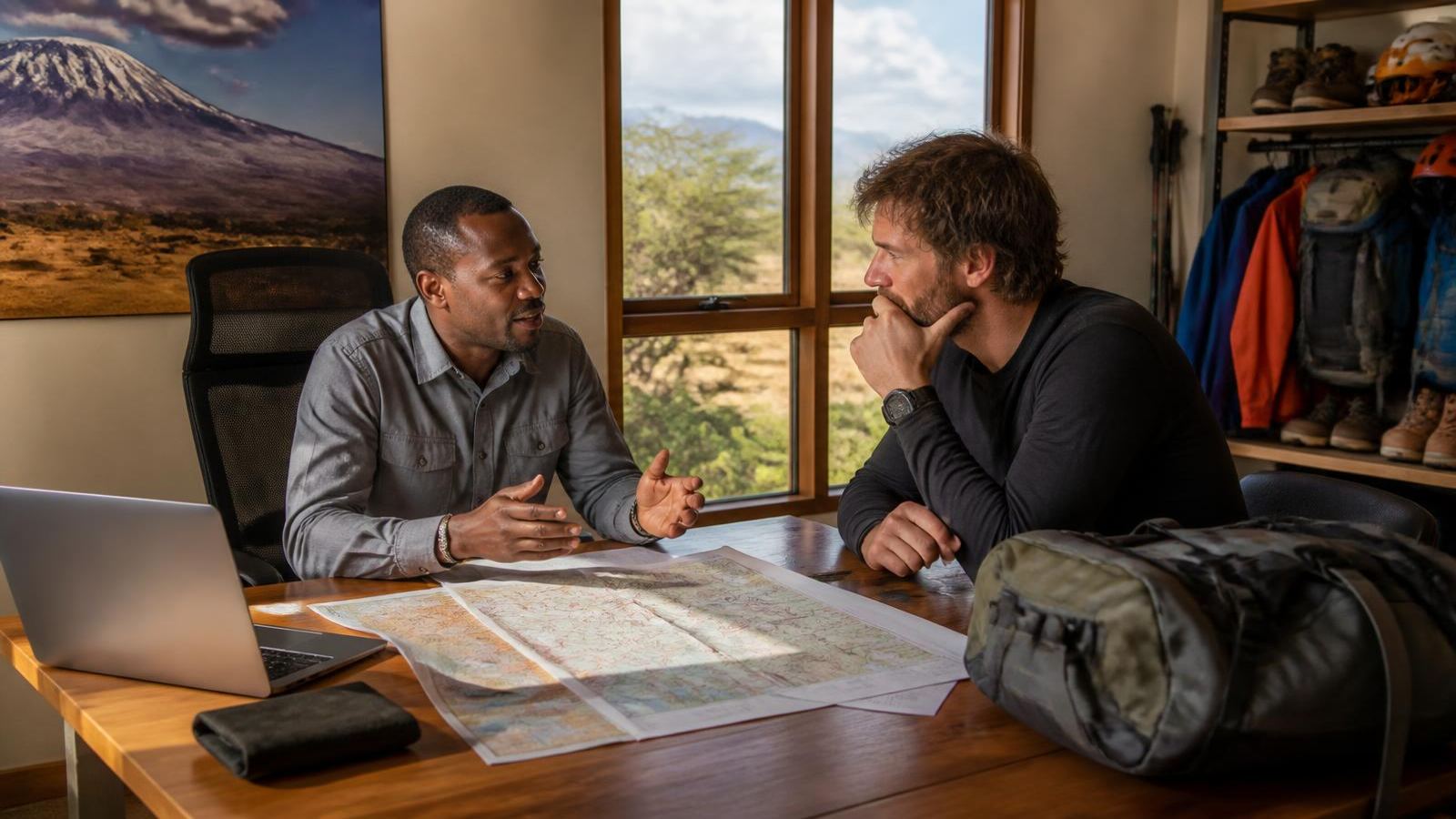
We're based in Arusha, two hours from the gate. Tell us your dates, your hiking background, your budget and any altitude history, and we'll come back with a route recommendation and a day-by-day itinerary built around your actual chance of summiting — not around what's easiest for us to sell.
Start with a free Kilimanjaro consultation, or browse our climbing and safari packages to see how a climb combines with the Serengeti or Zanzibar. There's no cost, no obligation, and you'll be talking to someone who's stood on that summit.
Plan Your Journey
Your route, your pace, your summit.
Arusha-based, licensed, KPAP-standard crew and a 90%+ summit rate on our seven-day-plus itineraries. Send us your dates and we'll build the climb around you.
- TALA Licensed Operator
- 4.9 ★ Guest Rating
- No Booking Fees
Keep Reading
More Kilimanjaro Guides
Kilimanjaro
Kilimanjaro Success Rate by Route: Choosing the Route That Maximizes Your Chances
Kilimanjaro
How Difficult Is Mount Kilimanjaro? A Realistic Guide for First-Time Climbers
Kilimanjaro