
Travel Tips
Tanzania Safari Health Guide: Everything You Need Before You Travel
Vaccinations, malaria prevention, food and water safety, sun, altitude and medical facilities — the honest health briefing we give our own clients before they fly to Arusha.

Introduction
The health question comes up in almost every first phone call I have with a new client, and it usually arrives in the same slightly embarrassed tone: "So — is there anything we need to worry about?" Behind it sits an hour of late-night reading that has produced a mixture of solid CDC guidance, a travel forum thread from 2011, and a cousin's story about someone who got sick in Africa once.
Here is the version I give over the phone. A Tanzania safari is one of the lower-risk adventure holidays you can take. You will spend most of your days in a vehicle, most of your nights in a lodge or a well-run tented camp, and most of your meals will be cooked by kitchens that feed international guests every single week of the year. The genuine risks are few, well understood, and almost entirely preventable with preparation you can complete in two appointments and one shopping trip.
This Tanzania Safari Health Guide covers what that preparation actually looks like in 2026: which vaccinations to discuss with your doctor, how malaria risk really varies across the country, how to eat and drink without spending a day in your tent, what the equatorial sun and 5,895 metres of mountain do to a body from a temperate climate, where the hospitals are, what belongs in your medical kit, and how emergency evacuation works when you are four hours from a paved road. I have written it the way I brief my own guides, because those are the details that matter when you are standing in the Serengeti rather than reading about it.
Is Tanzania Safe From a Health Perspective?
Broadly, yes — with the important caveat that "safe" here means "predictable and preventable" rather than "risk-free." Tanzania is a tropical country with a disease profile different from North America or Europe, and pretending otherwise helps no one. But the illnesses that actually affect visiting travelers are a short list, and nearly all of them respond to preparation.
In our own records, the overwhelming majority of health incidents on safari fall into three categories: mild traveler's diarrhea, sunburn and dehydration, and minor musculoskeletal complaints from rough roads and getting in and out of a Land Cruiser twenty times a day. Malaria cases among our clients are rare and, in every instance I can recall, involved someone who either skipped prophylaxis or stopped taking it early. Serious trauma is rarer still — the roads inside the parks are slow by necessity, and the animals are watched from a vehicle.
What genuinely changes the risk calculus in Tanzania is not the pathogens. It is distance. A stomach bug in Rome is an inconvenience; the same bug in the northern Serengeti means the nearest pharmacy is a four-hour drive and the nearest hospital is a flight. That asymmetry is why we push preparation so hard: it is far easier to carry a rehydration sachet from home than to source one at Kogatende airstrip. For a broader look at non-medical safety, our guide on whether Tanzania is safe for tourists covers crime, road safety and wildlife protocols in detail.
Recommended Vaccinations for Tanzania
Let me be precise about the language here, because it trips people up. There is a difference between required and recommended. Tanzania legally requires exactly one vaccination, and only conditionally: yellow fever, for travelers arriving from or transiting a yellow fever risk country. Everything else on the list below is recommended by health authorities such as the US CDC, the UK NHS and the WHO, and the right combination for you depends on your history, your itinerary and how long you are staying.
Routine vaccinations
Before anything exotic, travel clinics check that your standard immunizations are current. That typically means measles-mumps-rubella, diphtheria-tetanus-pertussis, polio, varicella and your seasonal influenza shot, plus COVID-19 boosters per your national schedule. Measles in particular is worth flagging: outbreaks occur in many parts of the world and adults born after the mid-1950s who received only one dose may need a second. Tetanus matters more than people assume on safari, where scratches from thorn scrub are routine — if your last booster was more than ten years ago, update it.
Hepatitis A
This is the one nearly every travel clinic will recommend, and I would take it without hesitation. Hepatitis A is transmitted through contaminated food and water, which makes it the most plausible vaccine-preventable infection for a traveler eating outside their own kitchen for two weeks. The vaccine is a single dose that gives good protection within a couple of weeks, with a booster at six to twelve months extending protection for decades. It is inexpensive, well tolerated, and one of the highest value items on the list.
Typhoid
Also food- and water-borne, also widely recommended for Tanzania. Typhoid vaccination comes as either an injection or an oral course of capsules, and neither offers total protection — efficacy sits somewhere in the 50–80% range depending on the product. That is not a reason to skip it; it is a reason to keep practicing good food and water hygiene even after you have had it. Clinics generally recommend it more strongly for travelers spending time outside major hotels, visiting smaller towns, or staying longer than a couple of weeks.
Hepatitis B
Hepatitis B is transmitted through blood and body fluids rather than food, so the relevance depends on your circumstances. Clinics typically recommend it for travelers who might receive medical or dental treatment abroad, anyone with a longer stay, those who may get a tattoo or piercing, and — a point rarely made but worth making — anyone undertaking a physically demanding trip where an accident requiring treatment is more plausible. Many travelers from countries with universal childhood immunization are already covered and simply need to check. The course runs over several weeks, which is another argument for booking your clinic appointment early.
Rabies — for specific travelers
Rabies exists in Tanzania, primarily in domestic dogs rather than wildlife, and it is effectively always fatal once symptoms appear. Pre-exposure vaccination is not needed by the average lodge-based safari guest, but it is genuinely worth discussing if you fall into one of these groups: travelers going to remote areas far from medical care, anyone spending extended time in rural communities, cyclists and runners, children — who are more likely to approach animals and less likely to report a lick or scratch — and volunteers working with animals.
Here is the part people misunderstand. Pre-exposure vaccination does not make you immune. What it does is remove the need for rabies immunoglobulin after an exposure — a product that can be difficult to obtain quickly in East Africa — and reduce post-exposure treatment to two additional doses. On a chimpanzee trekking itinerary in Mahale or Gombe, where you are days from a major hospital, that difference is meaningful. Any animal bite, scratch or lick on broken skin should be washed with soap and running water for a full fifteen minutes and reported immediately — to your guide and to a doctor, in that order.
Yellow fever — when proof is required
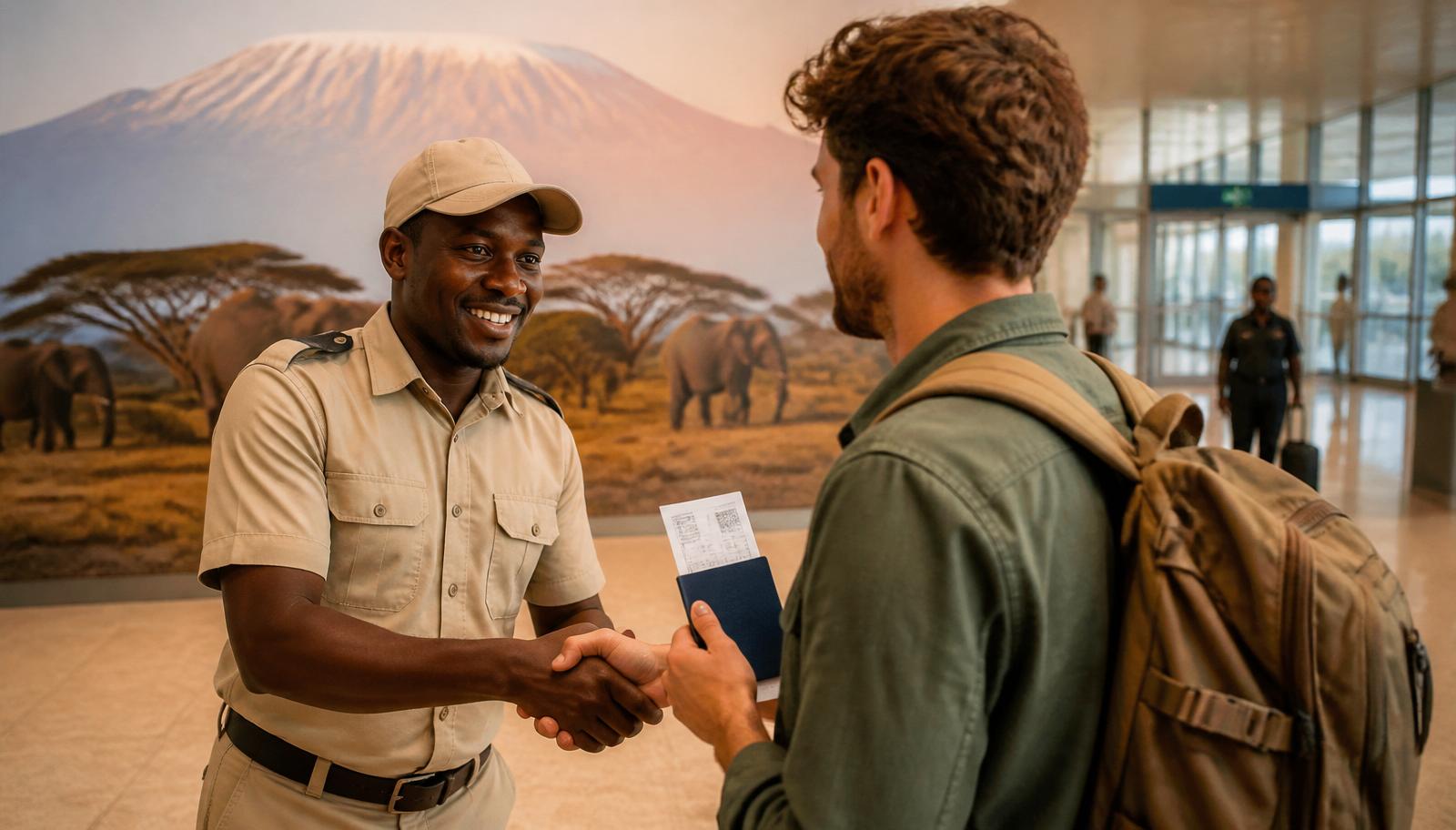
Tanzania is not a yellow fever endemic country. You do not need the vaccine to enter if you are flying directly from the United States, Canada, the UK, Europe, Australia, or most of Asia. Proof of vaccination — the yellow International Certificate of Vaccination or Prophylaxis, valid for life and effective ten days after administration — is required if you are arriving from a country with risk of yellow fever transmission, or if you spent more than 12 hours in transit at an airport in such a country.
That catches more people than you would think. Kenya, Uganda, Rwanda, Ethiopia, Angola, Nigeria, Ghana, the DRC, Brazil, Peru and Colombia are all on the risk list, and East African multi-country itineraries are common. A long layover in Addis Ababa or Nairobi can trigger the requirement. Immigration officers at Kilimanjaro International, Julius Nyerere in Dar es Salaam and Abeid Amani Karume in Zanzibar do check, and travelers without the certificate have been vaccinated at the airport at their own expense or, occasionally, denied entry. If your routing touches a risk country, sort this out at home.
Vaccination summary table
| Vaccine | Status for Tanzania | Who it's typically for | Timing before travel |
|---|---|---|---|
| Routine (MMR, DTP, polio, flu, COVID-19) | Recommended up to date | All travelers | Any time; check tetanus is within 10 years |
| Hepatitis A | Commonly recommended | Almost all travelers | At least 2 weeks before departure |
| Typhoid | Commonly recommended | Most travelers, especially longer stays | 2 weeks (injection) / 1 week after oral course |
| Hepatitis B | Recommended for some | Longer stays, possible medical care, adventure trips | Course over 3–8 weeks; accelerated schedules exist |
| Rabies (pre-exposure) | Recommended for some | Remote itineraries, children, long stays, animal contact | 3–4 weeks for the full pre-exposure course |
| Yellow fever | Required conditionally | Arrivals from / 12h+ transit via a risk country | At least 10 days before arrival |
| Cholera | Rarely advised | Aid workers, outbreak areas, high-risk conditions | Oral course completed 1 week before travel |
| Meningococcal | Situational | Long stays, dry-season travel in some regions | 2 weeks before departure |
This table is a conversation starter for your travel clinic, not a prescription. Only a healthcare professional who knows your medical history can tell you which of these you personally need.
Understanding Malaria in Tanzania
Malaria is the health topic that generates the most anxiety and, in my experience, the most bad information. So let us be clear about the shape of it. Malaria is a parasitic infection transmitted by the bite of an infected female Anopheles mosquito, which feeds between dusk and dawn. In Tanzania the dominant species is Plasmodium falciparum, the form that can become severe quickly. It is also entirely preventable in practice, and when treated promptly it is curable.
Where the risk actually is
Risk varies dramatically by altitude, season and region. A blanket statement about "malaria in Tanzania" is close to useless for planning.
| Area | Approx. altitude | Transmission risk |
|---|---|---|
| Arusha & Moshi towns | 1,400–900 m | Low to moderate; higher in Moshi and the lowlands |
| Ngorongoro Crater rim | ~2,300 m | Very low |
| Kilimanjaro above 1,800 m | 1,800–5,895 m | Negligible on the mountain itself |
| Serengeti & Ndutu | 1,400–1,800 m | Moderate; higher in and after the rains |
| Tarangire & Lake Manyara | 1,000–1,200 m | Moderate to high, especially near water |
| Ruaha, Nyerere, Katavi, Mahale | 200–1,100 m | High, particularly in the wet season |
| Zanzibar & the coast | Sea level | Present year-round; Zanzibar has reduced but not eliminated it |
Season matters too. Transmission peaks during and immediately after the long rains of March to May and again after the short rains of November and December, when standing water gives mosquitoes places to breed. The classic dry-season safari window of June to October is also the lower-risk window — one of several reasons it is the most popular. Our guide to the best time to visit Tanzania breaks the seasons down month by month.
Mosquito bite protection — the part you control
No tablet is 100% effective, which makes bite prevention the foundation rather than the fallback. Anopheles feed from dusk to dawn, so your discipline only needs to be excellent for about twelve hours a day.
- Repellent that works. Use 20–50% DEET, or 20% picaridin if you dislike DEET. Apply to all exposed skin from late afternoon and reapply per the label. Sunscreen goes on first, repellent second.
- Cover up at sundowners. Long sleeves, long trousers, socks and closed shoes from about 5:30pm. Ankles are the single most bitten part of a safari guest's body, because that is what is exposed under a dinner table.
- Use the net. Every reputable camp and lodge in a malaria area provides a treated mosquito net. Tuck it under the mattress before dinner, not at bedtime in the dark, and check for gaps.
- Treat your clothing. Permethrin-treated shirts, trousers and socks add a meaningful layer, especially for the southern and western parks. Treat at home a few days before you fly.
- Keep the tent closed. Zip your tent fully whenever you leave it, and do not leave lights on inside with the flap open at dusk. Camp staff will do a spray of the room during turndown in higher-risk areas.
- Skip the gadgets. Ultrasonic repellers, vitamin B and wristbands have no good evidence behind them. Do not substitute them for repellent.
Antimalarial medication
Prophylaxis is a prescription decision made by your doctor, and the right choice depends on your health, your other medications, your itinerary length and cost. The three commonly prescribed for East Africa are summarized here so you can have an informed conversation, not so you can self-select.
| Medication | Typical schedule | Often suits | Common considerations |
|---|---|---|---|
| Atovaquone-proguanil (Malarone and generics) | 1–2 days before, daily during, 7 days after | Short safaris; travelers wanting fewest side effects | Most expensive; take with food; daily dosing discipline |
| Doxycycline | 1–2 days before, daily during, 28 days after | Longer trips; budget-conscious travelers | Photosensitivity, stomach upset; take upright with water |
| Mefloquine (Lariam) | Weekly, starting 2–3 weeks before, 4 weeks after | Travelers who prefer weekly dosing | Not suitable with some psychiatric or seizure histories |
Two practical notes from the field. First, the post-trip doses are not optional padding — they cover the parasite's incubation in the liver, and stopping early is the most common reason prophylaxis fails. Second, doxycycline's photosensitivity is not theoretical at this latitude; if you take it, your sun protection needs to be genuinely rigorous.
When to consult a travel clinic
Six to eight weeks before departure is the sweet spot: early enough for multi-dose courses, late enough that boosters remain current. Take your full itinerary with you — altitude, region and season all change the advice — along with a list of your current medications and any conditions. If you are pregnant, immunocompromised, traveling with young children, or managing a chronic condition, go earlier and expect a longer conversation. Pregnancy in particular changes both the malaria advice and the vaccine options substantially.
Food Safety on Safari
This is where I get to reassure people. Safari food in Tanzania is safer than most travelers assume, because the economics work in your favor: a lodge that gives its guests food poisoning does not survive on TripAdvisor. Camp and lodge kitchens generally use filtered water, cook to order, and are inspected. In fifteen years the cases of serious food-borne illness among our clients have overwhelmingly come from meals eaten outside the itinerary — a roadside stop, a market snack, a beach shack chosen on a whim.
Some habits that have served us well:
- Hot food, freshly cooked. Anything served steaming from a kitchen is low risk. Buffet items that have sat lukewarm are the exception worth avoiding — at a busy lodge with fast turnover this is rarely an issue.
- Fruit you peel yourself. Bananas, oranges, mangoes and avocados are excellent and effectively self-packaged. Pre-cut fruit platters at reputable lodges are fine; the same platter at a roadside café is a gamble.
- Salads: know the kitchen. Quality lodges wash salad in treated water and it is perfectly safe. Below that tier, skip raw leaves.
- Be careful with dairy and seafood outside the lodges. Unpasteurized milk products and street-side seafood are the two categories where an upset stomach becomes likely rather than possible.
- Wash or sanitize your hands. Before every meal, without exception. On a picnic lunch in the bush there is no sink — carry a small alcohol gel in your daypack. This does more for your gut than any dietary rule.
- Ease into the local street food. Tanzanian street food is genuinely good and I would not tell you to avoid it forever. But eat it in Arusha or Stone Town on day one, where you have easy access to a pharmacy — not on the night before a bush flight to Katavi.
If you do get an upset stomach, most cases resolve in 24 to 48 hours with fluids and rest. Oral rehydration salts are the single most useful thing in your kit. Use loperamide sparingly and mostly for travel days when you cannot reach a bathroom. See a doctor promptly if you have a fever above 38.5°C, blood in the stool, or symptoms lasting more than three days — and remember that in a malaria area, any fever needs testing rather than assumption.
Drinking Water Guidelines
The rule is simple and absolute: do not drink the tap water anywhere in Tanzania, including in good hotels in Arusha and Dar es Salaam. This is not a comment on the country so much as on your microbiome, which has no established tolerance for the local bacterial mix.
- Sealed bottled water is available everywhere and every safari vehicle we run carries a cooler of it, included in your trip. Check the seal is intact.
- Lodge filtration stations are now standard at quality camps, letting you refill a reusable bottle from a purification system. Bring a 1-litre insulated bottle; it cuts plastic dramatically and keeps water cool through a long game drive.
- Boiled water — the tea and coffee served at camp, and water boiled for a full minute — is safe.
- Brush your teeth with treated water. It feels excessive on night one and it is exactly the kind of small slip that ruins day three.
- Skip ice you cannot vouch for. Lodges make ice from filtered water and it is fine. A roadside bar's ice is not.
- A backup filter is worth carrying on remote fly-camping or trekking itineraries. A LifeStraw-type bottle or a SteriPEN weighs nothing and removes any doubt.
Sun Protection at the Equator
This is the risk most consistently underestimated by visitors, and the one we treat most often. Tanzania sits within three degrees of the equator, most of the northern circuit is between 1,400 and 2,300 metres above sea level, and the safari day is spent in an open-roof vehicle with reflective light coming off pale grass in every direction. The UV index routinely reaches 11 or higher. A cloudy, pleasantly cool day on the Ngorongoro rim will burn you thoroughly if you let it.
- Broad-spectrum SPF 50 applied twenty minutes before you leave and reapplied every two hours, more often if you are sweating.
- A wide-brimmed hat, not a baseball cap. Ears and the back of the neck are the two most common burn sites on safari.
- Proper UV-blocking sunglasses. Dust and glare together cause a lot of eye irritation, and a spare pair costs almost nothing.
- Lip balm with SPF. Cracked lips at altitude are miserable and entirely avoidable.
- Long, light, loose sleeves beat sunscreen for all-day cover. Our Tanzania safari packing list covers exactly which fabrics and colors work in the field.
- Remember that the roof hatch is open above you. The classic safari burn is a perfectly symmetrical stripe across the shoulders from standing to photograph a leopard.
Preventing Dehydration
Dehydration is the quiet cause of a surprising share of the "I feel awful today" conversations on safari. It presents as headache, fatigue, irritability and poor concentration — symptoms travelers routinely blame on jet lag, the early starts, or the road. In dry air at 1,500 metres with a breeze through the vehicle, you lose fluid steadily without ever feeling sweaty.
- Drink to a schedule, not to thirst. Half a litre before you leave camp, then a bottle before and after each game drive.
- Carry oral rehydration salts. One sachet in your bottle at the end of a hot day does more than another litre of plain water, especially after any stomach upset.
- Go easy on the sundowner G&T and the third coffee. Both are diuretics, and after a 5:30am start the combination catches up quickly.
- Watch children and older travelers closely — both dehydrate faster and report it later. Guides are trained to check, but a parent's eye is better.
- Urine color is the simplest field test there is. Pale straw is the target; anything darker means drink more.
Altitude Considerations for Kilimanjaro Climbers
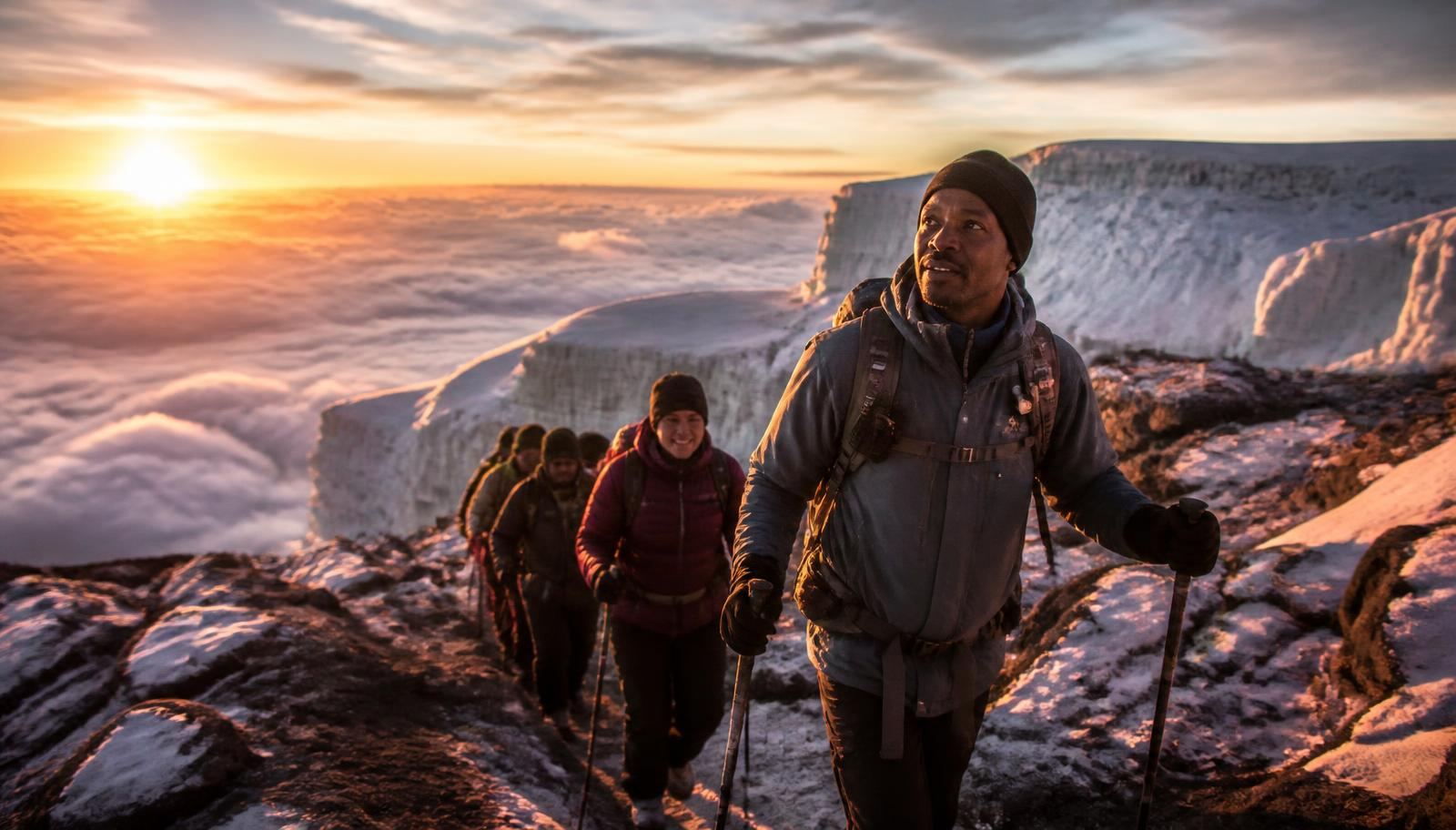
If your trip includes Kilimanjaro, altitude becomes the dominant health consideration and everything else on this page moves down the list. Uhuru Peak sits at 5,895 metres, where the air holds roughly half the oxygen available at sea level. Altitude illness is not a question of fitness or willpower; marathon runners fail on this mountain and sedentary sixty-year-olds summit comfortably. It is a question of ascent rate and individual physiology.
What to watch for
Acute mountain sickness (AMS) is common above 3,000 metres and presents as headache plus some combination of nausea, fatigue, dizziness and poor sleep. Mild AMS is manageable: stop ascending, hydrate, rest, and it usually settles. The two dangerous progressions are high altitude pulmonary edema (HAPE) — breathlessness at rest, a wet cough, blue lips — and high altitude cerebral edema (HACE) — confusion, loss of coordination, an inability to walk a straight line. Both are medical emergencies and both have exactly one reliable treatment: immediate descent.
How we manage it
- Choose the longer route. Success and safety both improve dramatically on seven- and eight-day itineraries versus five- or six-day ones. On Machame or Lemosho the extra acclimatization day is the best money on the invoice.
- Pole pole. "Slowly, slowly" is not a slogan, it is the medical protocol. If you can hold a conversation while walking, the pace is right.
- Climb high, sleep low where the route allows. Our guides build the afternoon acclimatization walks in deliberately.
- Daily health checks. Our mountain crews take pulse oximetry and Lake Louise scores twice a day and log them, so a trend is visible before it becomes a crisis.
- Emergency oxygen and a stretcher on every climb. Non-negotiable. Ask any operator you are considering whether they carry both, and how many people are trained to use them.
- Acetazolamide, if your doctor agrees. Commonly prescribed to assist acclimatization. Discuss dosing, sulfa allergy and side effects — tingling fingers and increased urination are typical — before you leave home.
- Be willing to turn around. The summit will be there next year. Every experienced guide on that mountain respects the climber who descends.
One insurance note that matters enormously here: standard travel policies typically cap trekking cover at 3,000 to 4,500 metres, which leaves the entire summit push uninsured. You need a policy explicitly rated to 6,000 metres with helicopter evacuation. Our Tanzania safari travel insurance guide spells out exactly what to look for.
Medical Facilities in Tanzania
Understanding the medical geography of a safari changes how seriously people take preparation, so here it is plainly. Tanzania's healthcare system runs from well-equipped private hospitals in the main cities down to rural dispensaries with a nurse and a limited drug cabinet. Where you are on that spectrum depends entirely on where you are on the map.
| Location | What's available | Realistic response |
|---|---|---|
| Arusha | Several private hospitals and clinics used by travelers; pharmacies; dentists | Same-day care for most non-critical issues |
| Moshi (KCMC) | Major referral hospital serving Kilimanjaro region | Trauma and specialist care; primary destination for mountain cases |
| Karatu (Ngorongoro gateway) | Well-regarded mission hospital | 1–1.5 hours from most crater-area lodges |
| Serengeti / Ndutu | Ranger posts and small dispensaries; camp first-aid kits | Basic stabilization then air evacuation from the nearest airstrip |
| Ruaha / Nyerere / Katavi / Mahale | Very limited; camp medical kits and radio | Air evacuation to Dar es Salaam or Arusha |
| Zanzibar | Private clinics in Stone Town and the north-east; decompression chamber | Good for routine care; serious cases fly to Dar or Nairobi |
| Dar es Salaam | The country's best private hospitals, including Aga Khan | Full-service, internationally comparable care |
Two practical realities. First, private hospitals here generally require payment or a written guarantee from an insurer before major treatment escalates, which is why your policy number is the most important number you carry. Second, pharmacies in Arusha, Moshi, Stone Town and Dar are surprisingly well stocked and staffed by competent pharmacists — but the specific brand of your regular medication may not be available, so bring your own supply rather than planning to buy it locally.
What to Pack in a Personal Medical Kit
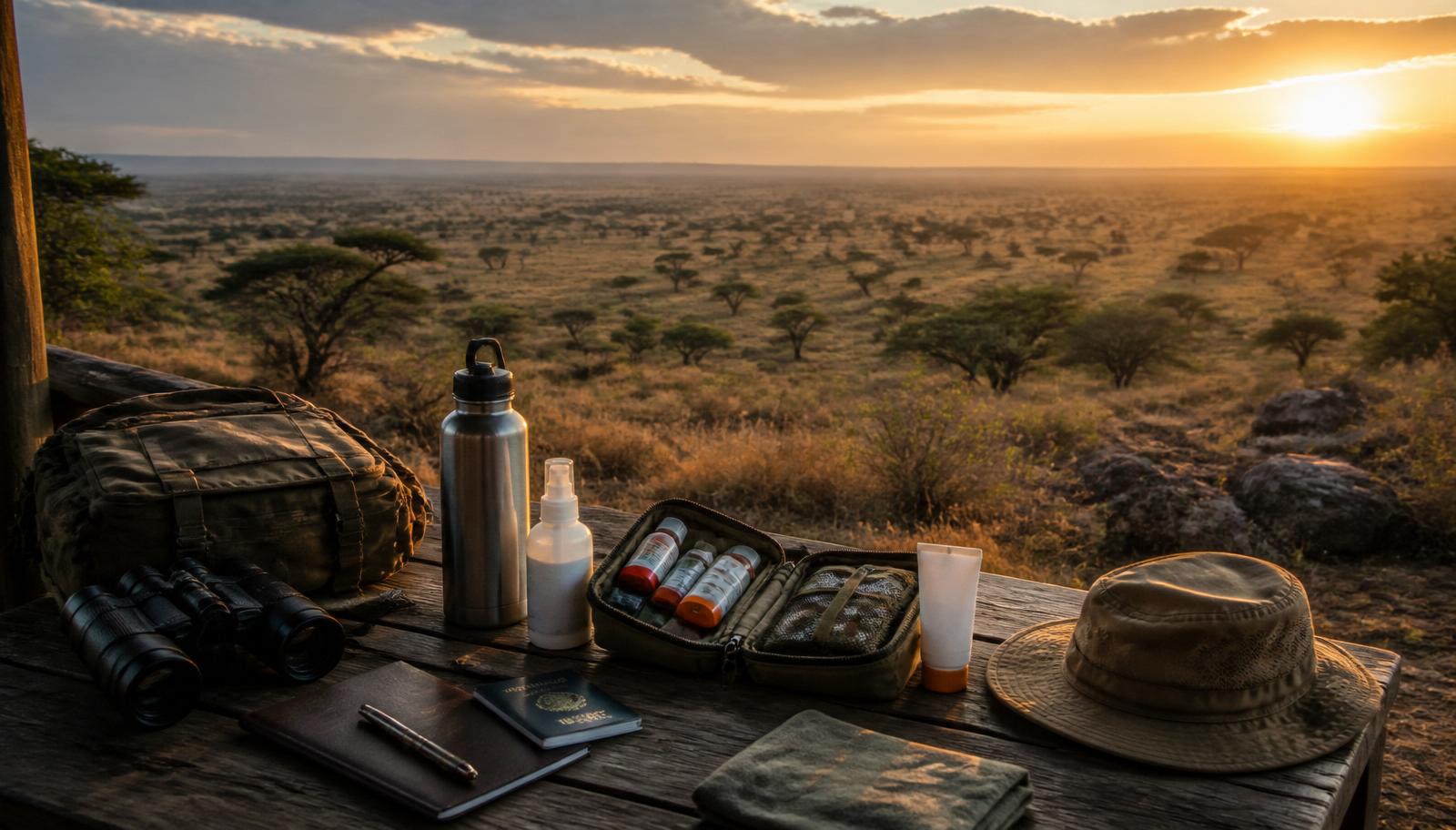
Your camp and your vehicle both carry a first aid kit, and our guides are trained in wilderness first aid. What we cannot carry for you is anything personal or prescription. This is the kit I recommend, sized to fit a one-litre zip pouch in your daypack.
| Category | What to pack |
|---|---|
| Prescriptions | Antimalarial; all regular medications with a week's surplus; standby antibiotic if advised; acetazolamide for Kilimanjaro if prescribed |
| Stomach | Oral rehydration salts (4–6 sachets), loperamide, antacid, a probiotic if you use one |
| Pain & fever | Paracetamol/acetaminophen and ibuprofen; a digital thermometer |
| Bites & skin | Antihistamine tablets, hydrocortisone 1% cream, antiseptic wipes, antibiotic ointment |
| Wounds | Assorted plasters, blister pads, sterile gauze, micropore tape, small scissors or tweezers |
| Sun & dust | SPF 50 sunscreen, SPF lip balm, aloe gel, saline eye drops, saline nasal spray |
| Travel | Motion sickness tablets, earplugs, melatonin if you use it for jet lag |
| Prevention | DEET or picaridin repellent, hand sanitizer, a few disposable masks for dusty drives |
| Personal | Spare glasses or contacts and solution, epinephrine auto-injectors (bring two), asthma inhalers with spares, any condition-specific supplies |
| Paper | Medication list with generic names and doses, allergy list, insurance policy number, 24-hour assistance number, doctor's letter |
Traveling With Prescription Medication
Tanzania is not difficult about medication, but a little formality prevents all friction at the border and in the unlikely event you need to explain yourself.
- Keep everything in its original labeled packaging with the pharmacy label intact. Loose pills in a daily organizer look ambiguous to a customs officer; bring the organizer as well as the boxes if you use one.
- Carry a signed letter from your doctor listing each medication by its generic name, the dose, the condition it treats, and your name as it appears on your passport. Absolutely essential for controlled substances, injectables, and anything you carry with needles.
- Pack medication in your hand luggage, not the hold. Temperature swings in a cargo hold degrade some drugs, and a lost bag should never mean a missed dose.
- Bring more than you need — the trip length plus at least a week. Flights get delayed and roads flood.
- Refrigerated medication such as insulin needs planning. Most lodges have a fridge and will store it for you happily, but tell us at booking so we can confirm at each camp and arrange a cooling pouch for the drives between them.
- Check the legality of anything unusual. A small number of medications common elsewhere are controlled in Tanzania; your travel clinic or the Tanzanian embassy can confirm, and a doctor's letter resolves nearly every case.
- Tell your guide on day one what you take, where you keep it and what an emergency looks like for you. Guides are discreet and they are the person who will be with you for ten hours a day.
Emergency Medical Assistance
Here is how an emergency actually unfolds in the field, so it is not abstract. Your guide is the first responder — every guide on our team holds current wilderness first aid certification and carries a comprehensive kit and a radio or satellite phone. Camps notify our Arusha operations desk, which is staffed around the clock during client travel. If the case exceeds what can be handled locally, we contact the evacuation provider named on your insurance policy, who dispatch an air ambulance — usually AMREF Flying Doctors out of Nairobi or a Tanzanian operator — to the nearest suitable airstrip.
Daylight matters. Most bush airstrips have no lighting, so a night evacuation often means stabilizing in camp until first light, then flying. This is one more reason prevention is weighted so heavily in this guide.
- National emergency numbers: 112 and 114 reach police, fire and ambulance services. Coverage and response vary widely outside cities.
- Your insurer's 24-hour line is the number that actually mobilizes an aircraft. Save it in your phone and carry it on paper.
- AMREF Flying Doctors operate the primary air ambulance service across East Africa. Many policies use them; some travelers also buy an inexpensive standalone membership.
- Our operations desk — the office and WhatsApp numbers on your itinerary — reaches a real person in Arusha at any hour while you are in-country.
- Your embassy in Dar es Salaam can assist with documentation, repatriation coordination and family contact, though they do not pay medical bills.
Olympus Adventure Health Tips
A handful of things we have learned running these trips that you will not find on a government health page.
- Give yourself a soft first day. Most long-haul arrivals land in Kilimanjaro late at night. Booking a full rest day in Arusha before the first game drive prevents the jet-lagged, dehydrated, sun-battered start that ruins day two. Our first-time visitors guide covers pacing an itinerary properly.
- Dust is a health factor, not just a nuisance. The dry-season plains generate fine dust that irritates sinuses and eyes. A buff for open-roof drives, saline nasal spray at night and eye drops in the vehicle make a genuine difference — especially for contact lens wearers and asthmatics.
- Tell us everything at booking. Allergies, diabetes, epilepsy, heart conditions, mobility limits, recent surgery. It never changes whether we take you; it changes camp selection, vehicle seating, drive lengths, kitchen briefings and which guide we assign. Late disclosure is the only version that causes problems.
- Eat breakfast even when you do not want it. A 5:30am departure with only coffee produces a bad-tempered, headachy morning that gets blamed on the road. Take the boiled eggs.
- Sit in the middle on rough roads. Guests prone to motion sickness do far better mid-vehicle, facing forward, with the window open. Take the tablet thirty minutes before departure rather than when you already feel unwell.
- Do not tough it out. The single most useful behavior on safari is telling your guide early. A mild fever mentioned at breakfast is a manageable situation; the same fever hidden until nightfall in a remote camp is not.
- Watch for fever after you get home. Malaria can present up to a year after exposure, most commonly within the first month. Any unexplained fever means telling the doctor you were in Tanzania — it reframes the entire diagnosis.
Common Questions
Frequently Asked Questions
No vaccine is legally required to enter Tanzania unless you are arriving from, or have transited for more than 12 hours through, a country with a risk of yellow fever transmission. That said, health authorities including the CDC and the UK's NHS recommend that most travelers be up to date on routine immunizations and additionally consider hepatitis A and typhoid, with hepatitis B and rabies advised for certain travelers. In practice, nearly every client we work with travels with hepatitis A and typhoid cover in place. Your own risk profile depends on your medical history, itinerary and length of stay, so the recommendation should always come from a travel health professional rather than a blog.
Malaria is present throughout mainland Tanzania and on Zanzibar, and it is the single most important health risk on a safari. That said, risk varies enormously with altitude, season and location. Arusha town, the Ngorongoro Crater rim and the higher slopes of Kilimanjaro sit above roughly 1,800 metres, where transmission is very low. The Serengeti, Tarangire, Lake Manyara, the southern and western parks, the coast and Zanzibar carry real risk, particularly in and just after the rains. The protection that works is unglamorous and highly effective: prescription antimalarial tablets taken correctly, DEET or picaridin repellent on exposed skin at dusk and after dark, long sleeves and trousers in the evening, and sleeping under the treated net your camp provides.
Only conditionally. Tanzania does not require proof of yellow fever vaccination from travelers arriving directly from Europe, North America, the UK, Australia or most of Asia. Proof is required if you are arriving from a country with risk of yellow fever transmission — much of West and Central Africa, plus parts of South America such as Brazil, Peru and Colombia — or if you spent more than 12 hours in transit in the airport of such a country. Kenya and Uganda both count for regional itineraries. If it applies to you, you need the International Certificate of Vaccination, the yellow card, and you need it dated at least ten days before arrival. Immigration officers do check it at Kilimanjaro and Julius Nyerere airports.
No. Tap water in Tanzania is not treated to a standard safe for visitors, and even where locals drink it without trouble your gut has no established tolerance for the local microbial mix. Drink sealed bottled water, filtered water from your lodge's purification system, or water you have boiled or treated yourself. Every reputable safari vehicle carries a cooler of bottled water, and most quality camps now run filtration stations so you can refill a reusable bottle rather than burn through plastic. Use the same water for brushing your teeth, avoid ice in roadside bars, and skip fresh juices where you cannot tell what they were diluted with.
Bring a prescription antimalarial, your regular personal medications in original packaging with enough for the trip plus a week, and a compact kit containing an oral rehydration salt sachet or two, loperamide for emergencies, a doctor-prescribed standby antibiotic for traveler's diarrhea if your clinic advises one, paracetamol or ibuprofen, an antihistamine, hydrocortisone cream for bites, antiseptic wipes, plasters and blister pads, motion sickness tablets for rough park roads, and high-SPF sunscreen and lip balm. Add altitude medication if you are climbing Kilimanjaro and your doctor recommends it. Everything else — bandages, splints, oxygen on our mountain crews — we carry as an operator.
Near towns, yes. Arusha has several private facilities used by travelers, and the Kilimanjaro Christian Medical Centre in Moshi is a well-regarded referral hospital serving the northern circuit and Kilimanjaro climbers. Karatu, on the doorstep of Ngorongoro, has a good mission hospital. Inside the parks themselves the answer is different: the Serengeti, Ruaha, Katavi and Nyerere have dispensaries and ranger posts capable of basic first aid, and that is it. A serious case is stabilized locally and flown out — usually to Arusha, Dar es Salaam or Nairobi. That flight is exactly why comprehensive travel insurance with at least $500,000 in medical evacuation cover is non-negotiable on a Tanzania safari.
Yes, and we host travelers with serious allergies regularly — but tell us in writing at the booking stage, not on arrival. Camp and lodge kitchens in Tanzania are generally very accommodating when given notice; they are far less able to improvise at 7pm on the night you arrive. If you carry an epinephrine auto-injector, bring two, keep both in your daypack rather than a checked bag, and show your guide where they are and how they work on day one. Dust is the other consideration: the dry-season plains are genuinely dusty, so asthmatics should bring more inhaler capacity than they think they need and a buff or scarf for open-roof drives.
Yes — it is the single most useful hour you will spend preparing for this trip. A travel health specialist reviews your vaccination history, your medical conditions and your specific itinerary, and gives you tailored advice on immunizations, the right antimalarial for you, and anything your existing medications interact with. Book six to eight weeks out, because some vaccine courses need multiple doses and rabies pre-exposure in particular runs over three to four weeks. Take your itinerary with you; whether you are spending nights in Zanzibar or summiting Kilimanjaro genuinely changes what they recommend.
Conclusion
Almost everything on this page reduces to five habits: see a travel clinic early, take the antimalarial exactly as prescribed, protect yourself from bites and sun, drink only treated water, and travel insured well enough that an aircraft can come for you. None of it is difficult. All of it is worth doing before you leave home, because the margin for improvisation narrows considerably once you are four hours from a paved road.
What I would not want you to take from this guide is anxiety. The travelers we send into the Serengeti come home with dust in their bags and a memory card they cannot stop scrolling through, not with stories about being ill. Preparation is exactly what buys that outcome — it turns the health question into something you settled weeks ago, so you can spend the trip watching a leopard come down a sausage tree instead of wondering whether you should have had the typhoid shot.
Staying healthy in Tanzania comes down to a handful of unremarkable habits done consistently: see a travel clinic early, take your antimalarial exactly as prescribed, cover up and use repellent from dusk, drink only treated water, respect the sun, and travel with insurance that can put an aircraft on a bush airstrip. Do those things and the odds are overwhelming that the only thing you bring home is dust on your boots and a memory card you cannot stop scrolling through.
Plan a Safe, Worry-Free Safari With Us
We walk every client through this before they fly: which health considerations apply to their specific route and season, how to brief their travel clinic, what their camps can accommodate medically, and what their insurance actually needs to cover. It is part of the service and costs nothing. Send us your dates, your group and any health considerations you want factored in, and our Arusha-based specialists will come back with a personalized draft itinerary, itemized costs, and a preparation checklist built around your trip. Start with a free safari consultation, or browse our safari packages if you would rather begin with some ideas.
Plan Your Journey
Travel with people who plan for the day that never comes.
Licensed, insured and locally based in Arusha. Tell us your dates and health considerations, and we'll design a tailor-made Tanzania safari built around them.
- TALA Licensed Operator
- 4.9 ★ Guest Rating
- No Booking Fees
Keep Reading
More Tanzania Travel Tips
Travel Tips
Tanzania Safari Travel Insurance Guide: Everything You Need Before You Travel
Travel Tips
The Ultimate Tanzania Safari Packing List (2026 Expert Guide)
Safari Guides
The Ultimate Tanzania Travel Guide: Everything You Need to Know Before You Visit
Kilimanjaro