Safari Planning
How to Book a Tanzania Safari: A Complete Step-by-Step Guide
Everything an Arusha-based operator wishes every traveler knew before booking — timing, parks, budgets, vetting companies, contracts, deposits and the mistakes that quietly cost people thousands of dollars.

Introduction
I've been arranging safaris out of Arusha for more than fifteen years, and the conversations that go best almost always start the same way: someone emails us with rough dates, a rough budget and an honest sentence about what they're hoping to feel on this trip. The conversations that go badly usually start with a forwarded quote from somewhere else and the question, "Does this look right to you?" Nine times out of ten, it doesn't — not because the other company is dishonest, but because the traveler was never shown how the pieces fit together.
Booking a Tanzania safari feels intimidating from the outside. You're wiring a significant amount of money to a company on another continent, months before you travel, for a product you can't inspect. There's no Booking.com refresh button, no instant confirmation, and the quotes you collect can differ by a factor of three for trips that look identical on paper. It's completely reasonable to feel uneasy.
Here's the good news: the process is far more predictable than it looks, and it follows a logical order. Dates first. Then parks. Then budget. Then the company. Then the itinerary. Then the paperwork and the deposit. Do it in that sequence and each decision narrows the next one sensibly. Do it out of order — picking lodges before you've fixed your dates, or chasing the cheapest quote before you understand what's in it — and you end up rebuilding the trip three times.
This guide walks through all seven steps the way we actually work through them on a planning call, including the parts most companies would rather not put in writing: how deposits work, what "all-inclusive" really covers, what happens if you have to cancel, and why the cheapest quote in your inbox is usually the most expensive one in the end.
Why Booking Your Safari Correctly Matters
A safari is not a hotel reservation. When you confirm a trip with us, we immediately start spending your deposit: prepayments to camps that hold rooms on a first-paid basis, seats on small bush aircraft that sell out, park permits, and a specific guide's calendar blocked for your dates. Almost none of that is reversible. That's why safari bookings behave more like chartering something than like booking a room — and why the quality of the company you choose matters so much more than the glossy photos on their website.
I've seen what happens when it goes wrong. A couple arrives in Arusha in August and discovers their "Serengeti lodge" is actually two hours outside the park boundary, which costs them four hours of game viewing every single day. A family finds out at the Ngorongoro gate that the crater service fee wasn't in their quote and has to pay $295 in cash on the spot. A group of six is squeezed into a five-seat minivan with a driver who's never worked the Western Corridor. Every one of those situations traces back to a booking decision made months earlier, usually to save a few hundred dollars.
Getting the booking right isn't about spending more. It's about buying the right things. A well-built $6,000 safari beats a badly-built $9,000 one every time, because the money went into vehicle time, guide quality and lodge location rather than into a middleman's margin or a poorly chosen route.
Step 1: Decide Your Travel Dates
Dates come first because everything else in Tanzania flexes around them. The parks you should visit, the camps that make sense, what you'll pay, and even how far ahead you need to book are all functions of when you travel. Travelers who try to pick lodges before fixing their window nearly always end up starting over.
The two questions to answer
First, are your dates fixed or flexible? If you're tied to school holidays or a specific block of leave, we plan around the wildlife that will be there then. If you're flexible — retirees, remote workers, couples without kids — you get to choose your dates around the wildlife, which is a genuine luxury.
Second, what is the one thing you'd be disappointed to miss? Mara River crossings only happen roughly July to early October in the far north. Calving season is January to March in Ndutu. If you have a non-negotiable, it sets your month, and everything else follows.
| Season | Months | What you get | Book by |
|---|---|---|---|
| Peak dry season | July–September | River crossings, best game density, dry roads, highest prices and crowds | 9–12 months ahead |
| Festive peak | Mid-Dec to early Jan | Excellent conditions, festive supplements, camps full | 10–12 months ahead |
| Calving season | January–March | Ndutu calving, extraordinary predator action, moderate crowds | 8–10 months ahead |
| Green season | April–May | Lowest prices (30–45% off), lush landscapes, rain and some closures | 3–5 months ahead |
| Shoulder | June, October–November | Great value, strong wildlife, fewer vehicles — our team's favorite window | 5–7 months ahead |
If you want the month-by-month detail — rainfall, herd positions, bird migration, lodge pricing bands — our Best Time to Visit Tanzania guide is the companion piece to this section, and Best Time to See the Great Migration maps the herds week by week.
Step 2: Choose the Best Parks
Tanzania has sixteen national parks plus the Ngorongoro Conservation Area, and you cannot see them all. The most common planning mistake I see is trying to cram five parks into seven days. You end up spending your holiday in a vehicle on transit roads instead of watching animals.
The honest rule: fewer parks, more nights in each. Two well-chosen parks over seven days will out-perform five parks over ten, every time.
The Northern Circuit — right for about 80% of travelers
- Serengeti National Park — the heart of any Tanzania safari. Endless plains, the highest lion density in Africa, and the Great Migration. Give it a minimum of three nights; four or five is better. Our Serengeti Wildlife Guide covers what lives where.
- Ngorongoro Crater — the most reliable Big Five day on earth, and the best rhino chance in the country. One night on the rim with one full crater day is the correct dose. Details in the Ngorongoro Crater Guide.
- Tarangire National Park — baobab country and enormous elephant herds, especially June through October. One or two nights.
- Lake Manyara — a good half-day on the way in, known for tree-climbing lions and superb birdlife. Skip it if your days are tight.
Southern and Western circuits — for repeat visitors
Ruaha, Nyerere, Katavi and Mahale are wilder, emptier and require flights rather than road transfers. They're spectacular, but I rarely recommend them for a first Tanzania trip unless you have twelve days or more, or you've been on safari before and want solitude over iconic scenery.
Zanzibar and Kilimanjaro extensions
Roughly half our guests add three to five nights in Zanzibar after safari. It's the easiest, most satisfying add-on in Tanzania — a short flight from the Serengeti and a complete change of pace. Climbers add Kilimanjaro before safari, never after; you want the mountain done while you're fresh.
Step 3: Decide Your Budget
This is the step travelers most want to skip, and the one that saves the most time. Telling a good operator your real budget isn't negotiating against yourself — it lets us build the best possible version of your trip at that number instead of sending you a quote you'll never accept. Every serious operator I know works this way.
Tanzania safari pricing is quoted per person per day, all-inclusive of park fees, vehicle, guide and full-board accommodation. Here's how the tiers really break down in 2026.
Budget safaris — $250–$400 per person per day
Shared group departures, basic lodges or public campsites outside park boundaries, typically a shared vehicle with six or seven other guests. The wildlife is identical — the animals don't know what you paid. What you give up is comfort, flexibility and proximity: longer drives in and out of the parks each morning, fixed schedules, and less time at sightings because someone else in the vehicle wants to move on.
Budget safaris are a legitimate and honorable way to see Tanzania, and plenty of our own staff travel this way. Just be alert: this tier is where corner-cutting hides. Below roughly $220 per person per day, the math simply doesn't work once park fees are paid, which means something is being skipped.
Mid-range safaris — $450–$750 per person per day
This is where most of our guests land, and honestly where the best value in Tanzania sits. You get a private 4x4 Land Cruiser with a pop-up roof, a dedicated professional guide, and comfortable permanent lodges or tented camps — often inside the park boundaries. You control your own schedule: leave at 5:45 a.m. for a leopard, stay two hours at a lion kill, take breakfast in the bush.
For a couple, a seven-day mid-range safari typically lands between $4,500 and $6,500 per person, everything on the ground included.
Luxury safaris — $900–$1,800+ per person per day
Luxury in Tanzania buys three real things: location (camps inside the migration zone, which saves hours of driving daily), service ratios, and exclusivity. The tents at this level are extraordinary — proper beds, hot bucket showers under the stars, chefs who'd hold their own in a city restaurant. Above $2,000 per person per day you're into ultra-luxury with private guides, private vehicles and sometimes private conservancies.
| Tier | Per person / day | Vehicle | Accommodation | Best for |
|---|---|---|---|---|
| Budget | $250–$400 | Shared, 6–7 guests | Campsites / basic lodges outside parks | Backpackers, students, flexible travelers |
| Mid-range | $450–$750 | Private 4x4 Land Cruiser | Comfortable lodges & tented camps | Most couples, families, first-timers |
| Luxury | $900–$1,800 | Private, guide assigned to you | Premium camps inside prime zones | Honeymoons, milestone trips, photographers |
| Ultra-luxury | $2,000+ | Private, dedicated spotter | Exclusive-use camps, mobile fly camps | Privacy-first travelers, large families |
For the full arithmetic — park fee schedules, vehicle day rates, lodge bands and where each dollar actually goes — read Tanzania Safari Cost and the line-by-line Tanzania Safari Cost Breakdown.
Step 4: Choose the Right Safari Company
This is the decision that determines whether your trip is good or great. Tanzania has well over a thousand registered tour operators and a long tail of unregistered ones. The difference between them is not visible on a website — every company has photos of lions and a page about "authentic experiences." You have to look at the fundamentals.
Local operator vs international agent
An overseas travel agency doesn't run your safari. They subcontract it to a Tanzanian ground operator — often one of the same companies you could have contacted directly — and add 15–35% for their role. That role has real value for some travelers: a familiar time zone, a local consumer-protection scheme, and someone to call in your own language.
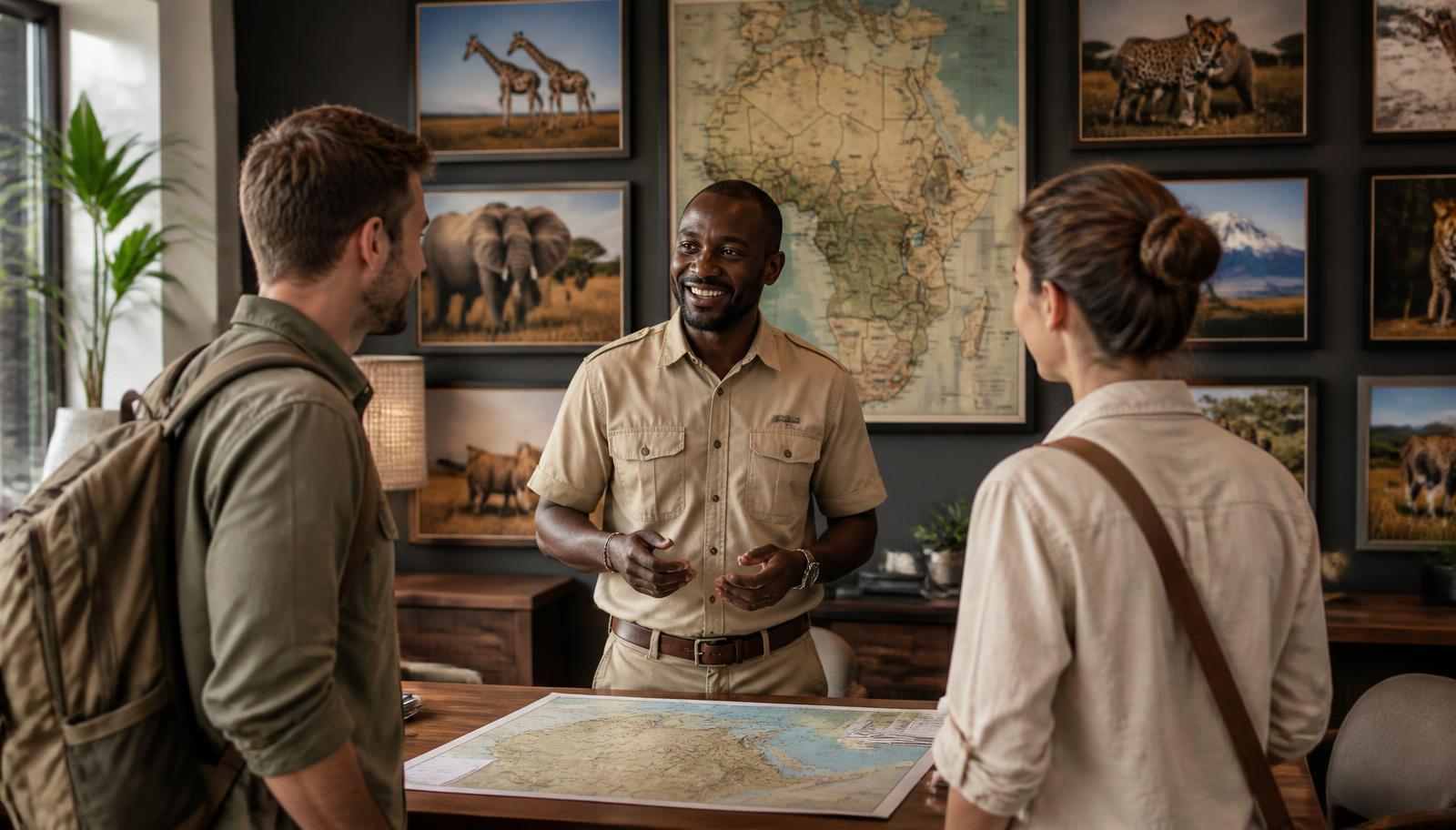
But the trade-off is information loss. When you ask "can we leave an hour earlier to catch the crossing?", the agent has to email the operator, who emails the guide. When you book direct with a licensed local company, you're talking to the people who own the vehicles, employ the guides and have relationships with the camp managers. In my experience that shortens the distance between what you want and what happens.
Licenses — the non-negotiable check
- TALA licence (Tanzania Tourist Agent Licence) issued by the Ministry of Natural Resources and Tourism. Every legal operator has one. Ask for the number and the registered company name.
- TATO membership (Tanzania Association of Tour Operators). Not legally required, but it means the company is accountable to an industry body with a complaints process.
- Business registration (BRELA) and a TIN. The company account you pay into should match this registered name exactly.
- Insurance — vehicle and passenger liability cover. Ask directly. A real operator answers in one sentence.
Reviews — read them properly
Don't count stars; read the middle. Anyone can gather five-star reviews. What tells you the truth is (1) whether reviewers name their specific guide — that means real trips with real people — (2) how the company replies to its three- and four-star reviews, and (3) whether reviews are spread over years rather than clustered in one month. TripAdvisor and SafariBookings are the two platforms Tanzanian operators actually live and die by.
Experience — ask about the guide, not the company
Your guide is your safari. Ask who they'll assign, how many years that person has worked, what languages they speak, and whether they're a certified wildlife guide or simply a driver. A great guide reads the bush: they know that vultures circling low means a fresh kill, that a cheetah on a termite mound at 7 a.m. is about to hunt, and that the quiet track nobody else takes is where the leopard sleeps.
Safety
- Vehicle age and service records — ask when the Land Cruiser was last serviced and whether it carries two spare tires.
- Radio or satellite communication in areas with no cell coverage.
- A first-aid kit in every vehicle and a guide trained in first response.
- Flying Doctors (AMREF) evacuation membership for your trip dates.
- A written emergency protocol and a 24-hour office contact while you're in the field.
Communication — the tell that predicts everything
How a company communicates before you pay is exactly how it will communicate when something goes wrong at 6 p.m. in the Serengeti. Watch for: response within 24 hours, answers to the question you actually asked, willingness to say "that won't work" instead of agreeing with everything, and a named person handling your file rather than a rotating inbox.
Step 5: Customize Your Itinerary
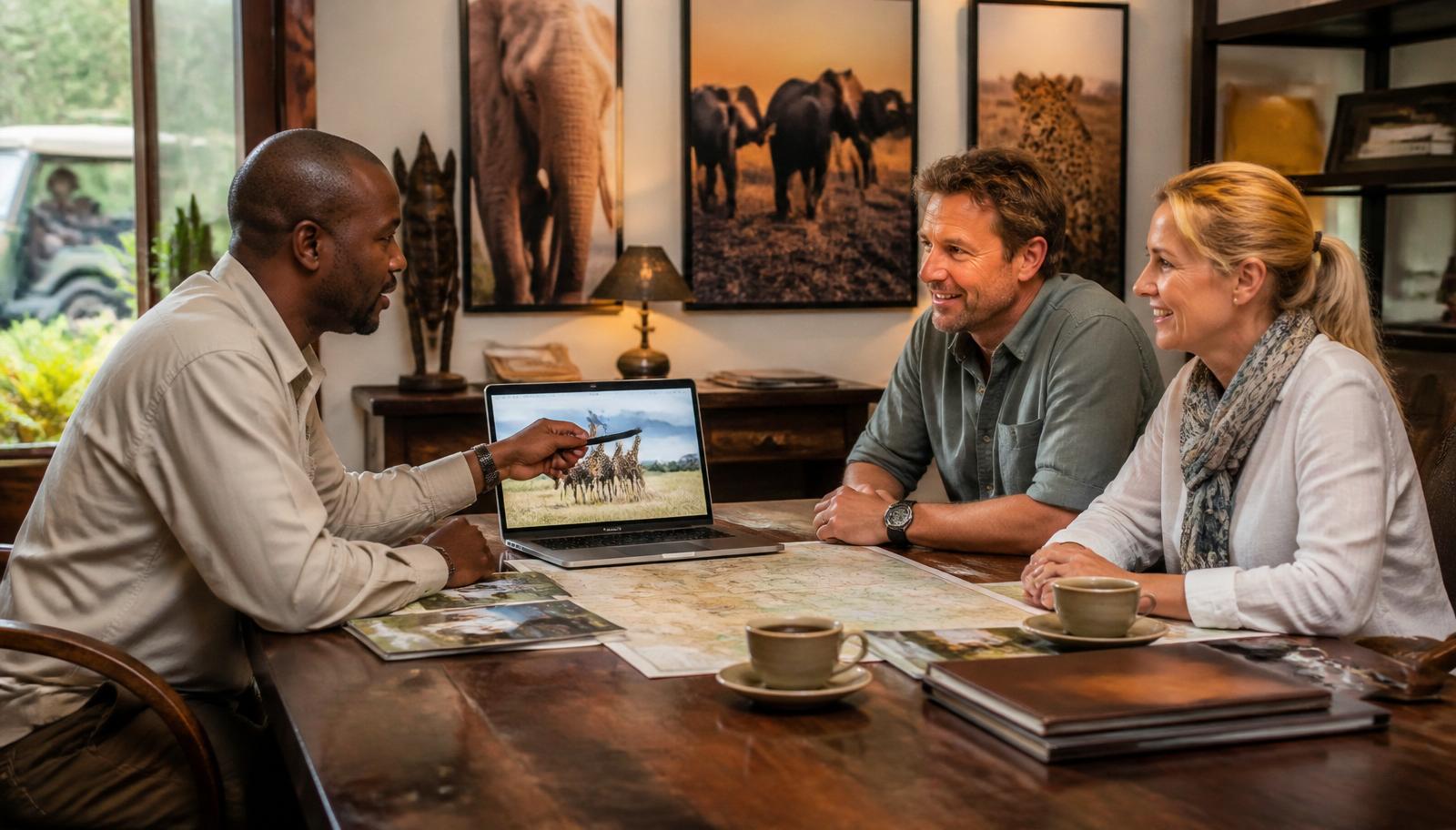
Published safari packages are conversation starters. Almost every trip we operate is tailor-made, and the customizing is where a good operator earns their fee. Here's what to tell us, and what we'll change.
What you should tell your operator
- Your pace — do you want to be out at dawn every day, or have slow mornings and a pool?
- Physical considerations — mobility, motion sickness, altitude sensitivity, back issues on rough roads.
- Dietary requirements — vegetarian, halal, gluten-free, allergies. Camps handle these well but need notice.
- Photography ambitions — serious photographers need a private vehicle, bean bags and dawn departures, and should say so early.
- Occasion — honeymoon, birthday, anniversary. Camps do lovely things when they know.
- Children's ages — this changes lodge options (many camps have minimum ages) and drive lengths.
Common and worthwhile customizations
- Fly one leg. Driving into the Serengeti and flying back to Arusha saves an entire day for a modest cost. Almost always worth it.
- Upgrade one night, not all of them. Put your money into the Serengeti nights inside the migration zone, and stay mid-range everywhere else.
- Add a cultural day. A morning with a Maasai community or a Hadzabe visit near Lake Eyasi is many guests' favorite memory.
- Balloon safari. Roughly $600 per person, one hour over the Serengeti at sunrise, ending with a bush breakfast. Book it at the itinerary stage — spaces are limited.
- Rest day. On trips over eight days, a non-driving day at a good camp resets everyone, especially families.
Couples should read Tanzania Safari for Couples before finalizing, and families will find the age-by-age pacing advice in Family Safari in Tanzania genuinely useful at this stage.
Step 6: Understand What's Included
This is where quotes become genuinely comparable — or genuinely misleading. Two quotes that differ by $1,500 per person often cover different things. Before you compare prices, line the inclusions up side by side.
Park fees and government charges
The largest fixed cost of any Tanzania safari, and the most common omission in a cheap quote. In 2026 this includes Serengeti entry (about $82.60 per adult per day plus 18% VAT), Ngorongoro entry (about $70 per adult per day), the Ngorongoro crater service fee ($295 per vehicle per descent), concession fees at camps inside conservation areas, and vehicle entry fees. On a seven-day Northern Circuit trip, government fees alone can exceed $900 per person. A legitimate quote states clearly that all park and government fees are included.
Accommodation
Should be named — the actual property, not "similar 4-star lodge." Ask whether the camp is inside or outside the park boundary, and if it's a mobile camp, which region it will be in on your dates. "Serengeti" is 5,700 square miles; the difference between a camp in Seronera and one near the Mara River in August is a completely different trip.
Meals
Safari camps are almost always full board: breakfast, lunch (often a packed picnic in the field), and dinner. Confirm whether meals are included on the first and last days, which are the usual gaps. Arusha hotels are frequently bed-and-breakfast only.
Transfers
Airport pick-up from Kilimanjaro International (JRO) and all ground transport in a private 4x4 should be included. Check whether transfers to and from your Arusha hotel on arrival and departure days are covered — a $60 gap that surprises people.
Flights
International flights are never included. Domestic bush flights (Serengeti to Arusha, or Serengeti to Zanzibar) may or may not be — they run roughly $250–$400 per person per leg and should be listed as separate line items so you can see them.
Drinks
Drinking water in the vehicle is standard and should always be included. Beyond that it varies enormously: some luxury camps include all house wines, beers and spirits; most mid-range lodges charge for everything except water and sometimes tea and coffee. Budget $25–$50 per person per day if you enjoy a sundowner.
Tips
Never included, and genuinely expected. Plan on $20–$30 per guest per day for your driver-guide and $10–$15 per guest per day for camp staff (pooled). On a seven-day trip for two, that's roughly $350–$450 in cash, handed over at the end. Bring clean, recent USD notes.
| Item | Usually included? | What to confirm in writing |
|---|---|---|
| Park & conservation fees | Yes | Includes VAT and the Ngorongoro crater service fee |
| Accommodation | Yes | Named properties, inside or outside the park |
| Meals | Yes (full board on safari) | First and last day coverage |
| Ground transfers | Yes | Airport and hotel transfers both ways |
| International flights | No | Arrival airport (JRO vs DAR vs ZNZ) |
| Domestic bush flights | Sometimes | Listed per leg with baggage allowance (usually 15 kg soft bag) |
| Alcoholic drinks | Rarely | Which camps are fully inclusive |
| Tips | No | Recommended amounts for guide and camp staff |
| Visa & insurance | No | Visa type ($50–$100) and insurance requirements |
Step 7: Booking & Payment Process
Once the itinerary is right, confirming should be simple and paper-trailed. Here's how a professional Tanzanian booking actually runs, start to finish.
The sequence
- 1. Provisional hold. We place a 5–7 day hold on your camps and flights at no cost while you decide. Holds are real — camps honor them.
- 2. Final itinerary and quotation. A written document with day-by-day detail, named accommodation, full inclusions and exclusions, and the total per person.
- 3. Booking contract. Terms, payment schedule, cancellation policy and liability. Read it. Ask about anything unclear before signing.
- 4. Deposit — 30%. Paid to the registered company account. Your booking is confirmed only once this clears.
- 5. Confirmation pack. Within a few days you receive camp vouchers, flight confirmations and a pre-departure guide.
- 6. Balance — 60 days before arrival. Paid the same way. Bookings made inside 60 days are paid in full at confirmation.
How to pay safely
- SWIFT bank transfer to the operator's registered company account. Lowest fees; allow 2–4 business days.
- Credit card via a secure payment link. Expect a 3–4% bank processing fee, which is charged by the payment provider, not the operator. Worth paying for the chargeback protection.
- Regulated transfer services such as Wise, where the recipient is the registered company.
Your booking checklist
Before you send the deposit, you should be able to tick every one of these:
- TALA licence number received and the company name matches the bank account.
- Written day-by-day itinerary with named camps and the park each night is spent in.
- Inclusions and exclusions listed explicitly, including park fees, VAT and crater service fee.
- Booking contract with a clear payment schedule and cancellation policy.
- Vehicle type confirmed (private 4x4 Land Cruiser vs shared minivan) and guide details.
- Domestic flight legs shown separately with baggage allowance.
- Travel insurance purchased, including medical evacuation.
- Passport valid for six months beyond travel, with two blank pages.
- Visa route decided (e-visa in advance is smoother than on arrival).
- Yellow fever certificate arranged if you're arriving via an endemic country.
- A named contact at the operator plus a 24-hour emergency number.
What Happens After Booking?
A common worry: "I've paid a deposit — now what?" With a well-run operator, quite a lot happens, most of it invisible to you.
- Immediately: camp prepayments go out, park permits are prepared, your guide is assigned and blocked on the roster, and flight seats are ticketed.
- Within a week: your confirmation pack arrives — vouchers, flight details, packing list, health guidance and visa instructions.
- 3–4 months out: we check in about dietary needs, celebrations, room configurations and any optional extras like a balloon flight.
- 60 days out: balance invoice, followed by final documents.
- 2–3 weeks out: a final briefing call or WhatsApp message — arrival logistics, weather forecast, current wildlife reports and where the herds are sitting.
- 48 hours out: your guide's name, photo and phone number, plus confirmation of your airport meet point.
- On the ground: a 24-hour office line, and a team that checks in with your guide daily.
Now is also the right moment to start gathering gear — our Tanzania Safari Packing List is built around the 15 kg soft-bag limit on bush flights, and the broader Ultimate Tanzania Travel Guide covers visas, health, money and connectivity in one place.
Common Booking Mistakes
1. Choosing on price alone
The lowest quote almost always contains a hidden compromise: a lodge two hours outside the park, a shared vehicle sold as private, or park fees excluded. Compare inclusions, not totals.
2. Booking too many parks
Five parks in seven days looks impressive on a brochure and feels like a coach tour in reality. Cut a park and add nights.
3. Ignoring where the camp actually sits
"Serengeti" on a quote means very little. In August, a camp near Kogatende puts you at the river crossings; a camp in Seronera puts you five hours away from them.
4. Leaving it too late for peak season
By March, the best July–September camps are largely gone. Late bookers don't pay more so much as get less.
5. Skipping travel insurance
A medical evacuation from a remote park runs into five figures. Insurance costs a fraction of one safari night.
6. Not asking about the vehicle
Minivans still get sold as safari vehicles. They struggle in the mud, have poor visibility and no ground clearance. Insist on a 4x4 Land Cruiser with a pop-up roof and a guaranteed window seat for every guest.
7. Booking flights before the safari is confirmed
Fix the ground itinerary first, then buy international tickets. Arrival airport and timing genuinely affect how the first day is built.
8. Under-budgeting for extras
Tips, drinks, visas, a balloon flight and souvenirs typically add $500–$900 per person to a week-long trip. Plan for it so it doesn't feel like a surprise.
Why Book Directly with a Local Operator?
I have an obvious interest here, so let me be straight about both sides. Booking through an overseas agency gives you consumer protection under your own country's law, a same-time-zone contact, and someone who has vetted the ground operator for you. For nervous first-time travelers, that's worth real money.
What booking direct with a licensed Tanzanian company gives you is different:
- Price. You remove 15–35% of commission for identical ground services.
- Knowledge. Our team was in the Serengeti last week. We know which road washed out, which camp changed managers and where the herds sat yesterday.
- Flexibility. Changes on the ground get decided in a phone call, not an email chain across three time zones.
- Accountability. The person who sold you the trip is the person whose reputation depends on it, in a city where reputation is everything.
- Impact. More of what you pay stays in Tanzania — with guides, camp staff, suppliers and the communities around the parks.
The condition attached to all of that is due diligence. Book direct, but verify the licence, read the contract, pay to a company account and buy insurance. Do those four things and booking direct is both cheaper and better.
Common Questions
Frequently Asked Questions
For peak season (July–September, plus mid-December to early January) book 9–12 months ahead — the best Serengeti camps in the migration zone sell out that far out, and so do the good guides. For February calving season, 8–10 months is sensible. For shoulder and green season (March, April, May, early June, November) 4–6 months is usually enough, and you'll still have real choice. We do take bookings closer than that, but the shorter the lead time, the more you're choosing from what's left rather than what's best.
Usually yes. Overseas agents and marketplace platforms typically add 15–35% in commission on top of the ground operator's price for exactly the same vehicle, guide and camps. Booking direct with a licensed Tanzanian operator removes that layer, and you speak to the people who actually run your trip instead of a middleman relaying messages. The trade-off is that you must do your own due diligence — licence, reviews, references and a proper contract.
Yes. Industry standard in Tanzania is a 30% deposit to confirm, with the balance due 60 days before arrival. The deposit isn't the operator's profit — it goes straight out as non-refundable prepayments to camps, domestic airlines and park authorities to hold your space. Some peak-season camps require higher or non-refundable deposits, and a good operator will tell you which ones in writing before you pay.
Completely. Almost every trip we run is tailor-made: your dates, your pace, your lodge style, your interests. Published packages are starting points, not fixed products. Common customizations include swapping a park, adding a Zanzibar or Kilimanjaro extension, flying one leg instead of driving, upgrading a single Serengeti night to a migration-zone camp, or building slower days for families and photographers.
It's essential, and we make it a condition of travel. At minimum you need medical cover including emergency evacuation (a Flying Doctors airlift from the Serengeti is expensive), plus trip cancellation and interruption cover for the money you've committed in deposits. Buy it the day you pay your deposit — cancellation cover only protects what you insure before something goes wrong.
Most Tanzanian operators, including Olympus Adventure, accept international bank transfer (SWIFT), major credit cards through a secure payment link, and in some cases Wise or similar regulated transfer services. Card payments usually carry a 3–4% processing fee that the bank charges, not the operator. Always pay to a registered company account whose name matches the company on your contract. Never pay into an individual's personal account, and never pay in cryptocurrency.
Yes, and sometimes at a genuine discount. Camps release unsold rooms in the final weeks, especially in shoulder months, and a good local operator can assemble a strong trip in 7–14 days — occasionally in 48 hours. What you lose is choice: specific migration-zone camps, particular guides and cheap domestic flight seats go first. Last-minute works best if you're flexible on lodges and you're travelling outside July–September.
Cancellation terms are set out in your booking contract and are driven by what the camps and airlines charge us. A typical structure is: deposit non-refundable, 60–30 days before arrival 50% of the total, and inside 30 days 100%. Some camps are stricter in peak season. This is exactly why cancellation insurance matters. Where possible we'll also try to move your dates rather than cancel outright — a date change is almost always cheaper than a refund.
Conclusion
After fifteen years of doing this, I've come to believe that booking a safari well is less about knowledge than about order and honesty. Fix your dates. Choose fewer parks. Say your real budget out loud. Verify the company properly rather than emotionally. Read the inclusions line by line. Sign a contract, pay a normal deposit to a normal company account, and buy insurance the same day.
Everything past that point is anticipation — the packing list, the wildlife reports, the message with your guide's photo two days before you fly. And then one morning you're on a track in the Serengeti at 6:15 a.m., the light coming up gold across the grass, and none of the planning matters anymore because you're simply there.
Booking a Tanzania safari well isn't complicated — it just rewards doing things in the right order: dates, parks, budget, operator, itinerary, contract, deposit. Get that sequence right and everything after it is anticipation.
Ready to Start Planning?
Tell us your travel dates, roughly how many days you have and what you'd hate to miss, and our Arusha-based team will send you a personalized draft itinerary — free, with no obligation and no pressure. If we're not the right fit for your trip, we'll tell you that too. Start with our free safari consultation, or browse our safari packages for ideas first.
Plan Your Journey
Get a free, personalized Tanzania safari itinerary.
Share your dates, group size and rough budget. Our Arusha-based specialists will design a tailor-made safari, show you exactly what's included, and answer every question before you commit to anything.
- TALA Licensed Operator
- 4.9 ★ Guest Rating
- No Booking Fees
Keep Reading
Related Tanzania Safari Guides
Safari Guides
The Ultimate Tanzania Travel Guide: Everything You Need to Know Before You Visit
Safari Guides
Best Tanzania Safari Itineraries: How to Choose the Right Route for Your Days
Safari Guides
Tanzania Safari for First-Time Visitors: The Ultimate Beginner's Guide