
Zanzibar Travel
Zanzibar Snorkeling & Diving Guide: Everything You Need to Know
The reefs that are worth your money, the ones that aren't, the seasons that decide everything, and what it actually costs to get in the water.

Introduction
There's a conversation I have with guests at least once a week. They've just spent a morning wading around in front of their hotel on the east coast, they've seen some seagrass, a sea cucumber and about four fish, and they want to know why everybody online keeps saying Zanzibar has incredible snorkeling. It's a fair question, and the answer is simple enough that it should be on the first page of every guidebook: the good reef is not in front of your hotel. It's two to five miles offshore, on the far side of the fringing reef, and you get there on a boat.
Once you understand that, Zanzibar stops being confusing and starts being very good indeed. The archipelago sits in the middle of the western Indian Ocean's coral triangle, warm enough to dive in a shorty every month of the year, with more than four hundred recorded reef fish species and coral systems that — in the protected areas at least — are in far better shape than most of the tropics right now. Mnemba Atoll is the famous one. Pemba, an hour's flight north, is the one serious divers whisper about. Between them sit Tumbatu, Chumbe, Leven Bank and a dozen quieter reefs that rarely make it into an itinerary.
I've been putting travelers in this water for years — honeymooners who've never worn a mask, families with nine-year-olds, and divers who've logged three hundred dives and want to know exactly which slack tide to book. What follows is what I'd tell you over coffee: where to go, when, what it costs, what you'll actually see, and where the island's marine tourism industry still gets things wrong.
Why Zanzibar Is a World-Class Diving Destination
Zanzibar's reputation rests on three things that happen to line up unusually well here: water temperature, reef structure, and protection.
Start with temperature. The Indian Ocean around the archipelago sits between 77°F and 86°F depending on the month. That's not just comfortable — it's the reason a first-time snorkeler can stay in the water for two hours without getting cold and without the psychological hurdle of squeezing into a 7mm wetsuit. Most divers here wear a shorty. Plenty wear nothing but a rash guard in February. For a beginner, that removes an enormous amount of friction.
Then there's the structure. Unguja — the island everyone calls Zanzibar — is surrounded by a fringing reef, with a scatter of offshore atolls, patch reefs and submerged banks beyond it. That variety matters. It means a family can spend a morning in 12 feet of flat water at Mnemba's western shallows while, an hour up the coast, an experienced diver is drifting a 100-foot channel at Leven Bank with kingfish going past. Very few destinations serve both ends of that spectrum from the same beach.
Protection is the third pillar, and it's the one that's genuinely improved in the last decade. The Mnemba Island Marine Conservation Area, Chumbe Island Coral Park and the Misali Island reserve off Pemba all restrict fishing and, in Chumbe's case, cap daily visitor numbers outright. Chumbe has been managed as a no-take zone since 1994 and is routinely cited as one of the healthiest shallow coral systems in East Africa. You can see the difference in a single swim — the coral cover is denser, the fish are bigger, and the reef makes noise.
I'll add a fourth, less romantic reason: logistics. You can be diving on Mnemba within two hours of landing at Zanzibar International, on a reef that would take a full day of travel to reach in most of the Indian Ocean. And because the island already runs on tourism, the dive infrastructure is mature — nitrox is available, several centers hold five-star PADI or SSI status, and there's a functioning recompression chamber in Dar es Salaam with an established evacuation route. That last point sounds boring until you need it.
Where Zanzibar doesn't compete: it isn't the Red Sea for wreck diving, and it isn't Raja Ampat for sheer biodiversity per square meter. What it is, honestly, is one of the best all-round warm-water destinations in the world for travelers who want serious reef within reach of a proper beach holiday — and who might want a Tanzania safari bolted onto the front of it.
Best Time for Snorkeling & Diving
Zanzibar has two monsoons and they run the show. The kaskazi blows from the northeast between roughly November and March, bringing hot, still, humid weather. The kusi arrives from the southeast around May and holds until October, cooler and windier but far more predictable. Between them sit the long rains of April and May, which are the only time of year I'd actively steer a diving trip elsewhere.
Underwater, what you care about is visibility, and visibility here is a function of three things: rainfall runoff, plankton, and tidal movement. Rain muddies the nearshore water. Plankton blooms after the rains and turns the water green. And the tides — which in Zanzibar swing up to 13 feet between high and low — stir sediment through the channels twice a day.
| Period | Conditions | Visibility | Water | Verdict |
|---|---|---|---|---|
| January – February | Hot, calm, light northeast kaskazi wind | 65–100 ft | 84–86°F | Warmest water and best photography light. Busy and pricey. |
| March | Humid, building cloud, occasional squalls | 45–80 ft | 84–86°F | Still good early in the month, deteriorating by late March. |
| April – May | Long rains, runoff, plankton bloom | 20–50 ft | 82–84°F | The weakest window. Many small operators close entirely. |
| June – August | Dry, breezy southeast kusi wind | 60–90 ft | 77–80°F | Reliable and cooler. Some chop on exposed sites in the afternoon. |
| September – October | Dry, settled, lightest winds of the year | 70–100 ft | 79–82°F | The sweet spot. If you can pick one month, take September. |
| November – December | Short rains, then clearing into festive season | 40–80 ft | 82–85°F | Patchy in November, strong from mid-December on. |
The month I'd book if I only had one
September. The rains are long gone, the kusi has softened, the water has warmed back up from its July low, and the visibility is as good as it gets. It's also just before the December price spike, so you get the best conditions of the year without paying festive-season rates. October runs it very close.
If your priority is underwater photography rather than pure visibility, February is the counter-argument. The water is at its warmest, the sea is often glassy by 8am, and the high sun angle throws light much deeper into the reef. The trade-off is crowds and cost — this is peak season, and Mnemba shows it.
A note on April and May, because people book them anyway for the cheap rates. The diving isn't dangerous, it's just disappointing — 20 to 40 feet of green water and a lot of cancelled boat days. Several smaller dive centers close entirely for six weeks. If those are your only possible dates, base yourself in the north where the water clears faster, keep expectations modest, and read our best time to visit Zanzibar guide before committing.
Mnemba Atoll
Mnemba is a tiny, triangular coral island about two miles off Zanzibar's northeast coast, ringed by a lagoon and a reef system that has been a designated marine conservation area since 2002. The island itself is a private lodge and you cannot land on it — that catches people out every season, and no, paying more doesn't change it. What you're going for is the water.
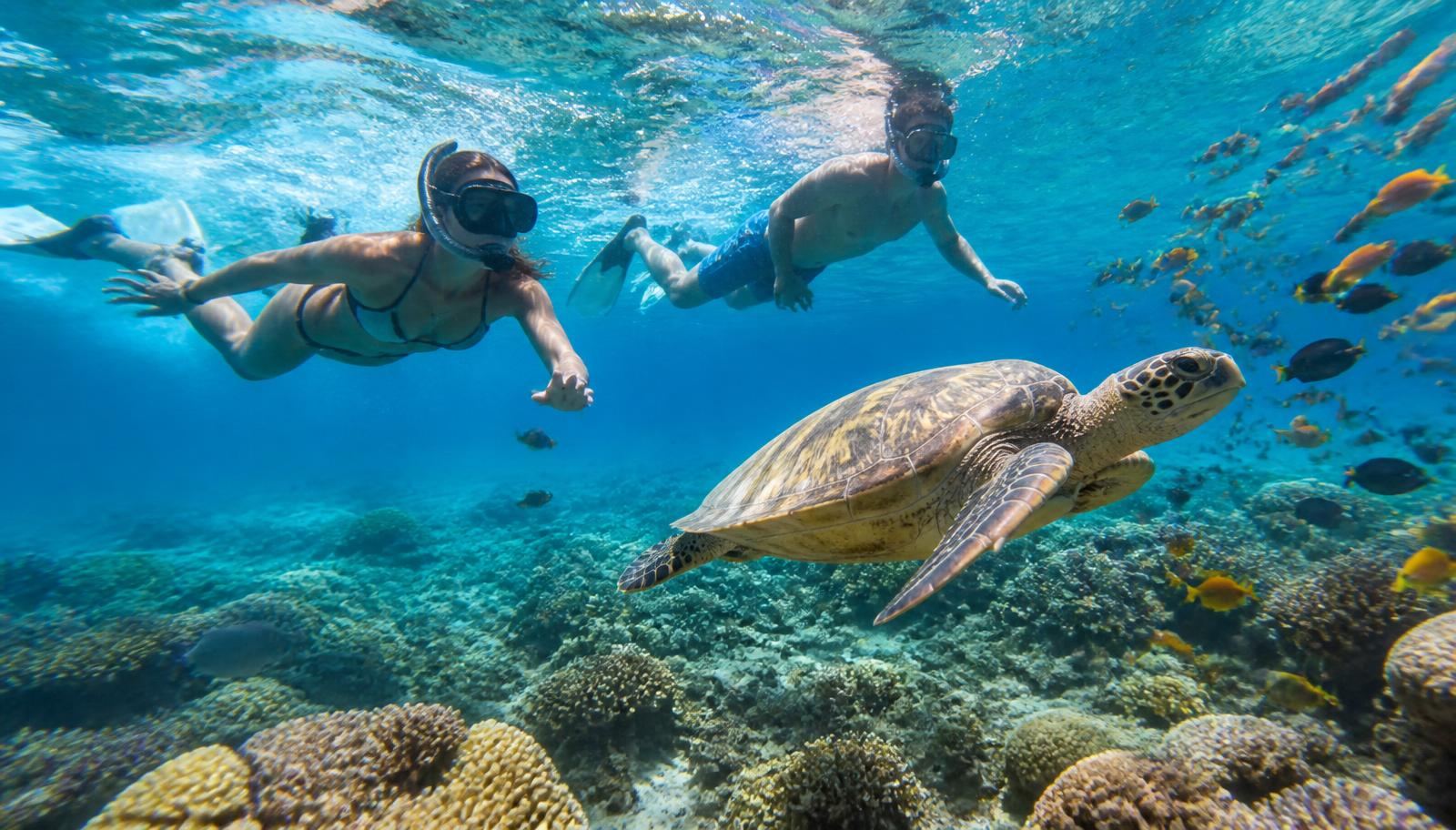
The atoll's western side is the snorkeling zone. It's sheltered, shallow — often 10 to 25 feet — and the fish density there is the highest I've seen anywhere in Tanzanian waters. On an average morning you'll swim through walls of yellow-and-blue fusiliers, past emperor angelfish, moorish idols, parrotfish grinding at the coral, clownfish defending their anemones, and almost always at least one green turtle working its way along the reef edge, entirely unbothered by you.
The eastern and southern sides are for divers. Kichwani is the classic — a sloping coral garden running from about 30 to 80 feet with excellent hard coral, ribbon eels and the occasional whitetip reef shark. Wattabomi is shallower and easier. Aquarium, as the name suggests, is a fish-dense shallow site that suits new divers and photographers. None of these are technically demanding dives; the current is usually mild, and the depth is forgiving.
The crowding problem, and how to beat it
I'll be honest about this because it's the one complaint I hear consistently: by mid-morning in high season, the Mnemba anchorage can hold twenty or more boats. That's a lot of fins in a small area, and it changes the experience — the fish are still there, but the sense of discovery isn't.
The fix is entirely within your control. Boats leaving Matemwe at 7:00 or 7:30am reach the reef by 7:30–8:00, which is a full ninety minutes before the Nungwi and Kendwa fleet arrives. The water is flattest at that hour, the light is beautiful, and the dolphins that patrol the deeper channel on the approach are far more likely to be around. I've had guests get an hour alone on the reef and come back convinced they'd paid for something entirely different from what their neighbors described.
Getting there
From Matemwe: 20 minutes by boat, sometimes less. From Nungwi or Kendwa: 40 to 55 minutes, depending on sea state. From Kiwengwa: around 45 minutes. From the east coast — Paje, Jambiani — Mnemba is a long road transfer plus a boat, and it makes for a tiring day. If snorkeling is a real priority for your trip, that fact alone should shape where you sleep; our guide to where to stay in Zanzibar breaks the areas down properly.
Tumbatu Island
Tumbatu sits off Zanzibar's northwest coast, separated from the mainland by a channel that funnels a serious amount of water on a big tide. It's inhabited — by the Tumbatu people, who have their own dialect and a long-standing reputation for keeping to themselves — and it sees a tiny fraction of Mnemba's visitor numbers. For divers who want quality reef without the traffic, this is where I point them.
The reefs on the sheltered side are gentle: coral gardens in 25 to 65 feet, decent hard coral cover, plenty of reef fish, and typically one or two other boats at most. It's a comfortable second or third dive for someone freshly certified, and the snorkeling on the shallow shelf is genuinely good on a calm day.
The channels are a different proposition. On a running tide you get real drift diving — 50 to 100 feet, current you have to respect, and the payoff of big schooling fish and the occasional larger predator cruising through. This is not a place to try your fourth ever dive. Go with a center that knows the tide tables intimately, and be prepared for them to cancel; the good ones do, regularly.
Access is from Nungwi, Kendwa or the small landings along the northwest coast — 30 to 45 minutes in a dive boat. Most northern dive centers run Tumbatu as a scheduled trip once or twice a week rather than daily, so ask about the schedule when you book your accommodation dates.
Leven Bank
Leven Bank is a submerged seamount roughly an hour north of Nungwi, rising from deep water to about 60 feet at its shallowest. It is, without much argument, Zanzibar's most demanding dive and its most exciting one.
The bank sits in open ocean with nothing to shelter it, which means current — sometimes gentle, sometimes strong enough that the plan becomes "descend fast, hold on, enjoy it." Because it's exposed and productive, it attracts size. Giant groupers hang in the lee of the pinnacles. Big Napoleon wrasse patrol the edges. Schools of barracuda and kingfish materialize out of the blue, and between August and November there's a real, if uncommon, chance of a manta.
Who should dive it: divers with an Advanced certification and, more importantly, a logbook that includes current and depth. Most centers require Advanced Open Water plus a minimum number of logged dives, and a few will insist on diving with you at the site once before signing you off. Take that seriously rather than shopping around for an operator who won't ask.
Who shouldn't: anyone freshly certified, anyone uncomfortable with a negative entry, and anyone who gets seasick easily. The surface run out there in the kusi season can be rough, and there is no snorkeling at Leven Bank in any meaningful sense — the shallowest point is deeper than a comfortable free dive and the current would take you.
Pemba Island
Pemba is the archipelago's other island — greener, hillier, far less developed, and about a 30-minute flight or a long ferry ride north of Unguja. If Mnemba is where Zanzibar snorkeling happens, Pemba is where Zanzibar diving happens.
The geography does it. The Pemba Channel between the island and the Tanzanian mainland drops to over 2,600 feet, and Pemba's western reefs fall away as steep walls into that deep water. The result is exceptional visibility — 100 feet is normal, 130 happens — and a reef community that includes gorgonian sea fans the size of a dining table, black coral, and steady traffic from pelagic species.
The names to know: Manta Point and Hunga Reef on the northwest, Renco Bommie and Uvinje Gap in the north, Njao Gap for wall diving, and Misali Island on the west coast, which is a protected marine reserve with outstanding shallow coral and reliable turtle sightings. Misali is the one Pemba site that works beautifully for snorkelers as well as divers.
The honest caveat is that Pemba is a commitment. There are only a handful of dive lodges, they book out, the flight schedule is limited, and the island has very little in the way of general tourist infrastructure. A Pemba diving trip means three to five nights minimum, and it works best as a dedicated segment rather than a day trip. For divers with a hundred-plus logged dives who are tired of sharing reefs, it's the best value in the western Indian Ocean right now.
Marine Life You Can Expect
Let's set realistic expectations, because marine wildlife lists have a habit of promising a documentary and delivering a nice swim. Here's what actually turns up, how often, and where.
| Species | Where | When | Likelihood |
|---|---|---|---|
| Green turtle | Mnemba, Misali, Chumbe | Year-round | Very likely |
| Hawksbill turtle | Mnemba, Pemba walls | Year-round | Occasional |
| Bottlenose dolphin | Kizimkazi, north coast, Mnemba approach | Year-round | Likely |
| Humpback whale | Offshore Mnemba, Pemba channel | Jul–Sep | Rare but real |
| Whale shark | Mafia Island (separate trip) | Oct–Feb | High at Mafia |
| Reef shark (whitetip, blacktip) | Leven Bank, Pemba, deep Mnemba | Year-round | Divers only |
| Manta ray | Leven Bank, Pemba | Aug–Nov | Uncommon |
| Blue-spotted ribbontail ray | Sandy patches everywhere | Year-round | Very likely |
| Octopus | Reef flats, night dives | Year-round | Likely |
| Moray eel | All coral sites | Year-round | Very likely |
| Lionfish & scorpionfish | Mnemba, Tumbatu, Pemba | Year-round | Likely |
| Clownfish in anemone | Mnemba shallows, Chumbe | Year-round | Guaranteed |
| Napoleon wrasse | Pemba, Leven Bank | Year-round | Divers only |
| Barracuda & kingfish | Leven Bank, Tumbatu channels | Year-round | Divers only |
| Dugong | Deep channels, extremely scarce | Year-round | Almost never |
The reef fish, which are the real show
Everybody arrives hoping for turtles and dolphins. What they remember, more often than not, is the fish. Zanzibar's reefs carry the full Indo-Pacific cast: emperor and regal angelfish, six or seven butterflyfish species on a single swim, powder-blue surgeonfish moving in nervous packs, titan triggerfish that will absolutely see you off if you drift over a nest, sweetlips hanging motionless under overhangs, and parrotfish audibly crunching coral. The soundtrack surprises people — a healthy reef is loud.
Turtles
Green turtles are the ones you'll see, and you'll probably see several. They feed on the seagrass and algae around Mnemba and Misali and have grown thoroughly indifferent to snorkelers, which makes for extraordinary encounters as long as nobody grabs at them. Hawksbills are less common and tend to be found deeper, on the coral itself. Both nest on Zanzibar's beaches — there's a long-running hatchery and rehabilitation project at Nungwi that's worth an hour of your time.
Dolphins, and a necessary warning
Bottlenose and Indo-Pacific humpback dolphins live year-round in the waters off Kizimkazi in the south and along the northern coast. Seeing them from a boat is genuinely common. The problem is the swim-with-dolphins industry that has grown up at Kizimkazi, where boats routinely surround pods, cut across their path and drop swimmers directly on top of them. Research on that population has documented changes in behavior and habitat use as a result.
The big seasonal visitors
Humpback whales migrate through the channel between roughly July and September on their way to and from breeding grounds. Sightings from boats near Mnemba and around Pemba do happen, particularly in August. Whale sharks are a Mafia Island story rather than a Zanzibar one — the aggregation there, from around October to February, is one of the most reliable in the world, and it's a separate flight and a separate few days. Mantas appear at Leven Bank and off Pemba, mostly late in the year, and remain a matter of luck.
Snorkeling vs Scuba Diving
This decision matters more in Zanzibar than in a lot of destinations, because the shallow reefs here are unusually rich. In plenty of places, snorkeling is the consolation prize. At Mnemba and Chumbe, it genuinely isn't.
| Factor | Snorkeling | Scuba diving |
|---|---|---|
| Cost per outing | $35–60 shared, plus $10 park fee | $75–90 single dive, $135–155 two-tank |
| Training needed | None — five minutes of briefing | Half-day intro, or 3–4 days for Open Water |
| Time in the water | 60–120 minutes, at your own pace | 40–55 minutes per dive |
| Depth range | Surface to about 15 ft on a breath-hold | 30–130 ft depending on certification |
| Best for seeing | Turtles, fish schools, shallow coral, light | Walls, pelagics, sharks, macro life, structure |
| Suits children | Yes, from around age 6 with a vest | Bubblemaker from 8, junior Open Water from 10 |
| Flight restriction | None | 18–24 hours before flying |
My practical advice: if you're on a seven-night beach holiday and you've never dived, don't feel obliged to. Two good snorkeling mornings at Mnemba and a Chumbe day trip will show you more color and more animals than most people see in a lifetime, and you'll spend a fraction of the money. If, on the other hand, you're already certified, Zanzibar is easy diving in warm water with well-run centers — and Pemba is worth reorganizing your itinerary for.
The middle path, which I recommend often, is a Discover Scuba session. Half a day, no certification, an instructor beside you the whole time, and a shallow dive at Mnemba or Nungwi. It costs around $110–130 and it either scratches the itch or turns you into a diver. Roughly half our guests who try it come back the following year for the course.
Best Tours for Beginners
If you've never put your face in the ocean before, some entry points are far kinder than others. These are the ones I actually recommend, in rough order of gentleness.
- Mnemba west side, early boat. Calm, shallow, spectacular, and you can hold onto a noodle the entire time and still see everything. Ask for a guide who'll swim with you rather than one who drops the group and waits on the boat — the good operators do this automatically.
- Chumbe Island Coral Park. The single best beginner snorkel in the archipelago. The reef starts in six feet of water, the park caps visitor numbers so you're never in a crowd, and every group goes out with a trained ranger-guide who names what you're looking at. Roughly $130–170 for the day including lunch and the walk through the forest reserve.
- Discover Scuba at Nungwi or Matemwe. Pool or shallow-bay skills in the morning, one supervised dive to about 25 feet in the afternoon. No prior experience, no certification, no commitment.
- A sandbank half-day. Nakupenda, Pungume or the Michamvi sandbanks — a shallow snorkel plus a couple of hours on a strip of sand in the middle of the ocean. Perfect for families where one half of the party is enthusiastic about reef and the other half isn't.
- PADI Open Water over three to four days. If you know you want to dive properly, do the course here rather than at home. Warm water, good visibility and an instructor-to-student ratio that's usually two or three to one. Budget $620–700.
How to tell a good operator from a cheap one
Prices for the same Mnemba trip can vary by 60% between operators, and the difference is almost never the boat. Things I look for: a proper safety briefing before departure, life vests actually on board and offered rather than hidden, a guide in the water with the group, the conservation fee stated up front, boats that aren't loaded to the gunwales, and — the tell that says the most — a willingness to change the plan or cancel when the sea says so.
Safety Tips
Zanzibar's water is warm, forgiving and, in the wrong conditions, genuinely capable of causing trouble. Almost every incident I've heard of here traces back to one of four things: current, sun, coral, or diving too close to a flight.
- Respect the current. The tidal range here is enormous and the channels move fast. Always enter the water up-current of the boat so you drift back toward it, and if you find yourself swimming hard and going nowhere, stop, signal, and let the boat come to you. Never try to out-swim a channel.
- The sun is the real hazard. Floating face-down at three degrees south, with water reflecting UV back at you, burns shoulders and calves faster than anyone expects. Wear a long-sleeve rash guard and, if you're prone, board shorts or leggings. This is not vanity — I've seen holidays effectively ended on day two.
- Don't touch the reef. Fire coral stings, stonefish and scorpionfish are superbly camouflaged, cone shells are venomous, and a coral graze in tropical water infects readily. Keep your hands to yourself and your fins up.
- Sea urchins on the reef flat. If you're walking out from an east-coast beach at low tide, wear reef shoes. Urchin spines break off in the foot and are miserable to remove.
- Mind the no-fly rule. Leave a minimum of 18 hours after a single dive and 24 hours after multiple dives or several consecutive diving days before you fly — including the short hop back to Arusha or Dar es Salaam for a safari.
- Check your insurance covers diving. Many standard policies exclude scuba below 60 feet, or exclude it altogether. Get a policy with hyperbaric treatment and medical evacuation cover — DAN is the usual choice among divers. Zanzibar's nearest recompression chamber is in Dar es Salaam.
- Hydrate more than feels necessary. Salt water, heat and sun dehydrate you quickly, and dehydration is a documented risk factor for decompression sickness. Drink before you dive, not just after.
- Declare your medical history honestly. Asthma, heart conditions, recent surgery, pregnancy and some medications all matter to a dive center. The form isn't bureaucracy; it's the thing that keeps you out of the wrong water.
Responsible Marine Tourism
Zanzibar's reefs are under real pressure. Bleaching events in 1998 and 2016 killed coral across the archipelago, some areas are still recovering, and the combination of overfishing, coastal development and a growing number of boats means the difference between a protected reef and an unprotected one is now visible to any snorkeler.
The good news is that the fixes are unglamorous and easy.
- Never stand on coral, kneel on it, or steady yourself against it. A single careless fin kick can undo a decade of growth on a branching colony.
- Wear mineral, reef-safe sunscreen — non-nano zinc oxide — or better, cover up with a rash guard and skip the lotion. Oxybenzone and octinoxate are demonstrably harmful to coral larvae, and they're in most drugstore sunscreens.
- Don't feed the fish. Bread and biscuits change feeding behavior, concentrate fish unnaturally and damage the reef's grazing balance. If your guide brings bread, ask them not to use it.
- Keep your distance from turtles and dolphins. Three body lengths is a reasonable minimum, no touching ever, and no blocking their path to the surface.
- Buy nothing made of coral, shell or turtle. The souvenir stalls in Stone Town still sell it, and export is illegal in most home countries anyway.
- Pay the conservation fees willingly. The Mnemba and Chumbe fees fund ranger patrols and community programs, and they're a fraction of what you're paying for the boat.
- Choose operators who employ and train Zanzibari guides. The island's dive industry has historically been foreign-run at the top; the centers investing in local instructors are the ones building something durable.
What to Pack
Operators supply the basics. What follows is the list of things that make a real difference and that you either can't buy here or will pay triple for.
- Your own mask, if you own one. The single highest-impact item. Rental masks are the usual reason a snorkel trip goes badly — leaks, fog, a skirt that doesn't fit your face.
- Long-sleeve rash guard. Sun protection that doesn't wash off, plus a little insulation on longer swims in July and August.
- Reef-safe mineral sunscreen, SPF 50. Hard to find locally and around $28 a bottle when you do.
- Reef shoes. Essential for east-coast low-tide walks and useful on rocky boat landings.
- Dry bag. Boats get wet. Phones, cash and passports don't enjoy that.
- Motion sickness tablets. Take them 45 minutes before departure, not when you start feeling green.
- Prescription mask or contacts. Dive centers carry a limited range of corrective masks and rarely your exact prescription.
- Certification card and logbook. Digital is fine, but download it — connectivity at dive centers is unreliable.
- Cash in small dollar bills. Park fees, tips and boat extras are cash transactions almost everywhere.
- A microfiber towel and dry change of clothes. Obvious, routinely forgotten, and the boat ride home in wet clothes is cold in the kusi season.
For the complete rundown on clothing, electronics, documents and everything else the island demands, see our Zanzibar packing list.
Costs & Budget
Prices below are 2026 rates in US dollars, based on what our guests actually pay through reputable operators. Anything meaningfully cheaper usually means the conservation fee has been stripped out, the boat is overloaded, or the guide stays in it.
| Activity | Budget | Typical | Premium |
|---|---|---|---|
| Shared half-day snorkel to Mnemba | $35 | $45–60 | — |
| Private boat to Mnemba (whole boat) | $150 | $200–250 | $300+ |
| Mnemba conservation area fee (per person) | $10 | $10 | $10 |
| Full-day snorkel + sandbank lunch | $60 | $75–95 | $110 |
| Chumbe Island day trip | — | $130–150 | $170 |
| Single guided dive (kit included) | $70 | $75–85 | $95 |
| Two-tank dive day | $120 | $135–155 | $180 |
| Discover Scuba (half day) | $90 | $110–130 | $150 |
| PADI Open Water (3–4 days) | $550 | $620–700 | $750 |
| PADI Advanced Open Water | $400 | $450–520 | $580 |
| Leven Bank / advanced offshore dive | — | $120–150 | $170 |
| Pemba dive package (per day, 2 dives) | $150 | $180–220 | $260 |
| Underwater camera rental (per day) | $25 | $35–50 | $70 |
What a week in the water actually costs
A couple doing two shared Mnemba snorkel trips and one Chumbe day should budget around $420 to $480 all in, including park fees and tips. A certified diver doing four two-tank days will spend roughly $550 to $650. A non-diver who does Open Water plus two fun-dive days lands around $850 to $950. Add 10% for tips — $5 to $10 per guest per boat day for the crew is normal and genuinely appreciated.
For a full picture of what a Zanzibar trip costs beyond the water — flights, accommodation, food and transfers — our Zanzibar travel cost guide breaks it down by traveler type.
Dive Site Comparison Table
One table to settle the question of where you should be spending your water days.
| Site | Level | Depth | Access | Highlight |
|---|---|---|---|---|
| Mnemba Atoll (west side) | Beginner / snorkeler | 10–50 ft | 20 min from Matemwe, 45 min from Nungwi | Turtles, huge fish schools, calm shallow water |
| Mnemba (Kichwani, Wattabomi) | Beginner to intermediate | 30–80 ft | Boat from Matemwe or Nungwi | Coral gardens, ribbon eels, occasional reef shark |
| Chumbe Island Coral Park | Snorkeler | 6–25 ft | 45 min from Stone Town | The healthiest shallow coral in the archipelago |
| Tumbatu (Coral Gardens) | Beginner to intermediate | 25–65 ft | 30–45 min from Nungwi or Kendwa | Quiet reef, almost no other boats |
| Tumbatu channels | Advanced | 50–100 ft | Boat from the northwest coast | Drift diving, big schools, real current |
| Mwana wa Mwana (Nungwi) | Beginner / training | 20–45 ft | 10 min from Nungwi beach | The standard Open Water training site |
| Leven Bank | Advanced only | 60–130 ft | 60–75 min from Nungwi | Pelagics, giant groupers, strong unpredictable current |
| Hunga Reef / Renco Bommie (Pemba) | Intermediate to advanced | 50–130 ft | Flight or ferry to Pemba | Wall diving, gorgonians, 130+ ft visibility |
| Misali Island (Pemba) | All levels | 15–80 ft | Boat from western Pemba | Protected reef, turtles, superb shallow snorkeling |
| Kizimkazi house reefs | Beginner / snorkeler | 6–30 ft | Shore or short boat, far south | Dolphins nearby, modest but easy reef |
Which base suits which traveler
| Traveler | Base | Why |
|---|---|---|
| First-time snorkeler | Matemwe | Twenty minutes to Mnemba, quiet, early departures standard |
| Family with kids 6–12 | Nungwi or Kendwa | Swimmable at all tides, many operators, short trips available |
| Learning to dive | Nungwi | Most dive centers, sheltered training site minutes offshore |
| Certified, 20–100 dives | Matemwe or Nungwi | Mnemba daily, Tumbatu weekly, Leven Bank when conditions allow |
| Experienced diver, 100+ | Pemba Island | Walls, 100+ ft visibility, almost no other boats |
| Honeymooners | Matemwe or Michamvi | Private boats, quiet reef mornings, seclusion ashore |
| Culture first, reef second | Stone Town | Chumbe and Prison Island day trips, then move to the coast |
| Budget traveler | Nungwi or Paje | Competitive shared trips, cheap beds, easy transport |
| Underwater photographer | Matemwe (Feb) or Pemba | Best light and clarity, private boat control over timing |
| Non-swimmer partner | Nungwi or Kendwa | Sandbank trips and sunset dhows for the one who stays dry |
If any of those rows made you rethink your booking, the area guides in our best beaches in Zanzibar article and the wider Zanzibar travel guide go into far more detail on tides, atmosphere and transfer times. For everything else you can fill your days with, see our roundup of the best things to do in Zanzibar.
Frequently Asked Questions
Common Questions
Frequently Asked Questions
Yes — with one caveat about where you do it. The reefs off Mnemba Atoll, Chumbe Island and Tumbatu are genuinely world-class: hard and soft coral in good condition, hundreds of reef fish species, green turtles on most trips and visibility that regularly hits 60 to 100 feet in the dry season. What is not worth it is the shallow lagoon directly in front of most east-coast hotels, which is sand, seagrass and very little else. That gap is why some travelers rave about Zanzibar snorkeling and others come home shrugging. Snorkeling here is a boat activity, not a walk-off-the-beach activity, and once you plan around that the island competes with anywhere in the western Indian Ocean.
Mnemba Atoll is the headline answer and it deserves the reputation — a small private island ringed by a protected reef about two miles off the northeast coast, reached in twenty minutes from Matemwe or forty-five from Nungwi. The sheltered western side is shallow, calm and packed with fish, which makes it ideal for nervous swimmers and children. After Mnemba I'd rank Chumbe Island Coral Park off the west coast, which is arguably in better ecological condition because it has been strictly protected since 1994 and limits daily visitor numbers. Tumbatu, off the northwest, is the quiet third option with almost no crowds. Pongwe and Kizimkazi both have modest house reefs you can reach at the right tide without a boat.
Absolutely, and it's one of the better places in East Africa to learn. Water temperatures run from 77°F to 86°F year-round so you're diving in a shorty or a 3mm at most, the sheltered sites around Mnemba's west side and Nungwi's Mwana wa Mwana sit in 20 to 50 feet of water with mild current, and there are PADI and SSI five-star centers in Nungwi, Matemwe, Kendwa, Paje and Stone Town. A Discover Scuba session takes half a day and gets you into the water on the same day you book. A full Open Water certification takes three to four days. Where beginners should not go is Leven Bank or the Tumbatu channels on a spring tide — those are strong-current, deeper dives for experienced divers only.
For the reef, yes. For the island itself, understand what you're paying for: Mnemba Island is a private luxury lodge and non-guests cannot land on the beach. What you're visiting is the marine conservation area that surrounds it, and that's the good part. Expect big schools of snapper and fusilier, angelfish, moorish idols, regular green turtle sightings, and dolphins in the deeper water on the approach. The one honest complaint is crowding — mid-morning in high season the anchorage can hold twenty-plus boats. Book a private boat, leave at first light, and it feels like a completely different place. That's the single biggest upgrade you can buy on a Zanzibar water day.
On a typical snorkel at Mnemba: green turtles, parrotfish, angelfish, butterflyfish, moorish idols, clownfish in anemones, wrasse, snapper and fusilier schools, and often a moray eel tucked into the coral. On a dive you add scorpionfish, lionfish, octopus, blue-spotted rays, and reef sharks at some sites. Bottlenose and humpback dolphins live in the waters off the north and south coasts year-round. Between roughly July and September, humpback whales migrate past the archipelago and are occasionally seen from boats around Mnemba and Pemba. Whale sharks show up off Mafia Island — a separate trip, roughly October to February. Pemba adds bigger pelagic life: barracuda, tuna, kingfish and, on the outer walls, the occasional reef shark.
The two dry seasons. June through October is the most reliable window overall — calm water, visibility often 65 to 100 feet, and the kusi trade wind keeping conditions predictable. December through February is the other strong period, with the warmest water of the year, glassy mornings and outstanding light for underwater photography. Avoid April and May if you have a choice; the long rains bring runoff, plankton bloom and visibility that can drop to 20 feet. November's short rains are less disruptive but still patchy. If you want one month, September. If you want warm water and the best photography light, February.
A shared half-day snorkeling trip to Mnemba runs about $35 to $60 per person from Matemwe or Nungwi, including equipment and usually fruit and water. Add the Mnemba Marine Conservation Area fee of around $10 per person. A private boat for the same trip is typically $150 to $300 depending on size and operator, which for two couples is often the better buy. Full-day trips combining snorkeling with a sandbank lunch or Prison Island cost $60 to $110. On the dive side, expect $70 to $90 for a single dive, $120 to $160 for a two-tank day, and $550 to $750 for a full PADI Open Water certification. Chumbe Island day trips are pricier at roughly $130 to $170 because the number of visitors is capped.
Every reputable operator provides a mask, snorkel and fins as standard, plus a life vest or foam noodle if you want one — never feel awkward asking, plenty of confident swimmers use them in current. Dive centers include the full kit: BCD, regulator, tank, weights and a shorty or 3mm wetsuit. What is rarely provided and worth bringing yourself: a rash guard for sun protection, reef-safe sunscreen, a dry bag for your phone and cash, prescription mask inserts if you need them, and your own mask if you have one that fits well. Underwater cameras can usually be rented at dive centers but stock is limited in high season, so reserve ahead if photography matters to you.
Conclusion
Zanzibar rewards travelers who treat the ocean as a planned part of the trip rather than an afterthought. Choose a base that puts you close to real reef, go out early, pick the right season for what you want to see, and use operators who keep their distance from the wildlife. Do that and the island's underwater half turns out to be every bit as memorable as the beaches above it.
If you want the compressed version: sleep at Matemwe, take the 7am boat to Mnemba at least twice, add a Chumbe day if you're anywhere near Stone Town, come in September or February, bring your own mask and a rash guard, and pay the conservation fee without grumbling. Do that and you'll come home with the version of Zanzibar that the photographs promise.
And if you've got a hundred dives behind you and the patience for an extra flight, go to Pemba. It's the closest thing to a secret left in this ocean.
Plan Your Zanzibar Trip With Olympus Adventure
Olympus Adventure is a Tanzanian-owned company based in Arusha. We build private, tailor-made trips that pair Zanzibar's coast with the northern safari circuit, and the water is something we plan properly rather than leave to a hotel desk — the right base for the reef you want, the right month for the visibility you're hoping for, operators we've vetted ourselves, and departure times that get you on the coral before anyone else.
Tell us your dates, whether you're snorkelers or divers, how many nights you have and roughly what you'd like to spend. We'll come back with a day-by-day plan, a transparent quote with the conservation fees and transfers already in it, and honest advice about what's realistic in your season.
Whether that's a week of reef mornings and slow afternoons, a dedicated Pemba diving segment, or two weeks that start with lions in the Serengeti and finish with a turtle at Mnemba, we'll handle the logistics so all you have to do is get in the water.
Keep Reading
More Zanzibar Guides
Zanzibar
Zanzibar Travel Guide: Everything You Need Before Visiting the Island

Plan Your Journey
Ready to plan a Zanzibar holiday built around the water?
Tell us your dates and we'll design a tailor-made trip combining Zanzibar's best reefs with an unforgettable Tanzania safari — operators, transfers and timing handled.
- TALA Licensed Operator
- 4.9 ★ Guest Rating
- No Booking Fees