
Culture & People
The Datoga Tribe in Tanzania: History, Culture & Responsible Cultural Tourism
Cattle keepers, metalworkers, and the people who forge the arrowheads their Hadzabe neighbors hunt with. A practical, respectful guide to the Datoga of the Lake Eyasi basin — and how to visit a homestead properly.

Introduction
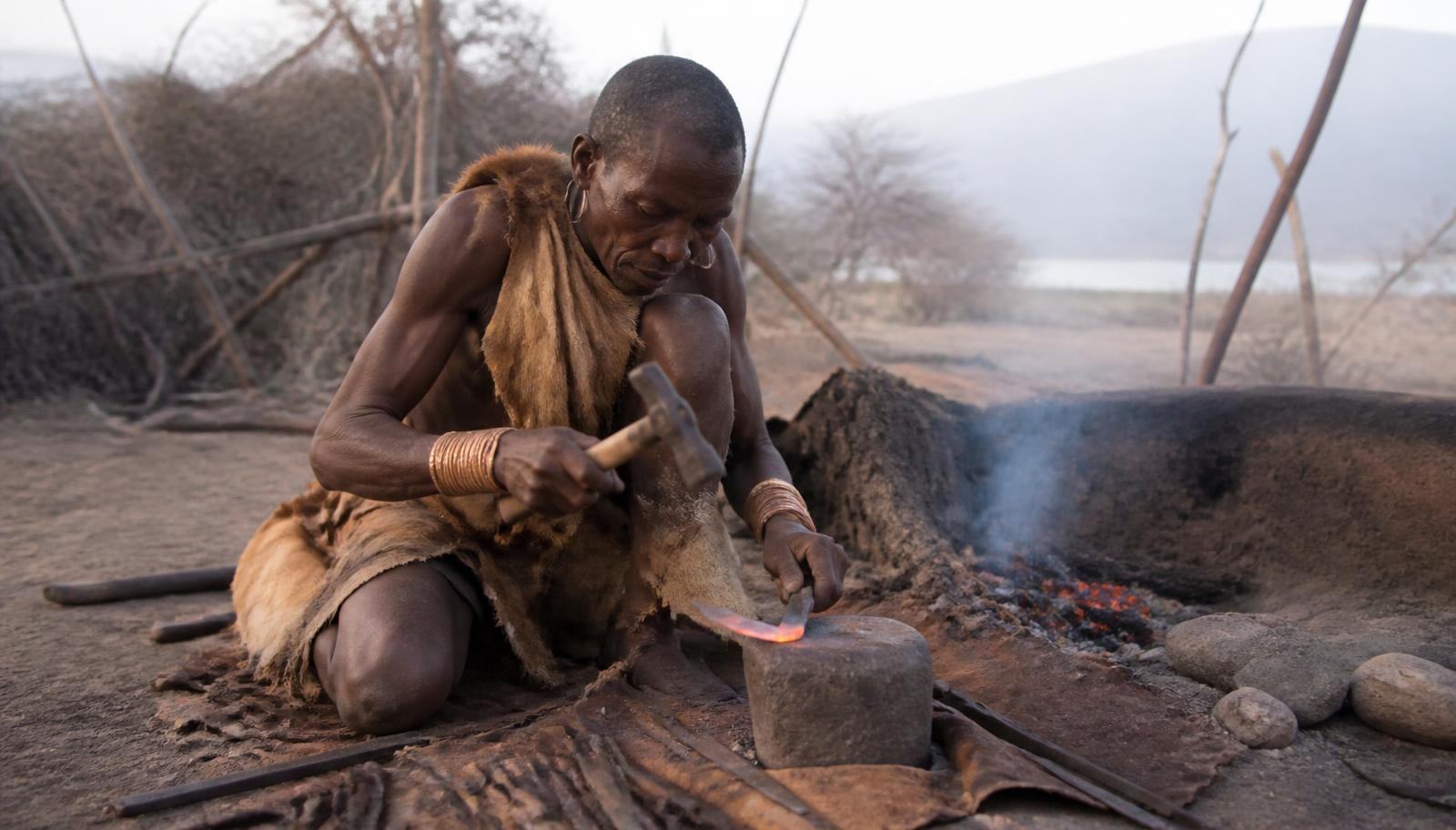
The first thing you hear at a Datoga homestead is not talking. It is the hammer. A flat, unhurried, slightly ringing sound that carries a surprising distance across dry country, and it usually starts before you are out of the vehicle. Follow it and you find a man sitting on the ground under a thorn tree with a stone at his knees, a charcoal fire beside him, and a boy working a pair of goatskin bellows that look older than both of them. He is turning a piece of truck suspension into an arrowhead. He has done it several thousand times.
I have been bringing guests into the Lake Eyasi basin for years, and the Datoga visit is the one that most often surprises people. Travelers arrive expecting a cultural stop and leave having watched a functioning workshop, a working cattle economy and a family negotiating the same problems as everyone else in rural Tanzania — school fees, rain that comes late, a grazing dispute with a neighbor. What they do not find, if the visit is arranged properly, is a show.
This guide is my attempt to give the Datoga the same treatment I would want given to my own family: accurate, unsentimental, and interested in the present as much as the past. It covers who the Datoga are, how they came to be where they are, what the blacksmithing tradition actually involves, what a homestead day looks like from before dawn until the fire goes out, and how to visit without turning a compound into a photo opportunity. There is also a fair amount of practical detail — costs, timings, dress, etiquette — because in my experience the difference between a good cultural visit and an awkward one is usually logistical rather than philosophical.
One note on names before we go further. You will see Datoga, Datooga and Tatoga used interchangeably; all are acceptable. Barabaig refers to the largest subgroup and is often used loosely for the whole people. You will also hear Mang'ati, an old term borrowed from Maa that carries a hostile edge — it means something close to "enemy." Guides still use it casually. I would not.
Who Are the Datoga?
The Datoga are a Nilotic-speaking pastoralist people whose territory sits across the highlands and dry plains of north-central Tanzania. Their closest linguistic relatives are not their immediate neighbors but the Kalenjin peoples of Kenya's Rift Valley, several hundred miles north — a clue to where they came from, and how long ago.
Population figures are slippery. The commonly cited range is 90,000 to 150,000, and the spread reflects a real problem: Datoga households are dispersed across five regions, frequently mobile, and not always captured cleanly in census categories. What is not in doubt is that they are one of Tanzania's smaller pastoralist groups, considerably fewer than the Maasai and far less visible internationally, despite living in the same landscape and facing many of the same pressures.
The people divide into a number of subgroups, each with its own dialect and territory. The Barabaig are the largest by a distance and are historically associated with the Hanang plains; you will also encounter Gisamjanga, Bajuta, Rotigenga, Bianjiida and others. The distinctions matter locally — they shape marriage, grazing rights and dialect — but a visitor to Eyasi will generally be meeting Barabaig or Gisamjanga families without the difference being remarked upon.
Two things define Datoga life in practice. The first is cattle. Herds are wealth, savings, bridewealth, insurance and social standing all at once, and almost every important decision in a household runs through the question of what the animals need. The second is metal. Datoga smiths supply arrowheads, blades, bells and ornament to a wide surrounding area, including to the Hadzabe hunter-gatherers who share the Eyasi basin with them. Very few pastoralist societies in East Africa kept household smithing alive through the twentieth century. The Datoga did, and the trade is still running.
History of the Datoga People
The long version of Datoga history begins somewhere in the southern Sudan and Ethiopian borderlands, with the slow southward drift of Nilotic-speaking herders down the Rift Valley. Linguists and archaeologists place Southern Nilotic speakers in the highlands of Kenya and northern Tanzania a good two thousand to three thousand years ago, which makes the Datoga among the earlier arrivals in the region — considerably earlier than the Maasai, whose expansion into northern Tanzania is a matter of the last few centuries.
For a long stretch, Datoga herders held large parts of the Serengeti plains, the Ngorongoro highlands and the Crater floor itself. Oral accounts from both Datoga and Maasai families agree on the broad outline of what happened next. Maasai expansion in the seventeenth and eighteenth centuries pushed the Datoga steadily south and west out of the best grazing. The conflict was real and long-running, and it is the source of the Maa word Mang'ati. By the nineteenth century, Datoga territory had contracted to the Eyasi basin, the Mbulu plateau, the Hanang plains and the country toward Singida.
The colonial period
German and then British administration treated the Datoga as difficult and peripheral. They had no paramount chief to negotiate with — authority sat with clan elders and councils — and a mobile, cattle-based economy was hard to tax and harder to control. Colonial policy leaned toward destocking schemes, boundary-drawing and the promotion of settled agriculture, none of which fitted how Datoga households actually made a living. Wildlife conservation boundaries drawn in the same era removed further grazing, a process that continued after independence.
Hanang and the wheat schemes
If you ask an older Barabaig man to name the turning point in his people's history, he will not say the Maasai wars. He will say Hanang. Beginning in the late 1960s and accelerating through the 1970s and 80s, a Canadian-funded state wheat program converted roughly 100,000 acres of the Basotu plains — prime Barabaig dry-season grazing — into mechanized wheat farms. Families were displaced with little consultation and minimal compensation. Sacred sites and the burial mounds of elders ended up inside plowed fields. The legal fight that followed ran for years in Tanzanian courts and became one of the better-documented indigenous land cases in East Africa.
The wheat scheme eventually faltered commercially, but the displacement did not reverse. Its legacy is the map you see today: Datoga households scattered farther south and west than their grandparents ranged, in drier country, on smaller holdings, and in closer contact — sometimes friction — with Hadzabe foragers, Iraqw cultivators and Sukuma herders who were already there.
Where the Datoga Live
Datoga country is not a single block on a map. It is a scatter of homesteads and grazing areas across five regions, thickest in Manyara and spreading into Arusha, Singida, Simiyu and Shinyanga. In practical terms, four clusters matter.
The Lake Eyasi basin is where nearly all visitors go. Homesteads sit on the escarpment slopes and the flats around Mang'ola, Barazani and the Eyasi shore, interleaved with Hadzabe camps and Iraqw onion farms. This is the accessible cluster: an hour and a half to three hours from Karatu depending on which compound and how the road has held up.
The Yaeda Valley, south and east of the lake, is drier, emptier and holds both Datoga herders and Hadzabe foragers under a set of village land-use agreements that have been carefully negotiated over the past fifteen years. Fewer visitors reach it, and those who do usually stay a night.
The Mbulu plateau and Hanang plains hold the historical Barabaig heartland, higher and cooler, with Mount Hanang rising to 11,214 feet above the old grazing lands. Tourism here is negligible; the visitors are climbers going up Hanang.
The western spread toward Singida, Meatu and Shinyanga reflects the last fifty years of displacement and drought movement. These communities are furthest from the safari circuit and least documented.
| Area | Character | Visitor access |
|---|---|---|
| Lake Eyasi & Mang'ola | Hot, dry, acacia and commiphora scrub at 3,300–4,600 ft; mixed Datoga, Hadzabe, Iraqw and Isanzu population | Easy. 1.5–3 hours from Karatu; the standard cultural extension on a northern circuit |
| Yaeda Valley | Remote grazing valley under community land-use agreements shared with Hadzabe | Moderate. Rough roads, best with an overnight; specialist operators only |
| Mbulu plateau & Hanang | Cooler highlands, historical Barabaig heartland, site of the wheat-scheme displacement | Limited. Almost no cultural tourism; some Mount Hanang trekking |
| Singida, Meatu & west | Dispersed households established through twentieth-century displacement and drought movement | Rare. No organized visitor programs |
Life Around Lake Eyasi
Lake Eyasi is a shallow, seasonal soda lake lying in a trough at the foot of the Ngorongoro highlands and the Eyasi escarpment. In a good wet season it spreads out silver and shallow and pulls in flamingos and pelicans; by October in a dry year, large parts of it are a cracked white pan you can walk across. The country around it is thorny, hot and demanding — and it supports one of the most culturally layered populations anywhere in Tanzania.
Within a radius of thirty miles you have four communities speaking languages from four different families. The Hadzabe speak a click isolate. The Datoga speak a Nilotic language. The Iraqw, who farm the escarpment slopes and grow the onions Mang'ola is known for, speak a Cushitic language. The Isanzu and Sukuma speak Bantu languages. There is almost nowhere else on earth with that density of linguistic difference in a single basin, and it is the reason anthropologists have been working here since the 1930s.
For a Datoga household, the basin's appeal is water and browse. Springs at Mang'ola run year-round, which is why irrigated onion farming took hold there; the surrounding bush carries enough grazing to hold cattle through the dry months if you are willing to walk them far. The constraint is that everyone else wants the same thing. Onion plots expand into grazing corridors. Cattle push into foraging grounds Hadzabe families depend on. Water points get crowded. None of this is dramatic on the day you visit, but it is the current running under every conversation about land in the basin.
Practically, the basin is hot. Plan on 85–95°F by midday from June through October, dropping sharply after dark. The tracks turn greasy and occasionally impassable in the long rains of March through May. The best window for a cultural extension is the same as for the rest of the northern circuit: June to October, with a secondary window in January and February.
Traditional Livelihood
Ask a Datoga man what he does and the answer will involve cattle before anything else, even if he spends more hours at a forge or in a maize field. Livestock is the organizing fact.
A household herd typically mixes zebu cattle with goats and sheep, and sometimes a donkey or two for water and transport. Cattle supply milk daily, blood occasionally, meat at ceremonies and slaughter, hides for bedding and clothing, and dung for plastering houses. More importantly, they function as a bank. Animals are the currency of bridewealth, the buffer against a failed harvest, the fund that pays school fees when it is sold at Mang'ola market, and the visible measure of a family's standing.
Herding labor falls largely to boys and young men, who take the animals out at first light and walk them to water and browse — a routine that can mean six or eight miles in a dry season. Women manage milking, milk processing, the compound, water, firewood, and increasingly the small fields.
That farming component has grown a lot in one generation. Maize, beans, sorghum and, near Mang'ola, onions now feature in most households I know. Very few Datoga families are purely pastoral anymore. Ask an older man about it and you will usually get a wry answer: nobody chose to farm, the grazing got smaller.
Craft income sits on top of both. A skilled smith earns from arrowheads and blades sold to Hadzabe and to neighboring farmers, and from bracelets and beadwork sold to visitors and at market. In households near the Eyasi road, tourism payments are now a meaningful, though rarely dominant, line in the family budget.
The Art of Blacksmithing
This is what the Datoga are known for, and it deserves more than the two-minute version most visitors get.
A working Datoga forge is astonishingly simple. There is a shallow pit of charcoal, a pair of bellows made from two goatskin bags with wooden handles and clay nozzles feeding air into the coals, a smooth hard stone serving as an anvil, a hammer — often itself shop-made — and a few chisels, punches and tongs. That is the whole workshop. It can be packed onto a donkey.
The raw material used to be smelted iron; today it is almost entirely scrap. Vehicle leaf springs are the prize, because the steel is hard and holds an edge, and a single spring yields many arrowheads. Old nails, worn hoes, reinforcing bar, cartridge cases and plumbing brass all get worked. The recycling here is complete and unsentimental.
How an arrowhead is made
Watching one made start to finish takes about fifteen to twenty-five minutes, and it is the single best thing about the visit. The boy on the bellows finds a rhythm; the coals go from dull red to a color that hurts to look at. The smith buries a short length of leaf spring in them, waits, pulls it out orange, and starts drawing it down on the stone — flattening, turning, flattening — with quick light blows rather than heavy ones. Back in the fire. Out again. The tang gets formed, then the blade, then the barbs are cut in with a chisel while the metal is still hot enough to move.
Then a decision. A small-game head is left plain. A head intended for larger animals gets barbs and a shallow groove behind them where the Adenium poison used by Hadzabe hunters is packed. Finally, the piece is quenched or simply left to cool in the dirt, and the edge is dressed on a stone. The whole thing is done without a measuring tool of any kind, and if you compare four heads made in a row they are nearly identical.
Traditional crafts overview
| Craft | Made from | Used by | Notes |
|---|---|---|---|
| Arrowheads | Vehicle leaf spring, old nails, scrap steel | Hadzabe hunters, Datoga households | The best-known Datoga product. Barbed heads for medium game, plain heads for small game, a groove behind the barb for poison. Traded for honey, meat, cash or maize. |
| Spear and knife blades | Leaf spring, scrap iron | Datoga herders, neighboring communities | Working tools rather than curios. A herder's knife gets used daily for hide work, bleeding cattle, castration and butchery. |
| Brass and copper bracelets | Melted cartridge cases, wire, plumbing scrap | Datoga women mainly; also sold to visitors | Coiled in tight stacks up the forearm. Weight and number signal household standing and marital status more than fashion. |
| Cattle and goat bells | Sheet scrap, hand-cut and folded | Every herding household | Tuned by ear so a herder can identify individual animals by sound at night or in thick bush. Deeply practical, not decorative. |
| Beadwork and leather | Glass trade beads, cow and goat hide, brass | Women and girls | Beaded leather skirts, collars, ear ornaments and belts. Patterns and colors carry meaning about age, marriage and clan. |
| Hoes and small farm tools | Heavy scrap plate | Datoga and Iraqw farming households | A growing share of the forge's output as more Datoga families cultivate maize alongside herding. |
Smithing is hereditary and, historically, socially complicated. In several Datoga clans smiths occupied an ambiguous position: indispensable, because everyone needed blades and bells, but slightly set apart, with restrictions on intermarriage between smithing and non-smithing families in some communities. Anthropologists have recorded similar patterns across Nilotic and Cushitic societies in the Horn and East Africa. How strongly it holds today varies household by household, and it is not something to raise casually with a family hosting you.
Family Structure
Datoga society is patrilineal and clan-based. Descent, inheritance and grazing rights run through the father's line, and clan identity — the bynda — governs who you may marry, who you can call on in a crisis, and who is obliged to help when cattle are lost.
A homestead, or gheda, is a fenced compound of thorn brush enclosing a livestock pen at the center and low mud-and-dung houses arranged around it. The houses are darker and lower than they look from outside, deliberately so — cool by day, defensible at night, easy to warm. Wealthy men are polygynous, and each wife has her own house, her own cooking fire, her own allocated animals and considerable autonomy over her section of the compound. First wives generally hold seniority in day-to-day decisions among the women.
Age structures respect more formally than in many neighboring societies without producing the highly organized age-set system you find among the Maasai. Elders — men who have raised families and accumulated standing — settle disputes in councils, often over home-brewed beer, and their rulings carry weight because the alternative is escalation between clans. Women have their own parallel authority, which outsiders consistently underestimate: senior women mediate marital and household disputes and can impose social sanctions that a man's council will not overturn.
Marriage is negotiated between families and settled in cattle, sometimes over several years, with the transfer creating an ongoing relationship rather than closing a transaction. The bride moves to her husband's compound, receives her own house, and is expected to build her own herd from allocated animals and gifts over time.
Children work early. Boys begin with goats around age six or seven and graduate to cattle; girls take on water, firewood, younger siblings and milking. This is one of the tensions in Datoga life right now — every child at school is a child not herding, and households make that arithmetic explicitly.
Clothing and Jewelry
Datoga dress is the most visually distinctive thing about them after the forge, and it is worth understanding rather than just photographing.
Women wear leather dresses and skirts made from tanned cow or goat hide, heavily worked with glass beadwork in dense geometric patterning — reds, blues, whites and yellows in bands and blocks. Over that go the metals: coiled brass and copper bracelets stacked up the forearms, sometimes a dozen or more, along with beaded collars, ear ornaments and belts. The brass is usually made in the household's own forge or a neighbor's, which is part of why the smithing tradition survived.
This is not costume and it is not put on for visitors. Quantity and weight of metalwork track a woman's marital status, her household's standing and how long she has been married, and adding to the stack is a lifetime project. Younger women in market towns increasingly mix traditional beadwork with kanga cloth and imported clothing, which is exactly what you would expect and not a sign of anything being lost.
Men dress more plainly — a cloth wrap or shuka, occasionally a hide cape for older men, usually with a knife at the belt and a herding stick or spear in hand. Some older men carry facial scarification, often a set of small marks around the eyes and cheeks, associated with initiation in certain subgroups. It is much less common in younger men.
Food and Daily Life
The Datoga diet is built on milk, maize and, less often than outsiders assume, meat.
Fresh and soured milk is the staple, drunk plain and used in cooking; gourds are smoked with a burning stick before filling, which both sterilizes them and gives the milk a distinct taste that takes some getting used to. Ugali — stiff maize porridge — has become the daily carbohydrate for nearly every household, cooked in the evening and eaten with milk, beans or a vegetable relish. Blood, tapped from a living animal and mixed with milk, features occasionally, mainly in dry periods or for someone recovering from illness or childbirth. Meat is a ceremonial and occasional food, not a daily one; killing a productive animal for dinner makes no economic sense.
Home-brewed beer, usually from maize or honey, matters socially more than nutritionally. It accompanies elder councils, dispute resolution and celebrations, and being offered some is a real courtesy.
| Time | Activity | What it looks like |
|---|---|---|
| Before sunrise | Milking and stock check | Women and older girls milk into gourds while boys count the herd and look over any animal that limped in the night before. This happens in near silence and in the dark. |
| 6:30–8:00am | Herds move out | Boys and young men walk the cattle and small stock toward water and grazing, sometimes several miles. In a dry year they leave earlier and come back later. |
| 8:00–11:00am | Compound work and the forge | Houses are swept and re-plastered, hides scraped, maize pounded, water fetched. If there is smithing to do, this is when the charcoal fire gets going, while the air is still cool. |
| 11:00am–3:00pm | Shade, food, repair | The hottest part of the day is spent low: mending fences and tools, beadwork, sleeping children, visitors received, long conversations about grazing and rain. |
| 3:00–6:00pm | Herds return, second milking | Animals come back to the thorn enclosure, calves are reunited with mothers, and the evening milking begins. The compound is at its busiest and loudest. |
| After dark | Fire, food, talk | Ugali, milk, sometimes meat. Elders talk, children listen, and much of what passes for Datoga history and law moves from one generation to the next in exactly this setting. |
The rhythm above is why I push guests toward a mid-morning visit. Arrive at seven and the compound is empty of animals and full of people trying to finish work. Arrive at four and you collide with the return of the herds, which is fascinating but chaotic and not a time anyone wants to sit and talk. Between nine and noon, the household has room for you.
Language and Oral Traditions
Datooga belongs to the Southern Nilotic branch, sharing an ancestor with the Kalenjin languages of Kenya — Nandi, Kipsigis, Pokot and the rest. Dialects track the subgroups: Barabaig speech differs noticeably from Gisamjanga, though speakers understand each other without difficulty. Estimates put fluent speakers somewhere around 90,000 to 130,000.
By the standards of small East African languages, Datooga is in reasonable health. Children learn it first at home and use it in the compound; Kiswahili comes with school, market and the wider world. Nearly all men and a growing majority of women are bilingual. English is rare outside guides and a few young people who have gone through secondary school.
Worth clearing up: Datooga has no relationship to Hadzane, the click language of the Hadzabe who live next door — none whatsoever, they belong to entirely different linguistic worlds — and only a distant one to Maa, which is Eastern Nilotic. Neighbors are not relatives.
Almost everything Datoga know about themselves travels orally. Clan genealogies, migration accounts, grazing agreements and the details of who owes whom cattle from a marriage settled thirty years ago are all held in memory and recited by elders. Songs carry a surprising amount of this load — praise songs for cattle, funeral songs at a bung'eda, work songs, and satirical songs that function as social correction, since being mocked in a song that spreads is a genuine sanction. There is a small but growing written literature in Datooga, largely from missionary and academic transcription work.
Ceremonies and Cultural Practices
Religious life centers on Aseeta, a creator associated with the sun, and on the ancestors, who remain involved in the affairs of the living and are addressed at graves and in blessing rituals. Christianity and, to a lesser extent, Islam have made inroads, and many households hold both frames at once without any apparent difficulty.
The major ceremonies are listed below. A visitor will almost certainly not witness any of them, and should not expect to — these are family and clan events, not scheduled attractions. If you happen to arrive during one, the correct response is to leave and come back another day unless you are specifically invited.
| Ceremony | Occasion | What happens |
|---|---|---|
| Bung'eda | Funeral of a respected elder man | The most significant Datoga ceremony. A large earth mound is raised over the grave, and relatives gather over weeks or months for singing, cattle slaughter and speeches. The mound is later planted and becomes a marked place in the landscape. |
| Gitabaraku | Birth and naming | Naming follows clan lines and circumstance — a child may carry a name tied to the season, the place of birth or an event in the herd. Female relatives lead the ritual and the mother is secluded and fed richly for a period afterward. |
| Initiation and age transition | Adolescence into adulthood | Boys move into the responsibilities of herding and, later, marriage negotiation, with facial scarification traditionally marking the transition in some subgroups. Practices vary widely between clans and have changed considerably in recent decades. |
| Marriage and bridewealth | Union of two families | Negotiated between clans and settled in cattle, sometimes over years. Weddings involve extended singing, gift exchange, and the bride's move to her husband's compound where she is given her own house. |
| Rain and blessing ceremonies | Drought, disease, misfortune | Elders gather to petition Aseeta and the ancestors, often with an animal sacrifice and the ritual sharing of milk or beer. These are practical events tied to the state of the pasture, not calendar festivals. |
| Gadyeda beer gatherings | Dispute settlement and community decisions | Home-brewed maize or honey beer accompanies elder councils where grazing conflicts, fines and family matters are argued out and resolved. Consensus matters more than authority. |
The bung'eda deserves a note of its own. When a senior man dies, the funeral is not an afternoon but a process — sometimes stretching across many months — in which relatives arrive in waves, cattle are slaughtered and eaten, songs are sung, and earth is carried and piled until a substantial mound stands over the grave. Its size reflects the man's standing and the number of people who came. Those mounds are legal and emotional facts on the landscape, which is precisely why the plowing of grave sites during the Hanang wheat displacement is remembered as a desecration rather than an inconvenience.
Relationship With Neighboring Communities
No account of the Datoga makes sense without their neighbors, because the Eyasi basin runs on exchange between very different economies.
The Hadzabe
The Datoga–Hadzabe relationship is the most interesting and the most misrepresented. The trade is old and mutually useful: Datoga smiths supply arrowheads and knife blades; Hadzabe hunters supply honey, meat, game skins and, increasingly, cash from tourism. I have watched that exchange happen a dozen times, and it is entirely ordinary — two men negotiating in Kiswahili over a handful of metal.
At the same time, Datoga cattle are one of the real pressures on Hadzabe foraging land. Herds strip understory, empty water sources and displace the small game Hadzabe hunters rely on, and expanding Datoga settlement in the Yaeda area has been documented as a major factor in Hadzabe territorial loss. Both things are true simultaneously: partners in trade, competitors for land. Any guide who gives you a simpler story than that is simplifying.
Iraqw, Maasai, Isanzu and Sukuma
The Iraqw are Cushitic-speaking farmers on the escarpment and around Karatu, and the relationship is largely economic — grain and onions moving one way, livestock products and metal tools the other, with periodic friction where fields meet grazing corridors. The Maasai relationship carries historical weight from centuries of competition, but today it is mostly unremarkable coexistence, with intermarriage in some areas. Isanzu and Sukuma communities to the west and south trade cattle and share markets, and Sukuma herd expansion is now a competing pressure on the same rangeland.
What ties all of them together, practically, is market day. At Mang'ola or Endamaghan you will see Datoga women in full beadwork, Iraqw farmers with sacks of onions, Hadzabe men selling honey, Sukuma traders and Maasai herders, all doing business in Kiswahili. If you can time your Eyasi extension to include one, do it — it is the most honest cultural experience in the basin and nobody is hosting anybody.
Modern Challenges and Change
The pressures on Datoga households today are concrete, and worth understanding before you visit, because they shape what you will see.
- Land. The Hanang displacement removed the best dry-season grazing two generations ago and nothing replaced it. Ongoing expansion of cultivation, conservation boundaries and village land allocations continues to shrink the range available for mobile herding.
- Drought and herd loss. Rainfall in the Eyasi basin has become less reliable, and a bad year can cost a family a third of its animals. Restocking after that takes years, and some households never recover — which is the main pathway into farming and wage labor.
- Water competition. Irrigated onion farming around Mang'ola draws heavily on the springs that also water livestock, and the arithmetic of who gets what is a live local dispute.
- Education access. Dispersed homesteads and mobile herding fit badly with fixed schools. Enrollment has improved substantially, girls' attendance less so, and boarding remains difficult to afford for most families.
- Health services. Clinics are distant, maternal healthcare is thin, and a serious injury at a remote homestead is a genuinely dangerous situation.
- Market dependence. As cash becomes necessary for school fees, medicine and food, families are more exposed to livestock price swings and to whatever tourism does in a given year — as everyone in this region learned in 2020.
- Cultural change. Younger Datoga move to Karatu, Arusha and Mwanza for work, wear different clothes and marry later. Some see this as loss; most families I speak with see it as an adjustment they are managing on their own terms.
Set against that, there are real bright spots. Village land-use planning in the Yaeda area has given both Datoga and Hadzabe communities formal recognition of grazing and foraging areas. Livestock markets have improved. Community-based tourism, where it is structured properly, is now one of the few sources of cash that does not require selling an animal.
Responsible Cultural Tourism
I will be direct, because this section is the one that matters. A large share of Datoga visits sold on the northern circuit are not good. The standard bad version runs like this: a vehicle pulls into a roadside compound at 2pm, guests are met with a dance nobody arranged in advance, the smith bangs a piece of metal for four minutes, everyone photographs the women's bracelets, a mat of souvenirs comes out, and the group is back on the road inside forty minutes. The fee went to a broker in Mang'ola. The family got a share.
The good version is not exotic or expensive — it just requires that a few conditions hold.
- The household agreed in advance and can decline. A family that is hosting because they chose to that morning behaves completely differently from one that had a vehicle appear.
- Payment is transparent and lands in the compound. Ask your operator to tell you the number and who receives it. Vagueness here is the single clearest warning sign.
- Nothing is staged. The forge should be working because there is work, the milking should happen because it is milking time. If a dance is arranged, it should be described as what it is — a paid performance — not presented as spontaneous tradition.
- Photography is permission-based, every time. Not a blanket fee that buys unlimited access to people's faces.
- There is a real translator. Someone who can carry a two-way conversation, not just narrate at you in English while the family waits.
- Purchases go direct. Buying from the maker is the cleanest money in the entire transaction.
Is it ethical at all? I think so, on those terms, and the Datoga families we work with treat hosting as ordinary paid work — closer to running a small business than to being observed. There is very little wage employment in the Eyasi basin. Cultural tourism, structured honestly, is one of the few ways cash enters a homestead without an animal leaving it. What is not defensible is the extractive version, and the difference between the two is decided at booking, not on the day. The same principles apply everywhere in Tanzania; our safari etiquette guide covers the broader ground.
Visiting a Datoga Village
Here is how it actually works, logistically.
Most people come from Karatu, which sits between the Ngorongoro gate and Lake Manyara and is the natural base for a Lake Eyasi extension. The drive down the escarpment to the Mang'ola area takes ninety minutes to three hours depending on the compound and the state of the road. In the long rains it can take longer or become impossible. Some travelers instead overnight at a camp near Eyasi, which I recommend if you are also doing the Hadzabe, because it removes a punishing pre-dawn start.
Cost for a homestead visit is generally $25 to $50 per person, on top of vehicle, guide and fuel. A combined Datoga and Hadzabe day out of Karatu, including both community fees, a guide and a vehicle, typically lands in the $200 to $350 range for a small group. Pay in cash, in shillings where possible.
| Format | Length | What happens | Suits you if |
|---|---|---|---|
| Homestead and forge visit | 1.5–2 hours | You are received at the compound, walk through the houses and livestock enclosure, sit at the forge while a piece is worked from start to finish, and buy directly from the maker. | Almost everyone; the standard and, done well, genuinely worthwhile format |
| Datoga plus Hadzabe full day | 6–8 hours | Dawn foraging walk with Hadzabe, then a Datoga homestead late morning. The arrowhead you watch being forged is the one you saw on a bowstring at sunrise. | Travelers with a spare day who want the region's economy to make sense |
| Half day with a women's beadwork session | 3–4 hours | Slower time in the compound: hide preparation, beadwork, cooking, milking. Fewer photographs, more conversation, usually with a female translator. | Repeat visitors, writers, photographers, anyone tired of the standard circuit |
| Overnight near Lake Eyasi | 1–2 nights | Basing at a camp near Mang'ola instead of day-tripping from Karatu, which removes the 4am start and lets both community visits happen at sensible hours. | Anyone serious about the Eyasi extension; strongly recommended |
| Market day at Mang'ola or Endamaghan | 2–3 hours | A working livestock and goods market where Datoga, Iraqw, Isanzu and Hadzabe all trade. No admission, no hosting, no performance — just the region doing business. | Independent-minded travelers; check the day of the week with your guide first |
What to bring: water, a hat, sun protection, closed shoes, cash in small denominations for crafts, and a genuine list of questions. What to leave behind: drone, strong perfume, sweets for children, and any expectation of a schedule. If it is your first trip to Tanzania, our first-timer's guide covers the wider practicalities.
Children travel well here. Unlike a Hadzabe hunt, there is no long walk and nothing distressing, and Datoga kids are usually around and curious. Younger visitors tend to remember the bellows and the sparks far longer than anything they see on a game drive.
Photography & Visitor Etiquette
Datoga homesteads photograph beautifully, which is exactly the problem. The brass, the beadwork, the sparks off the anvil — it is all very easy to consume through a viewfinder and walk away having said almost nothing to anyone.
My rule for guests is simple: for the first twenty minutes, keep the camera in the bag. Sit down, get introduced, ask a few questions, let people register you as a person. The photographs you take afterward will be better anyway, because the family will have relaxed and you will know what is worth photographing.
| Situation | What to do |
|---|---|
| Arriving at the compound | Wait to be invited in. Greet the senior man and senior woman present, in that order, and let your guide handle introductions before you start moving around. |
| Photographing people | Ask every time, through your translator, and accept no. Women are asked constantly and refuse more often than men. Never photograph inside a house without explicit permission. |
| The livestock enclosure | Do not walk into it uninvited, do not count the cattle out loud, and do not ask how many animals the family owns. Herd size is wealth and asking is like asking a stranger their salary. |
| At the forge | Sit where you are shown and stay clear of the bellows operator's arc. Do not touch tools or hot metal. If you want to try the bellows, ask — it is often welcomed. |
| Buying crafts | Pay near the asking price. Hard bargaining over a two-dollar bracelet reads badly in a compound where your vehicle costs more than the herd. |
| Gifts | No sweets, no alcohol, no cash to children. If you want to give something beyond payment, ask your guide what the household actually needs — often it is something dull like a jerrycan or school fees. |
| Questions | Ask about the present as well as the past. Rain, grazing, school, the price of a goat at Mang'ola. Treating people as contemporaries changes the whole tone of a visit. |
A few technical notes for photographers. The forge is a high-contrast subject — bright coals against deep shade — so expose for the metal and let the background go dark rather than the other way around. Mid-morning side light through the compound entrance is the best light of the day. Avoid flash entirely; it is intrusive, it ruins the fire's color, and it startles livestock. And if you promise to send prints, actually send them. Our guides carry them back on later trips, and the number of visitors who promise versus the number who deliver is a running joke in some of these compounds.
Datoga Culture Fact Box
| Name | Datoga (also Datooga, Tatoga). Barabaig is the largest subgroup and often used for the whole people. Mang'ati is an older exonym from Maa, now considered impolite. |
|---|---|
| Population | Roughly 90,000–150,000, depending on the survey; no precise recent census figure |
| Language | Datooga — Southern Nilotic, related to the Kalenjin languages of Kenya; several dialects by subgroup |
| Homeland | Lake Eyasi basin, Yaeda Valley, Mbulu plateau, Hanang plains, extending west toward Singida and Meatu |
| Regions | Manyara, Arusha, Singida, Simiyu and Shinyanga regions of north-central Tanzania |
| Economy | Cattle, goats and sheep first; small-scale maize and beans; blacksmithing, beadwork and craft sales |
| Social structure | Patrilineal clans (bynda), age-based respect, councils of elders, polygynous households in fenced compounds |
| Housing | Low rectangular or oval mud-and-dung houses inside a thorn-fenced compound (gheda) with a central livestock enclosure |
| Religion | Aseeta, a creator associated with the sun, alongside strong ancestor veneration; some Christian and Muslim adherence |
| Best-known craft | Household blacksmithing — arrowheads, spear tips, knives, bracelets, bells and beads worked from scrap metal |
| Neighbors | Hadzabe foragers, Iraqw and Isanzu farmers, Maasai and Sukuma pastoralists, Nyaturu to the south |
| Access from Karatu | About 1.5–3 hours by road to the Eyasi-area homesteads, depending on the cluster and the season |
Responsible Visitor Guidelines
If you take nothing else from this article, take these eight. They are the difference between a visit a family is glad happened and one they tolerate.
- Book through an operator who can name the homestead and explain the payment.
- Come mid-morning and let the household set the pace.
- Greet the senior man and senior woman before you look around.
- Ask permission for every photograph and accept a refusal without pushing.
- Never ask about herd size or count cattle out loud.
- Buy crafts directly from the maker and pay near the asking price.
- Bring no sweets, alcohol or cash handouts to children.
- Ask about today — rain, grazing, school — not only about tradition.
Frequently Asked Questions
Common Questions
Frequently Asked Questions
The Datoga — also spelled Datooga, and known locally as Barabaig after their largest subgroup, or by the older Kiswahili term Mang'ati — are a Nilotic pastoralist people of north-central Tanzania. They number somewhere around 90,000 to 150,000 depending on which count you trust, and they live in scattered homesteads across the Lake Eyasi basin, the Yaeda Valley, the Mbulu and Hanang highlands and the plains around Singida and Manyara. Cattle sit at the center of their economy and their sense of standing, but they are also the best-known metalworkers in the region — the smiths who forge the arrowheads their Hadzabe neighbors hunt with. They speak Datooga, a Southern Nilotic language related to Kalenjin, and most people you meet will also speak Kiswahili.
Their heartland runs from the southern and eastern shores of Lake Eyasi down through the Yaeda Valley to the Mbulu plateau and the country around Mount Hanang, spreading west toward Singida and Meatu. The clusters visitors normally reach sit within an hour or two of Karatu — homesteads on the Eyasi escarpment road and around Mang'ola, close enough to fold into a northern-circuit itinerary alongside Ngorongoro and Lake Manyara. Datoga families also move: grazing pressure and drought have pushed households south and west over the last fifty years, and some now herd in areas their grandparents never used.
Because they are among the very few communities in northern Tanzania who kept working metal at the household level after imported goods arrived, and because their neighbors depend on the output. A Datoga smith works with a stone anvil, a simple hammer, goatskin bellows and a charcoal fire, and his raw material today is mostly scrap — vehicle leaf springs, old nails, worn-out tools. From that he makes arrowheads, spear tips, knife blades, bracelets, cattle bells and beads. The craft is hereditary and traditionally carried some social ambivalence: smiths were essential yet held slightly apart, and in some clans marriage between smithing and non-smithing families was discouraged. What you see at a forge is not a demonstration invented for tourists. Hadzabe hunters have been trading meat, honey and cash for Datoga arrowheads for generations, and that trade is still running.
Yes. Homestead visits around Lake Eyasi and Mang'ola are established, legal and normally arranged through a licensed operator or a district cultural tourism program. A typical visit lasts one to two hours: you are received at the compound, shown the houses and the livestock enclosure, spend time at the forge watching a piece being made, and usually have a chance to buy jewelry and tools directly. Cost runs roughly $25 to $50 per person plus vehicle and guide. The quality gap between operators is wide — a rushed forty-minute stop where you are steered from a dance to a souvenir mat is a very different thing from a visit where the family sets the pace and your guide can actually translate a conversation.
It can be, and the test is the same one you would apply anywhere. Does the household agree to the visit in advance and keep the right to say no? Is the payment clear, and does the bulk of it reach the compound rather than a broker in Mang'ola? Is anything being staged that would not otherwise happen that morning? Is photography permission-based? Where those conditions hold, cultural tourism is one of the few cash sources in an area with almost no wage employment, and Datoga families I know treat it as ordinary work rather than an intrusion. Where they do not hold, you end up funding a performance and calling it culture. Ask your operator the specific questions before you book, not after.
Datooga, a Southern Nilotic language in the same branch as Kalenjin languages spoken in Kenya, with several dialects tracking the major subgroups — Barabaig, Gisamjanga, Bajuta, Rotigenga and others. It is a healthy language by regional standards, with children still learning it at home, and it is unrelated to Hadzane, the click isolate spoken by their Hadzabe neighbors, and only distantly related to Maa, spoken by the Maasai. Most Datoga men and a growing number of women also speak Kiswahili, which is how nearly all visitor conversations happen. English is rare in the homesteads, so a good translator matters.
Practical and modest. Long pants or a long skirt, covered shoulders, closed shoes you do not mind getting dusty. You will be walking through a livestock compound and sitting on the ground near an open forge fire, so leave anything delicate in the vehicle. Skip strong perfume around the animals, bring a hat and water, and avoid safari-costume extremes — in a working homestead the effect is odd rather than respectful. If you are visiting between November and April, add a rain shell; the Eyasi tracks turn quickly.
Yes, and it is by far the best way to do both. The standard format is a single long day out of Karatu or, better, from a camp near Eyasi: out with Hadzabe hunters at first light, back to camp for a foraging walk and craft time, then a Datoga homestead late morning or early afternoon. The two visits explain each other. You watch the smith hammer a leaf spring into an arrowhead, and you have already seen the same arrowhead on a bowstring at sunrise. It also gives you the honest version of the region's tension — Datoga herds are one of the pressures on Hadzabe foraging land, and hearing both communities describe that in their own words is worth more than either visit alone.
Conclusion
The Datoga are easy to reduce to a single image — the brass bracelets, the smoke, the hammer coming down on a stone anvil — and that image, while accurate, leaves out almost everything that matters. What you are looking at in an Eyasi homestead is a cattle-keeping people who have been squeezed off the Barabaig plains at Hanang, pushed into drier country, and who have kept a metalworking tradition alive largely because their neighbors still need the tools. The jewelry is not costume. The forge is not a demonstration. Both are what a household does on an ordinary Tuesday. Go in the middle of the morning, sit down, ask about cattle and rain and grandchildren before you ask about tradition, buy something from the person who made it, and you will leave with a far better understanding of northern Tanzania than any game drive can give you.
The Datoga are not a footnote to the Hadzabe, and they are not a lesser version of the Maasai. They are a people who lost their best land inside living memory, kept their cattle and their craft, and continue to supply the tools their neighbors use. Visit them properly and you will understand the Lake Eyasi basin — arguably the most culturally complex corner of Tanzania — in a way that no amount of time in a game-viewing vehicle can give you.
Plan a Lake Eyasi Extension With Olympus Adventure
Olympus Adventure is a Tanzanian-owned safari company based in Arusha. We work with specific Datoga homesteads in the Eyasi area rather than with whichever compound a broker points us toward on the morning, and we can tell you which family you will meet, what they are paid, and what happens if they would rather not host that day.
The version we recommend is a full Eyasi day, ideally with a night near Mang'ola. You walk out with Hadzabe hunters at first light, come back for foraging and craft time, then spend the late morning at a Datoga homestead watching an arrowhead made from start to finish and buying straight from the smith. The two visits explain each other, and by the afternoon the basin's economy — trade, competition, adaptation — makes sense in a way no briefing achieves.
It fits neatly into a northern circuit, usually alongside Lake Manyara and Ngorongoro, and pairs well with a Maasai community visit for a fuller picture of how differently people live within a hundred miles of each other. If you are still working out the shape of the trip, start with how to book a Tanzania safari.
Send us your dates, your group size and the ages of any children, and we will propose a specific format, a specific community, and an honest account of where your money goes. If we think the day is not right for your group, we will tell you.
Keep Reading
More Tanzania Culture Guides
Culture
The Maasai Tribe in Tanzania: History, Culture, Traditions & Responsible Tourism
Culture
The Hadzabe Tribe in Tanzania: Culture, Traditions & Responsible Travel
Culture
Tanzania Safari Etiquette: Essential Do's and Don'ts for First-Time Visitors
Safari Guides
The Ultimate Tanzania Travel Guide: Everything You Need to Know Before You Visit
Kilimanjaro
Mount Kilimanjaro Climbing Guide: Everything You Need Before Your Adventure
Zanzibar
Zanzibar Travel Guide: Everything You Need Before Visiting the Island
Plan Your Journey
Add a respectful Datoga cultural day to your Tanzania safari
We work directly with Datoga homesteads near Lake Eyasi — real forge time, fair fees paid to the families who host you, and the option to pair it with a Hadzabe morning. Tell us your dates and we'll build it into your northern circuit.
- TALA Licensed Operator
- 4.9 ★ Guest Rating
- No Booking Fees