Tanzania Safari Guide
Mahale Mountains National Park Guide: Chimpanzee Trekking, Lake Tanganyika and Whether It Is Worth the Trip
A practical look at western Tanzania's forest-and-lake park — what trekking for wild chimpanzees actually involves, when to go, how many nights to give it, and who should plan something else instead.

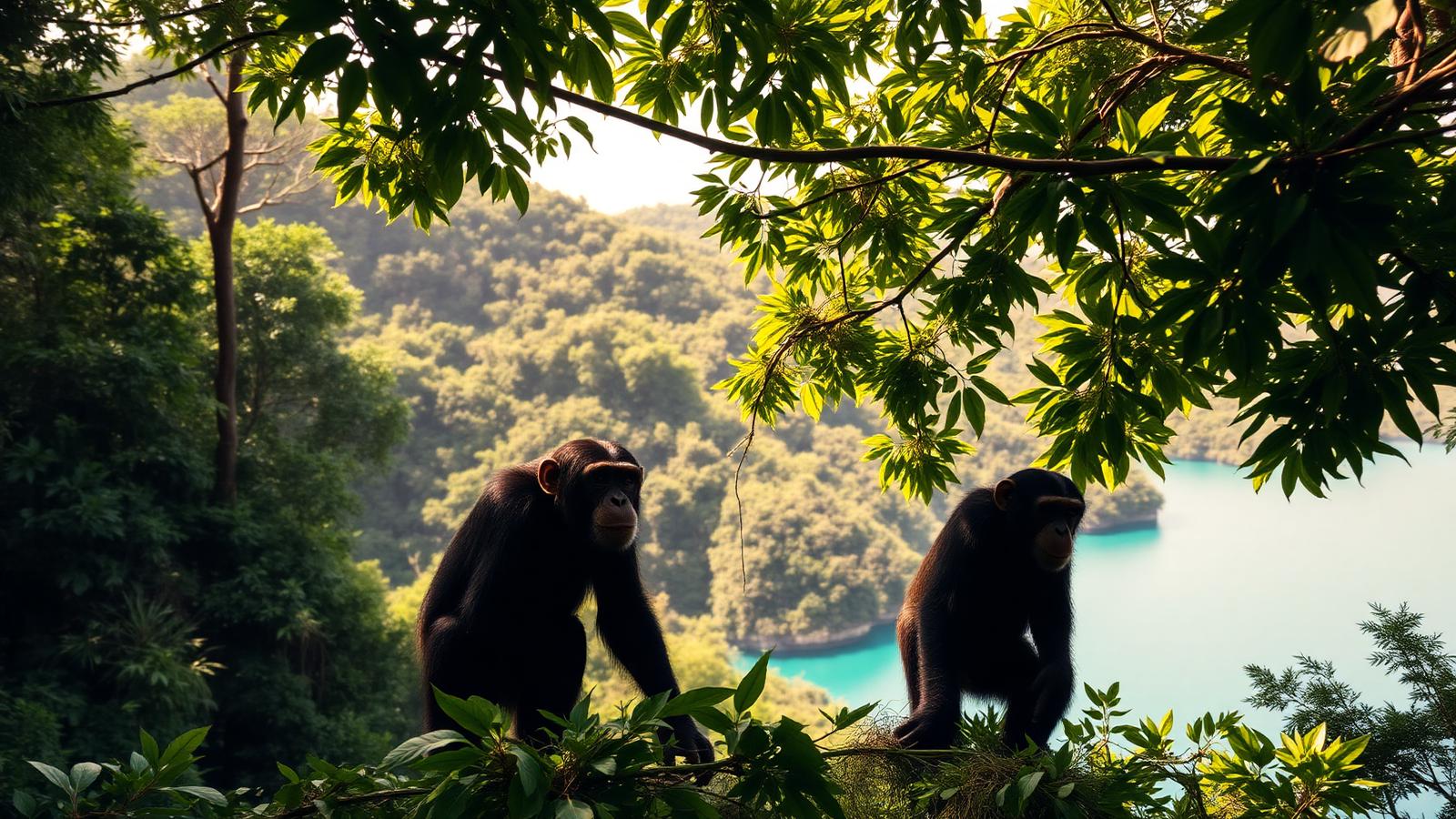
Mahale Mountains National Park sits on the eastern shore of Lake Tanganyika, in a part of western Tanzania with no road access and very little infrastructure. Forested mountains drop straight into clear water, camps are reached by boat, and the main reason people travel there is to walk into that forest and look for wild chimpanzees.
This guide covers what the park is genuinely like to visit: how trekking works and what it asks of you, what else there is to do on the lake and in the hills, how the seasons change the experience, what the logistics involve, and how Mahale compares with Gombe and Katavi. For the wider planning picture, our worked itineraries and the complete Tanzania travel guide explain how a western leg fits into a full trip.
The Short Answer
Go to Mahale if watching wild chimpanzees in their own forest is something you would organize a trip around, and if you have the days and the budget to reach a park served by a small number of scheduled flights. The combination of rainforest, mountain and lake is unlike anywhere else in Tanzania, and the time you spend by the water between treks is part of the appeal rather than filler.
Choose somewhere else if your trip is short, if this is a first safari built around big game, or if you need flexible travel dates. Mahale is a commitment: two travel days at the edges, limited camp choice, and an outcome that depends on where wild animals happen to be. Those trade-offs suit some travelers very well and suit others badly, and it is worth being honest about which you are.
Where Is Mahale Mountains National Park?
The park lies in western Tanzania, south of Kigoma, along a stretch of Lake Tanganyika shoreline backed by the Mahale range. The mountains run roughly parallel to the lake and climb steeply behind the beaches, so the walk from water level into forest starts gaining height almost immediately. Nkungwe, the highest peak, stands well above 2,000 meters.
There is no road into the park and no through traffic. Camps sit on the shoreline, boats move between them, and everything arrives by air or water. That is the practical reason the park feels so quiet: getting there is deliberate, and nobody passes through Mahale on the way to somewhere else.
Geographically this is a meeting point. Lowland forest species associated with the Congo Basin overlap with drier miombo woodland species from the east, and the lake adds an aquatic world of its own. That overlap is part of why the forest feels so layered compared with the savanna parks most visitors know from the Serengeti.
What Makes Mahale Different?
Most Tanzania safaris are built around open country, vehicles and long sightlines. Mahale reverses all of that. You walk, you see very little at a distance, and the animal you have come for lives in the canopy and on the forest floor rather than on a plain. It changes the rhythm of a day and the way you pay attention.
- On foot, not in a vehicle. There are no game drives. Time in the field means walking on steep, uneven ground with a guide setting the pace.
- A single headline species. Chimpanzees are the reason people come. Everything else is a bonus rather than a substitute.
- A lake that is genuinely usable. Between treks you can be on or in the water, which is unusual for a Tanzanian park.
- Very few people. Camp numbers are small and treks are limited, so the forest rarely feels crowded.
- An outcome you do not control. Trackers work hard, but the animals move where the food is. Some days are extraordinary; some are a long walk.
Lake Tanganyika
Lake Tanganyika is one of the world's great freshwater lakes — extremely deep, very old, and biologically distinctive, with a large number of fish species found nowhere else. Along the Mahale shore the water is usually clear, warm and calm in the mornings, and the mountains behind it make for a setting that most visitors remember as strongly as the forest.
Practically, the lake does three things for a stay. It provides the transport corridor between the airstrip and camps. It gives you something restorative to do on the afternoons after a hard walk. And it changes the texture of the trip: a safari where you swim, snorkel or paddle between activities feels different from one spent entirely in a vehicle.
Chimpanzee Trekking
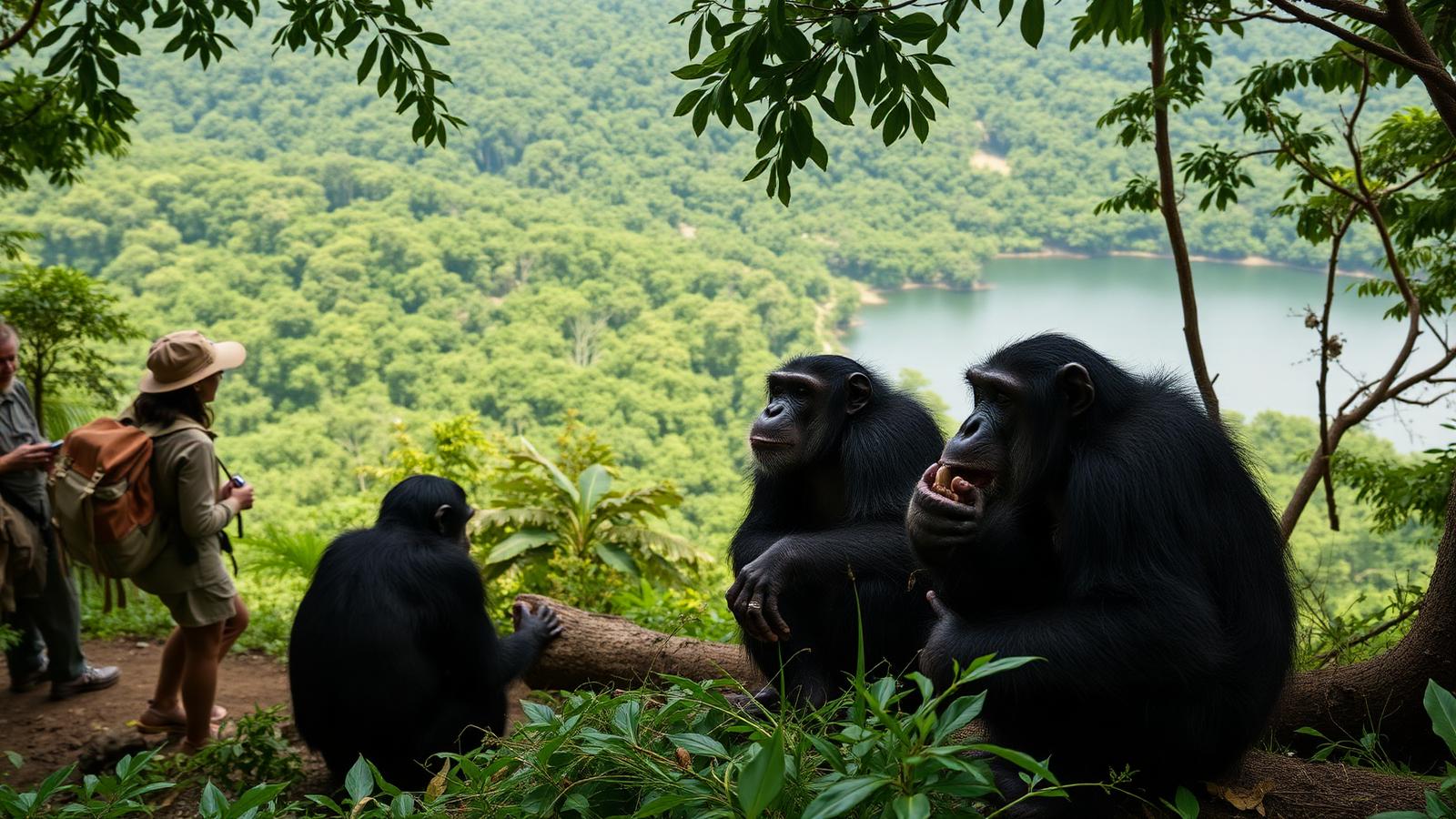
Chimpanzee trekking in Mahale means walking into the forest with park guides and trackers to find a community that has been habituated to human presence over many years. Habituation means the animals tolerate observers at a distance; it does not mean they are tame, predictable, or obliged to be anywhere in particular.
Trackers typically start from where the group nested the previous evening and follow signs and calls from there. Sometimes that means a short walk from the shore. Sometimes it means climbing for hours as the community moves after fruiting trees. Radios keep the guiding team in contact, so once the animals are located the group is walked toward them as directly as the terrain allows.
When you do find them, the experience is unusually intimate. Chimpanzees feed, groom, argue, move and rest around you at close quarters, largely ignoring the people watching. It is loud, fast and often chaotic rather than serene, and it is very different from watching wildlife across an open plain.
Trekking Rules and Etiquette
Chimpanzees share enough of our biology to be vulnerable to human respiratory illness, so visiting is regulated. The exact rules are set by the park authority and can be revised, and camps brief guests on the current version before every trek. Expect controls along these lines:
- Small groups with a guide. Numbers per group are capped, and treks are allocated by the park.
- A limited time with the animals. Viewing time is restricted once the group is found, to reduce disturbance.
- A minimum distance. Guides will position you and may ask you to move back if animals approach.
- Face coverings. Masks are commonly required when near the chimpanzees. Bring your own as a backup.
- Health screening. Visitors who are unwell may be asked not to trek. This protects the community and is not negotiable.
- Age limits. Minimum ages apply to chimpanzee trekking and vary; confirm before booking a family trip.
- No food, no flash, low voices. Eating near the animals and flash photography are not permitted.
What a Trekking Day Involves
Days start early. You are briefed at camp, given a rough picture of where the community was last known to be, and then walked or boated a short distance to the starting point. From there the pace is set by the terrain and by what the trackers are hearing ahead.
The walking is rarely steady. Long stretches of climbing are broken by pauses while the guides listen, then a sudden burst of movement when a direction is confirmed. Guides carry water and can take a daypack for anyone struggling. Most treks return to camp by the middle of the day, leaving the afternoon free for the lake, though a difficult day can run longer.
If the community cannot be located, that is the outcome for the day. It is one of the strongest arguments for booking three or four nights rather than two — a second and third attempt changes the odds far more than anything else within your control.
Fitness and Terrain
You do not need technical skill, but you do need to be comfortable walking uphill for a few hours on rough ground. The forest floor is a mix of roots, loose leaf litter, mud and stream crossings, and gradients are steep in places. Humidity makes moderate effort feel harder than it looks.
- Shoes with real grip matter more than anything else you bring.
- Long trousers and long sleeves help with vegetation, insects and scratches.
- A light rain layer is sensible in any month; forest weather changes quickly.
- Trekking poles help on descents, which are often harder than the climbs.
- Tell your guide honestly about knees, backs and fitness. Pace can be adjusted, and shorter alternatives exist on some days.
Other Wildlife and Primates
Mahale is not a big-game park, and it is better to know that before arriving. What it does have is a good range of forest species, several of them primates, plus an underwater world in the lake. The table below reflects what visitors realistically encounter, not a checklist of everything recorded in the park.
| Species | Realistic chance | Notes |
|---|---|---|
| Chimpanzee | Good in the drier months, lower in heavy rain | Habituated communities are tracked daily, but the animals are wild and mobile. Trackers work from the previous evening's nesting site; some days produce a long close encounter, others produce nothing |
| Red colobus | Good | Noisy troops in the canopy, often seen on the walk in or out rather than at the chimpanzee sighting |
| Red-tailed and blue monkey | Good | Common in gallery forest near camps and along stream lines |
| Yellow baboon | Good | Seen along the shore and forest edge; keep tents and daypacks closed |
| Bushpig, duiker, bushbuck | Uncertain | Present but shy in thick cover; usually a brief glimpse rather than a sustained sighting |
| Forest squirrels, mongoose, small carnivores | Occasional | More likely on slow walks than on a focused chimpanzee trek |
| Leopard | Very unlikely to be seen | Occurs in the wider range but is rarely observed; not something to plan around |
| Elephant, buffalo, lion | Not part of the visitor experience | Some large mammals use remote parts of the park and its woodland fringes, but Mahale is not a big-game destination. For that, plan a separate leg |
| Cichlid fish | High where snorkeling is offered | Lake Tanganyika's rocky shallows hold a remarkable diversity of small, brightly marked fish |
If seeing elephant, lion and buffalo matters to you, treat Mahale as one part of a longer trip and add a savanna leg. Our Ruaha guide and Nyerere guide cover two southern options that combine reasonably with a western leg, and the Big Five overview explains where those species are most reliably seen.
Birds and Smaller Species
Birding in Mahale is rewarding but demanding, as it is in most closed forest. Much of what you hear stays invisible. Along the shore and forest edge the going is easier — kingfishers, fish eagles, hornbills and various waterbirds are regular sights — while the interior turns up greenbuls, robins, barbets and occasional specials for those with patience.
The lake itself deserves attention. Snorkeling over rocky shallows reveals a dense, colorful community of small fish, many of them found only in Lake Tanganyika. It is one of the few places on a Tanzanian itinerary where the most memorable species of the afternoon might be underwater.
Forest and Mountain Landscape
The park's structure is simple to describe and dramatic to see: water, a narrow shore, and then mountains. Habitats change quickly with altitude, from gallery forest along the streams to montane forest, and higher still to bamboo and grassy ridges. A hard morning's walk can pass through several of them.
| Zone | Character | What it means for visitors |
|---|---|---|
| Lake shore and beaches | Narrow strips of sand and pebble between forest and water, where most camps sit and where boats arrive | Swimming and snorkeling where camps allow it, sundowners, boat departures, easy birding |
| Lowland and gallery forest | Dense, humid forest along streams behind the shore, rising quickly from the lake | The usual starting ground for chimpanzee treks in the drier months; other primates and forest birds |
| Mid-altitude montane forest | Steeper, cooler forest with tall trees, tangled understory and slippery footing | Where treks often lead when the chimpanzees move higher; hard walking, atmospheric surroundings |
| Ridges, grassland and bamboo | Open patches and bamboo stands on the higher slopes of the Mahale range | Long views over the lake on clear days; reached on longer guided hikes, not on every visit |
| Miombo woodland edges | Drier woodland on the park's inland and southern margins | A different set of species from the forest; rarely the focus of a short stay |
Hiking Beyond the Chimpanzees
Walking in Mahale is not limited to trekking. Shorter guided forest walks near camp are a good use of a morning when you are not going out with the trackers, and they often produce better sightings of monkeys, birds and trees than a fast-moving chimpanzee trek does.
Longer climbs toward the ridges and viewpoints of the Mahale range can be arranged with the park, subject to time, fitness and conditions. These are proper hikes rather than strolls, and they are worth discussing in advance rather than requesting on the morning. Waterfall and stream walks are also offered by some camps when water levels allow.
Lake-Based Activities
What is available varies by camp, by season and by conditions on the day. The table sets out the activities most commonly offered and the caveats attached to each.
| Activity | What it involves | Availability |
|---|---|---|
| Chimpanzee trekking | Guided forest walk with park staff and trackers to locate a habituated community | The core activity, usually offered daily, but subject to park rules, group size limits, ranger availability, health screening and conditions on the day |
| Forest and waterfall walks | Shorter guided walks near camp for birds, primates, trees and streams | Commonly available and a good use of a non-trekking morning; routes vary by camp and water levels |
| Longer mountain hikes | Half- or full-day climbs toward ridges and viewpoints on the Mahale range | Arranged case by case with the park; needs fitness, time and settled weather |
| Boat cruises on Lake Tanganyika | Dhow or motorboat trips along the shoreline, often at the end of the day | Usually available; wind and lake conditions can change plans, especially in the afternoons |
| Snorkeling | Shallow-water snorkeling over rocky shoreline for endemic cichlids | Offered by most lakeside camps in calm conditions; visibility is best when the lake is settled |
| Kayaking and swimming | Paddling near camp and swimming off the beach | Camp-dependent and always at the guide's discretion. Follow the camp's instructions about where and when it is considered safe |
| Fishing | Catch-and-release lake fishing from a boat | Offered by some camps only, under park regulations; confirm before booking if it matters to you |
Photography in Forest Light
Forest photography is harder than savanna photography, and Mahale is a good place to be realistic about it. Light under the canopy is dim and contrasty, subjects move constantly, and there is usually vegetation between you and the animal. High ISO performance and a fast, moderately wide lens are more useful than long reach.
- Expect to shoot at higher ISO than you would on an open plain, and accept some noise.
- A zoom in the 24–105mm range often works better than a long telephoto at close quarters.
- Flash is not permitted near the chimpanzees; plan around available light.
- Bring dry bags or a rain cover. Humidity and sudden showers are routine.
- Save wide, scene-setting shots for the boat and shoreline, where light is far more cooperative.
Our photography guide covers gear and technique in more depth, including how to handle mixed conditions across a multi-park trip.
Best Time to Visit
Mahale can be visited across much of the year, but conditions change substantially. The drier months are more popular because the walking is easier and communities more often range at lower elevations. The wetter months are greener, quieter and less predictable.
| Period | Conditions | What it means for your visit |
|---|---|---|
| Late May – June | Rains easing, forest still green, humidity dropping, lake generally calm | A quiet, attractive time. Trails are drying, chimpanzees are often still moving between elevations, and camps are less full |
| July – October | The main dry period; clearer skies, firmer trails, warm days | The most popular window. Chimpanzee communities frequently range lower in the forest, treks tend to be shorter, and lake activities are usually reliable |
| November – December | Short rains arrive in bursts; forest greens up, afternoons can be wet | Fewer visitors and lush conditions. Walking is muddier and plans need flexibility, but the forest looks its best |
| January – February | Warm and humid with intermittent rain | Variable. Some camps operate, fruiting patterns shift chimpanzee movements, and treks can be longer and steeper |
| March – April / early May | Heaviest rain of the year in western Tanzania | Most remote camps close for part of this period and access becomes unreliable. Confirm operating dates before considering these months |
Seasonal timing across the country is covered in our month-by-month guide, which is useful if a Mahale leg has to sit alongside migration timing in the north or dry-season viewing in the south.
Wet Season vs Dry Season
The drier months
Trails firm up, streams are easier to cross, and treks tend to be shorter because communities frequently feed lower down. The lake is usually calm in the mornings, which makes boating and snorkeling more reliable. This is also when camps are fullest and space is hardest to secure.
The wetter months
The forest is at its most striking — dense, dripping and loud — and there are fewer visitors. The cost is practical: mud, longer and steeper walks when the chimpanzees move higher, and afternoons that can be written off by rain. Some camps close during the heaviest period, so operating dates need confirming before you plan anything around them.
How Long Should You Stay?
Because arriving and leaving each consume most of a day, the number of nights determines how much of the park you actually experience. Two nights leaves one real day. Three or four turns the trip into something considered rather than rushed.
| Length of stay | Verdict | Notes |
|---|---|---|
| 1 – 2 nights | Hard to justify | A single trekking attempt with no margin for a difficult day, after two travel days to get in and out |
| 3 nights | Practical minimum | Two full days in the park, so a quiet first day is not the whole trip; leaves room for a lake afternoon |
| 4 nights | The comfortable choice | Two or three trekking attempts, a forest walk, boat time, and space for weather to interfere without wrecking plans |
| 5+ nights | For photographers, honeymooners and repeat visitors | Time to hike higher, work the same forest in different light, and treat the lake as more than a filler |
Accommodation Options
Camp choice in Mahale is small. A handful of lakeside properties operate along the shore, most of them seasonal, and they range from comfortable tented camps to more polished lodges. All are supplied by boat or air, which is the main reason nightly rates sit above what the same standard would cost in a mainstream park.
- Book early for the dry months. With so few rooms in the park, July to October fills far ahead of time.
- Check what is included. Park fees, trekking fees, boat transfers and activities are packaged differently by different camps.
- Confirm operating dates. Seasonal closures around the heaviest rains are normal in western Tanzania.
- Expect simplicity in some areas. Power, connectivity and laundry arrangements are shaped by the location, not by the price.
How accommodation styles compare across the country, and what drives the difference in rates, is covered in our accommodation guide.
How to Get There
Access is by air and then water. Scheduled light aircraft connect western Tanzania with Arusha, Dar es Salaam and other parks on a limited number of days per week during the operating season, landing at an airstrip serving the park. From there a boat transfer along the lake brings you to camp.
- Flight days shape the itinerary. Build the trip around them rather than trying to fit them around preferred dates.
- Baggage limits are strict. Light aircraft restrict weight and usually require soft bags. Our packing list explains how to pack for fly-in legs.
- Allow buffer days. Keep at least one night between the last bush flight and an international departure.
- Boat times vary. Transfer length depends on the camp and lake conditions; arrivals late in the day can be moved for safety.
- Private charters exist. They add flexibility at a cost, and are sometimes the only way to make a tight routing work.
What the Remote Location Means
Remoteness is the source of both Mahale's appeal and its friction. It keeps visitor numbers low and the forest quiet. It also removes most of the flexibility travelers take for granted elsewhere.
- Few people. You are unlikely to share a sighting with a crowd, and the shoreline is largely undeveloped.
- Limited contingency. Changing nights mid-trip is rarely simple when flights run on set days.
- Higher costs. Supply by air and boat is reflected in every rate.
- Medical distance. Evacuation takes longer from western Tanzania, so insurance covering remote areas matters. See our travel insurance guide.
- Connectivity. Assume patchy or scheduled internet, and tell people at home before you go.
How Costs Are Built
We do not publish fixed prices for a destination where flights, fees and camp rates move independently. What is more useful is understanding which components drive the total, so you can see where a budget can flex and where it cannot.
| Cost component | Why it matters |
|---|---|
| Flights | Scheduled light-aircraft seats into western Tanzania are the largest single variable, and they run on limited days |
| Park and activity fees | Park entry and chimpanzee trekking fees are set by the authorities and change from time to time |
| Camp rates | Few camps, short seasons and everything supplied by boat or air keep nightly rates high compared with mainstream parks |
| Boat transfers | Usually included by camps, but they add operational cost and shape arrival and departure timing |
| Trip length | Because getting in and out consumes time, a Mahale leg tends to make sense only inside a longer, higher-budget itinerary |
For how safari budgets are structured more generally — and where the money usually goes — see our cost guide.
What to Bring
- Walking shoes with grip, already broken in. This is the single most important item.
- Long trousers, long-sleeved shirts and a light waterproof layer.
- Gaiters or high socks if you dislike mud and biting insects around the ankles.
- Masks for trekking, as a backup to whatever the park or camp provides.
- Dry bags for cameras and phones, for both boat transfers and rain.
- Swimwear, a quick-dry towel and reef-safe sunscreen for lake time.
- Insect repellent, blister plasters and any personal medication in your hand luggage.
- A soft duffel rather than a hard case, for light-aircraft baggage rules.
Health and Responsible Visiting
Because chimpanzees can catch human illnesses, health screening is part of visiting responsibly. Travelers with cold or flu symptoms may be asked to stay behind, and that decision protects a community that has been observed for decades. It is worth building a spare day into the plan so an off-day does not cost you the whole experience.
Routine travel health precautions for Tanzania apply here as elsewhere — malaria prevention, sensible water and food practice, and up-to-date vaccinations. Our health guide covers the general picture, and your own doctor should confirm what is right for you.
Mahale vs Katavi
These two parks are usually discussed together because they are the backbone of a western Tanzania trip and they complement each other rather than overlap. One is forest and lake on foot; the other is floodplain and river from a vehicle.
| Factor | Mahale | Katavi |
|---|---|---|
| Main draw | Tracking habituated chimpanzees in mountain rainforest above Lake Tanganyika | Floodplains, seasonal river pools and large concentrations of hippo and buffalo late in the dry season |
| How you experience it | On foot, in forest, with boat transfers along the shore | From a vehicle, with walking possible where arrangements allow |
| Big game | Not the point; no classic Big Five viewing | Elephant, buffalo, hippo, crocodile and lion are the mainstays |
| Physical demand | Moderate to hard; steep, humid, slippery walking | Low to moderate; long drives in heat and dust |
| Downtime | The lake gives genuine rest between activities | Camp-based rest between drives, with limited alternatives |
| Best combined | With Katavi, on a longer western trip | With Mahale, for contrast between plains and forest |
If you are weighing the pair, our full Katavi guide sets out what that park delivers season by season and how many nights it warrants.
Mahale vs Gombe
Both parks offer chimpanzee trekking on the shore of Lake Tanganyika, and travelers regularly ask which to choose. The honest answer usually comes down to time, budget and how much you want the surrounding experience rather than the animal alone.
| Factor | Mahale | Gombe |
|---|---|---|
| Setting | A large park where forested mountains rise steeply from the lake, with long undeveloped shoreline | A much smaller protected strip of forested valleys north of Kigoma |
| Scale of the forest | Extensive; treks can range widely and climb hard | Compact; walking is steep but distances are shorter |
| Access | Light aircraft to an airstrip serving the park, then a boat transfer | Usually a flight to Kigoma and a boat along the lake |
| Accommodation | A small number of lakeside camps, mostly seasonal and high-end | Simpler options, including basic park accommodation and lodge stays near the park |
| Cost and trip shape | Higher, and usually built as a dedicated leg of a longer itinerary | Cheaper to reach and easier to add on for travelers already in Kigoma |
| Best fit | Travelers who want the fullest wild-chimpanzee and lake experience and can give it the days | Travelers with limited time or budget who mainly want to see chimpanzees and the research history |
Our Gombe guide covers that park in its own right, including access through Kigoma and what a shorter chimpanzee trip looks like.
How Mahale Fits an Itinerary
Mahale works best as a dedicated leg rather than a detour. A common shape is a few nights in Katavi followed by three or four in Mahale, connected by a short flight, on a trip of roughly two weeks. Another is Mahale paired with a northern or southern savanna leg for travelers who want both forest and big game, accepting the extra flying that involves.
It also pairs well with a coastal finish, since the pace of the lake and the pace of the islands suit each other. What rarely works is squeezing Mahale into a nine- or ten-day trip that already includes the northern circuit — the flights consume too much of the time available. Worked routings and night counts are set out in our itineraries guide.
Who Is Mahale Best For?
- Travelers for whom seeing wild chimpanzees is a genuine priority, not a curiosity.
- Repeat visitors to Africa who already know what they enjoy in the field.
- People who like walking and are comfortable on steep, humid terrain.
- Couples and honeymooners who want somewhere quiet with real downtime by the water.
- Photographers prepared to work in difficult forest light for a few strong frames.
- Anyone building a longer western Tanzania trip around Katavi.
When Another Destination Makes More Sense
- First safaris. A first trip is usually better spent on the northern circuit — our first-timers guide explains why breadth and simple logistics matter early on.
- Trips under about ten days, where two travel days for one park is too high a price.
- Travelers who want a Big Five checklist; Mahale is not built for that.
- Anyone with mobility limits or knee problems that make several hours of steep forest walking unrealistic.
- Families with young children, given age limits on trekking and the length of the journey.
- Travelers who mainly want to see chimpanzees at lower cost — Gombe is the more practical option.
Common Planning Mistakes
| Mistake | Better approach |
|---|---|
| Booking two nights to keep costs down | Give Mahale at least three nights so a difficult trekking day is not the whole experience |
| Assuming flights run daily | Confirm the actual flight days for your dates first, then build camps and nights around them |
| Treating a chimpanzee sighting as certain | Plan for variation. Trackers improve the odds; wild animals still decide the outcome |
| Arriving with no forest-ready footwear | Bring broken-in shoes with grip, long trousers and a light rain layer, whatever the season |
| Expecting a classic game-drive safari | Pair Mahale with a savanna park if Big Five viewing matters to you |
| Adding Mahale to a nine- or ten-day first trip | Keep the first trip simpler and save western Tanzania for a longer or later itinerary |
| Booking late for the popular dry months | Camp capacity is tiny; reserve well ahead for July to October |
| Promising activities to your group before confirming | Ask what the camp and park can actually run on your dates, including hikes, boating and snorkeling |
Related Guides
- Gombe Stream National Park guide — the other chimpanzee option on Lake Tanganyika.
- Katavi National Park guide — the natural partner on a western trip.
- Ruaha National Park guide — a wild savanna leg with simpler access.
- Nyerere National Park guide — river and boat safaris in the south.
- Tanzania safari itineraries — worked routings and night counts.
- Safari photography guide — how to shoot forest and low light.
Common Questions
Frequently Asked Questions
It is worth it if chimpanzees in genuine mountain rainforest are a real priority and you can absorb the travel time and cost. Mahale is remote, reached by air and boat, with very few camps and hard walking in humid forest. Travelers who want that experience usually rate it as the highlight of their trip. Travelers with a short holiday, tight budget or limited mobility often get more from a savanna park.
No. The chimpanzee communities followed here are long habituated to researchers and visitors, which makes close, natural sightings possible, but they are wild animals moving through steep forest. Some days they are found quickly and some days they are not found at all. Weather, the group's movements and trail conditions all matter, which is the main argument for staying more than one or two nights.
The drier months, broadly July to October, are the usual recommendation: trails are less slippery, the lake is often calmer and the chimpanzees are frequently at lower elevations. May and June can also be good and quieter. The heaviest rains around March and April make walking harder and several camps close, so check current opening dates before planning those months.
It is moderately demanding walking rather than technical hiking. Expect steep gradients, humidity, wet leaf litter, roots and stream crossings, sometimes off any formal path. Trek length varies widely with where the group is on the day, from a fairly short walk to several hours. Reasonable fitness, sturdy footwear and comfort on uneven ground matter more than any particular experience.
Almost everyone flies. A scheduled or chartered bush flight from Arusha, Katavi or another western airstrip lands near the park, and a boat transfer along Lake Tanganyika completes the journey to camp. There is no road access into the park. Schedules are limited and seasonal, so the flight calendar usually dictates the shape of the itinerary.
Most camps on the shore offer time on and in the lake, which can include swimming, snorkelling, kayaking or boat outings. What is available depends on the camp, the weather and conditions on the day, and camps set their own safety guidance for the stretch of shoreline in front of them. Ask your camp what is running during your dates rather than assuming a fixed activity list.
Three nights is a sensible minimum, giving two trekking attempts plus time on the lake. Four nights is more comfortable and allows a forest walk or a slower day. Given the cost and effort of getting there, one or two nights is a poor use of the flights.
Both sit on Lake Tanganyika and both offer chimpanzee trekking. Gombe is smaller, closer to Kigoma and generally cheaper and easier to reach, which suits shorter or more budget-conscious trips. Mahale is larger, wilder and more mountainous, with a stronger sense of remoteness and a more polished camp experience, at a higher price and with more travel involved.
It is the standard western Tanzania pairing and works well because the two are so different: forest, mountains and lake at Mahale, open floodplains and big herds at Katavi. Three or four nights each is a common shape. The combination has to be built around the bush flight schedule, so confirm routings before committing.
It depends on mobility and the camp. The trekking is steep and humid, and camps often set minimum ages for going out with the chimpanzees. Families with young children or travelers who cannot manage uneven, slippery ground for a few hours may enjoy the lake and the setting but should not plan the trip around trekking.
Closed hiking shoes with grip, lightweight long trousers and long sleeves for insects and undergrowth, a rain layer, a small daypack, plenty of water capacity, insect repellent and swim gear for the lake. Camera equipment needs protection from humidity and rain. Our packing guide covers the broader safari list.
If your trip is under about ten days, if you want big cats and large herds, or if the flight cost is disproportionate to the rest of the itinerary, a northern or southern circuit park will serve you better. Mahale earns its place when chimpanzees, forest and lake are the point of the trip rather than an add-on.
Final Thoughts
Mahale's appeal is specific and unusually strong: mountain rainforest above one of the world's great lakes, reached without roads, where the main event is walking until you find animals that behave as though you are not there. Few places in Tanzania feel less like a standard safari.
The trade-offs are equally specific. Limited flights, very few camps, real cost, hard walking, and an outcome that depends on wild animals in dense forest. Judge Mahale on whether those terms suit the trip you are planning. If they do, it is one of the most rewarding places in the country. If they do not, Gombe is the shorter, cheaper route to chimpanzees, and a savanna park will give you a fuller wildlife trip with far less friction.
Mahale rewards travelers who plan for it properly: enough nights to absorb a slow trekking day, flights booked around a limited schedule, and realistic expectations about wild animals in dense forest. On those terms it is one of the most distinctive places in Tanzania. On any other terms, another park will give you more for less effort.
Plan Your Journey
Planning a western Tanzania trip around chimpanzee trekking?
Send us your dates and how many days you can give the trip, and our Arusha-based team will map what is realistic: which flight days work for your travel window, how many nights Mahale warrants, whether pairing it with Katavi makes sense, which camps are open on your dates, boat transfer timings, and how the season is likely to affect trekking and lake activities. If your trip is too short for Mahale to be worth the travel, we will tell you and suggest a better use of those days — and no one can promise a chimpanzee sighting.
- TALA Licensed Operator
- 4.9 ★ Guest Rating
- No Booking Fees
Keep Reading
Related Tanzania Safari Guides
Safari Guides
The Ultimate Tanzania Travel Guide: Everything You Need to Know Before You Visit
Safari Guides
Gombe Stream National Park Guide: Chimpanzee Trekking on Lake Tanganyika