Tanzania Safari Guide
Best Time to Visit Tanzania: Complete Safari Guide
A month-by-month guide from our Arusha planning desk — real weather figures, the wildlife calendar, migration timing, and the right season for your travel style and budget.

Introduction
Every week someone emails our office in Arusha asking the same question in slightly different words: when should we come? It sounds like a weather question. It almost never is.
The honest answer is that the best time to visit Tanzania depends on what you actually want to stand in front of. A couple who want to watch wildebeest hurl themselves into the Mara River need a different month from a family of five who mostly want good sightings, a pool and no long drives. A photographer chasing storm light wants the month most guides would politely steer a first-timer away from. All three can have an outstanding trip — just not in the same week of the year.
This guide is written from the planning side of the desk. It is the same seasonal reasoning we use when we build itineraries, including the parts that rarely make it onto brochure pages: which months are genuinely oversold, where the green season quietly outperforms peak, and how far ahead you really need to commit.
The short answer
If you want one recommendation and no caveats: come in September. You get dry-season game viewing at its easiest, the Mara River crossings are still running in the north, Kilimanjaro's summit weather is at its most reliable, Zanzibar is sunny with a breeze, and the camps are marginally less pressed than in August.
If you would rather trade the crossings for the best predator viewing of the year and half the vehicles, come in February instead. And if the budget is the deciding factor, look hard at June and November — two months that quietly deliver most of the peak-season experience at shoulder-season rates.
How Tanzania's seasons actually work
Tanzania sits on the equator, so forget summer and winter. What governs the safari year is rainfall, and rainfall comes in two distinct pulses with two dry spells between them.
The long dry season (June to October)
This is the season the industry is built around. Grass shortens, waterholes shrink, and the wildlife has nowhere to hide. Roads are firm, bush flights run on schedule, mornings are genuinely cold and afternoons are pleasantly warm. It is the easiest safari to photograph, the easiest to plan and the most expensive to book.
A detail worth knowing: the dry season also means dust. By late September the central Serengeti tracks throw up a fine red powder that gets into everything. It makes for magnificent backlit images and ruins unprotected camera sensors, which is why we tell guests to bring a dry bag and change lenses inside the vehicle.
The long rains (March to May)
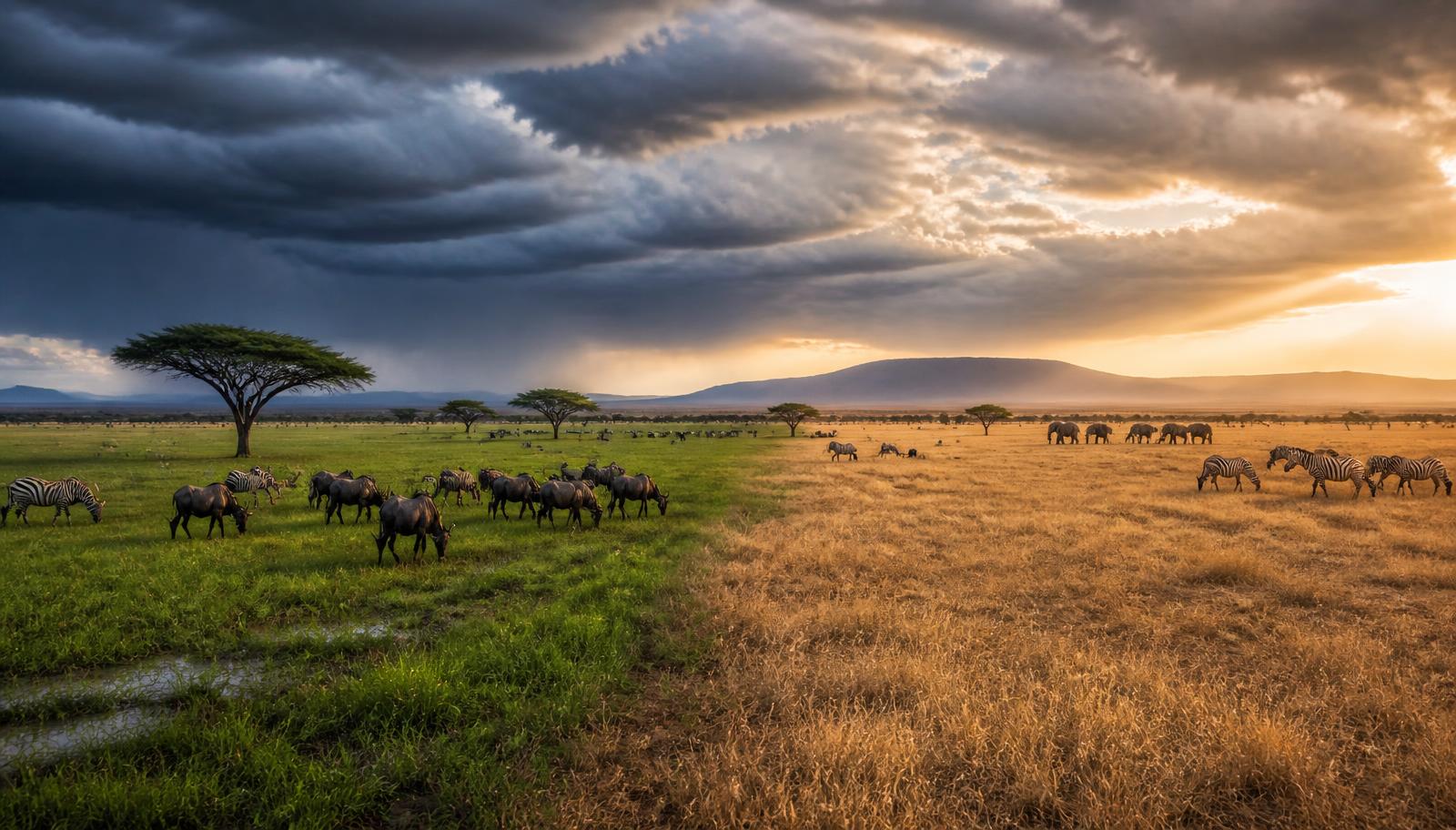
April is the heart of it. Rain here is not the grey all-day drizzle of northern Europe; it arrives as heavy afternoon storms that pass through in an hour or two and leave the light extraordinary. The bush turns emerald, the birding is at its peak, and a handful of remote seasonal camps close entirely.
What genuinely changes is access. Black-cotton soil in parts of the Serengeti turns to grease after heavy rain and some tracks become impassable. Well-run operators plan around this by routing you through areas with murram roads; poorly planned itineraries lose a day to a stuck vehicle.
The short dry break (January to February)
A hot, bright interval that is far more than a footnote. This is calving season on the southern short-grass plains and, in our view, the single best window of the year for watching predators actually hunt rather than sleep under a tree.
The short rains (November to mid-December)
Brief afternoon showers, dust knocked out of the air, migrant birds arriving and the herds drifting back south. Rates fall, availability opens up and the game viewing stays strong. If you asked our guides which month is most underrated, most would say November.
Month-by-month weather table
Average daytime high and night-time low, by region. Treat these as planning figures rather than forecasts — microclimates in the highlands vary considerably.
| Month | Serengeti | Ngorongoro | Zanzibar | Rainfall | Crowds |
|---|---|---|---|---|---|
| January | 28°C / 16°C | 22°C / 10°C | 32°C / 24°C | Low – short dry break | High (festive tail) |
| February | 29°C / 16°C | 23°C / 10°C | 33°C / 25°C | Low – driest of the green months | Moderate |
| March | 28°C / 17°C | 22°C / 11°C | 33°C / 25°C | Rising from mid-month | Low |
| April | 27°C / 17°C | 20°C / 11°C | 31°C / 24°C | Heaviest month of the year | Lowest |
| May | 26°C / 16°C | 20°C / 10°C | 30°C / 23°C | Easing after mid-month | Low |
| June | 25°C / 14°C | 19°C / 8°C | 29°C / 22°C | Dry | Building |
| July | 25°C / 13°C | 18°C / 7°C | 29°C / 22°C | Dry, cool nights | Peak |
| August | 26°C / 13°C | 19°C / 7°C | 29°C / 22°C | Dry, dusty | Peak |
| September | 27°C / 14°C | 20°C / 8°C | 30°C / 22°C | Dry | Peak |
| October | 29°C / 15°C | 22°C / 9°C | 31°C / 23°C | Dry, first storms late | High |
| November | 28°C / 16°C | 21°C / 10°C | 32°C / 24°C | Short rains – afternoon showers | Low |
| December | 28°C / 16°C | 22°C / 10°C | 32°C / 24°C | Showers easing | High from 20th |
Wildlife calendar
Weather is only half the picture. What is actually happening in the ecosystem matters more, and it runs on its own schedule.
| Period | Highlight | What you will see |
|---|---|---|
| January – March | Calving season on the southern plains | Around 400,000 wildebeest calves born near Ndutu in roughly three weeks. The highest concentration of predator activity in the safari year. |
| April – May | Green season, birthing across the north | Impala and zebra foals everywhere, migrant birds in full breeding plumage, Tarangire and Manyara at their most photogenic. Thick grass makes cats harder to spot. |
| June | Herds mass in the western corridor | The Grumeti river crossings — smaller and far less crowded than the Mara ones, with enormous crocodiles. |
| July – September | Mara River crossings, northern Serengeti | The famous crossings at Kogatende and Lamai. Elsewhere, dry-season game viewing is at its easiest all year. |
| August – October | Peak Tarangire elephants | Up to 3,000 elephants drawn to the Tarangire River. Arguably the best elephant viewing in East Africa. |
| October – November | The herds return south | Long columns moving down through Lobo and Seronera. Fewer vehicles, excellent value, dramatic skies. |
| Year-round | Ngorongoro Crater and Manyara | The crater's resident population never leaves — black rhino, big-maned lions, elephant bulls and flamingos in every month. |
For the detail behind each of these — which predators dominate which region, and where the resident populations sit — our Serengeti wildlife guide and Ngorongoro Crater safari guide go park by park.
Great Migration timeline
The migration is not an event with a start date. It is a continuous clockwise circuit of roughly 1.5 million wildebeest and 300,000 zebra, and the only question that matters for your booking is where will they be in my month, and am I sleeping near there?
| Window | Region | What is happening | Where to stay |
|---|---|---|---|
| Late Jan – Mar | Ndutu & southern Serengeti | Calving, peak predator action | Ndutu, Kusini |
| April – May | Moru, Seronera, central plains | Herds regroup and drift north-west | Central Serengeti |
| June | Western corridor / Grumeti | Grumeti River crossings | Grumeti, Kirawira |
| July – Aug | Northern Serengeti | First Mara River crossings | Kogatende, Lamai |
| Sept – Oct | Northern Serengeti & Mara | Repeated back-and-forth crossings | Kogatende, Lamai |
| Nov – Dec | Lobo, Seronera, heading south | Southward return with the short rains | Central & eastern Serengeti |
We go far deeper into the mechanics — river dynamics, crocodile behaviour, how to read the herds — in the Great Wildebeest Migration guide, and month-by-month positioning in best time to see the Great Migration.
Best time by safari type
| Your priority | Best window | Second choice | Why |
|---|---|---|---|
| First safari / Big Five | June – October | Late Jan – Feb | Thin bush, animals concentrated at water, easiest sightings and firm roads. |
| Great Migration crossings | Late July – early October | June (Grumeti) | The Mara River drama only happens when the herds are in the far north. |
| Calving & predators | Late January – February | Early March | Newborns on open short-grass plains means visible, frequent hunts. |
| Birding | November – April | May | Palearctic migrants present, resident species in breeding plumage. |
| Kilimanjaro trek | June – October | Jan – mid-March | Dry trails, stable weather and the highest summit success rates. |
| Zanzibar beaches | June – October | Dec – Feb | Sunny, low humidity, calm seas and reliable dive visibility. |
| Value / fewer vehicles | May & November | Early June, early Dec | Green-season rates with dry-season-quality game viewing. |
Month-by-month verdict
| Month | Verdict | What to expect |
|---|---|---|
| January | Excellent | A hot, bright pause between the rains. Calving begins on the Ndutu plains and Zanzibar is at its most glamorous. Book early — the first ten days still carry festive pricing. |
| February | Outstanding | Our personal favourite month. Peak calving, extraordinary predator action, clear skies and far fewer vehicles than July. If you care about wildlife behaviour over crossings, come now. |
| March | Good early | The first two weeks behave like February at lower rates. From mid-month the long rains build and the southern plains empty out as the herds drift north. |
| April | For the initiated | The wettest month. Some seasonal camps close and black-cotton roads get sticky. Rewarding for repeat visitors and photographers; not our recommendation for a first safari. |
| May | Green-season value | Rains ease from mid-month. Tarangire and Manyara are stunning, rates are 30–40% below peak, and you can have a sighting to yourself. Bring a rain shell and patience. |
| June | Excellent | The bush dries out quickly, herds mass in the western corridor and the Grumeti crossings begin. Peak-quality game viewing at shoulder pricing — the best-value month of the dry season. |
| July | Peak | First Mara River crossings, perfect weather, cold mornings. Everything is superb and everything is full. Northern Serengeti camps sell out ten to twelve months ahead. |
| August | Peak | The classic month. Crossings at their most frequent, Tarangire elephants massing on the river, Zanzibar sunny with a cooling breeze. Expect company at sightings. |
| September | Peak, our pick | Everything July offers with slightly fewer vehicles and the most reliable Kilimanjaro summit window of the year. If you can only travel in peak season, choose September. |
| October | Excellent | The herds begin their return south. Hot and very dry, so waterholes deliver. Good availability late in the month and softer rates than August. |
| November | Underrated | Short rains arrive as brief afternoon storms, the dust settles and the light turns spectacular. Excellent game viewing, low rates, almost no crowds. |
| December | Very good | Showers ease and the plains green up. From around 20 December, festive pricing and minimum-stay rules kick in — book ten months ahead or travel in the first two weeks. |
Best time for families
For families we recommend late June to early August or December into early January — not because the wildlife is better, but because everything else is easier.
- Dry roads mean shorter, calmer drives. Children tolerate three hours on firm murram far better than four hours on wet corrugation.
- Fewer mosquitoes and lower malaria pressure in the dry months, which reassures most parents considerably.
- Sightings come quickly. A six-year-old's patience runs out in about forty minutes; dry-season density means you rarely need longer.
- Zanzibar in August is sunny, breezy and the sea is calm — an ideal decompression leg after four or five safari days.
Best time for a honeymoon
February and September to early October are the two windows we push hardest for honeymooners, and they suit different temperaments.
February gives you warm, clear days, the calving plains almost to yourselves, and the best chance of an unhurried private sighting. It pairs beautifully with Zanzibar, which is at its hottest and most languid. September delivers the classic postcard safari — crossings, golden light, cool mornings — but you will share the good sightings.
For the coastal half of the trip, timing and location are covered in our Zanzibar travel guide.
Best time for photography
Serious photographers should think differently from everyone else. The months that produce the cleanest images are not the months that produce the easiest sightings.
- February — short green grass, uncluttered backgrounds, newborn calves and constant predator interaction. The best single month for wildlife behaviour.
- Late March and May — towering storm clouds, dramatic side-light and empty parks. The green-season landscape work you cannot get in August.
- August to September — dust and backlight at the crossings, big skies, and the highest chance of action frames at the river.
- November — the rains settle the dust, colours saturate, and the light after an afternoon storm is the best of the year.
Best time for budget travellers
The gap between peak and green-season pricing in Tanzania is larger than in almost any other safari destination. The same tented camp that costs USD 750 per person per night in August can be USD 420 in May. Park fees do not move — those are government-set — but everything else does.
- May — the single best-value month. Rains easing, camps hungry for guests, landscapes at their most beautiful.
- November — short-rain rates with strong game viewing and the herds moving back through the central Serengeti.
- Early June and the first half of December — shoulder pricing applies right up to the peak-season cut-off. Travelling on 5 June rather than 25 June can save several hundred dollars a head for near-identical conditions.
- Base in Karatu rather than the crater rim in any month. It is 40 minutes from the gate and a fraction of the price.
Full figures, including what park fees and permits actually add up to, are in our Tanzania safari cost breakdown.
Zanzibar and Kilimanjaro timing
Zanzibar
The island runs on the same two rain seasons as the mainland but feels them differently. June to October is hot, dry and breezy — the best combination for diving, sailing and lying still. December to February is hotter and more humid, with glassy seas and superb visibility on the reefs. April and early May bring genuinely heavy rain and some hotels close; that is the one window we would steer you away from.
Kilimanjaro
Two windows, and the difference between them is real. June to October is the most reliable overall — stable weather, dry trails, the highest summit success rates and the busiest trails on Machame and Marangu. January to mid-March is warmer, often clearer at the summit and noticeably quieter, with snow on the crater rim making for spectacular photographs.
Skip April, May and November. Wet trails, muddy camps and cloud that hides the view you came for. If you want solitude within a good window, choose the Rongai or Northern Circuit routes and start in the first ten days of the month.
Expert seasonal tips
- Book the season, then the camp — never the reverse. A famous lodge in the wrong region for your month is a worse trip than a modest camp in the right one.
- Shift your dates by ten days. Moving from 28 June to 8 June, or 20 October to 5 November, routinely saves 20–30% with almost no change in conditions.
- Layer for the highlands in every month. Guests consistently under-pack warm clothing. The Ngorongoro rim before dawn is cold in July and cool in February.
- In the green season, prioritise Tarangire and the crater. Both hold up superbly in the rain; the remote northern Serengeti does not.
- Fly the long legs in the wet months. A one-hour bush flight replaces a five-hour drive that becomes seven when the road is soft.
- Watch the festive cut-off. Most camps switch to peak-season rates and minimum stays around 20 December and drop back around 4 January.
What to actually bring, season by season, is covered in the Tanzania safari packing list.
Common planning mistakes
| The mistake | What it costs you | What to do instead |
|---|---|---|
| Booking July for the crossings and staying in central Serengeti | A four-hour drive each way, or no crossings at all | If crossings are the goal, sleep at Kogatende or Lamai. Nothing else works. |
| Avoiding the green season on principle | Paying 40% more for a busier version of the same wildlife | Consider late Jan–Feb, June or November. Rain in Tanzania is usually a 90-minute afternoon event. |
| Planning around rainfall averages rather than terrain | Wasted days in the wrong park | April rain barely affects the crater floor but can close remote Serengeti tracks. Season affects each park differently. |
| Leaving peak-season bookings until six months out | Second-choice camps and long transfers | For July–October or Christmas, commit 10–12 months ahead. Deposits are usually modest and refundable up to a point. |
| Packing for the equator only | A miserable 6am game drive at 7°C | The Ngorongoro rim is cold before dawn in every month. Layers, always. |
| Chasing the migration instead of the wildlife | Missing the best sightings of the trip | The resident predators, elephants and rhino do not migrate. A well-planned green-season safari often out-delivers a rushed peak one. |
One more park-specific note, because it comes up constantly: Tarangire's reputation is built on the dry season, and rightly so — by August the elephant concentration along the river is one of the finest sights in East Africa. In the green season the herds disperse and the park reads completely differently. Our Tarangire National Park guide explains how to plan for either version.
Frequently Asked Questions
Common Questions
Frequently Asked Questions
June to October. The bush thins out, wildlife concentrates around permanent water, roads are firm and bush flights run on schedule. If we had to name one month it would be September — dry-season game viewing, Mara River crossings still running in the north, the most reliable Kilimanjaro summit weather of the year and slightly less pressure on camps than August. The trade-off is price and company at sightings.
Late July to early October for the Mara River crossings in the far northern Serengeti, and late January to February for the calving season on the southern plains near Ndutu. Location matters more than the month: if crossings are your goal you must sleep at Kogatende or Lamai, because the herds are a four-hour drive from central Serengeti camps. Give yourself three nights in the north — crossings are unpredictable and one night is a lottery.
No — with one caveat. Rain in Tanzania usually arrives as a heavy afternoon storm that clears within a couple of hours, and the green season brings emerald landscapes, superb birding, newborn animals, dramatic light and rates 30–40% below peak. April is the one month we steer first-time visitors away from: it is the wettest, some remote camps close, and black-cotton tracks in parts of the Serengeti become difficult. May and November are excellent value.
May is the single best-value month, followed by November, early June and the first half of December. The same tented camp that costs around USD 750 per person per night in August can be USD 420 in May. Park and conservation fees are government-set and do not change with the season, so the saving comes entirely from accommodation and vehicle rates.
June to October is the most reliable window, with stable weather, dry trails and the highest summit success rates — but Machame and Marangu are busy. January to mid-March is warmer, often clearer at the summit and noticeably quieter, with snow on the crater rim. Avoid April, May and November: wet trails, muddy camps and cloud that hides the view you came for.
June to October is hot, dry and breezy — the best combination for diving, sailing and beach days. December to February is hotter and more humid with glassy seas and excellent reef visibility. April and early May bring genuinely heavy rain and some hotels close, so that is the window to avoid if the coast is a major part of your trip.
Late June to early August, or December into early January. It is less about the wildlife and more about everything else: dry roads mean shorter and calmer drives, mosquito pressure is lower, and dry-season density means you rarely have to search for forty minutes to find something. Zanzibar in August is calm and breezy — an ideal decompression leg. Because these are also school holidays worldwide, book family rooms and triple tents about twelve months out.
On the coast and in the low-lying parks, yes — Zanzibar, Tarangire and the Serengeti floor stay warm to hot in every month. The highlands are a different story. The Ngorongoro Crater rim sits at around 2,300m and can fall below 7°C before dawn in July, and Kilimanjaro's summit is sub-zero every night of the year. Guests are consistently more surprised by the cold than the heat.
For July to October or the festive period, 10–12 months. Northern Serengeti camps during the crossing window are the scarcest inventory in East Africa and the good ones close out first. Green-season trips in May or November can often be arranged inside two months, sometimes at short notice. Deposits are usually modest and refundable up to a defined date, so committing early costs less than most travellers expect.
In Closing
Final Thoughts
There is no single best time to visit Tanzania — only the best time for the trip you actually want. September will give you the classic dry-season safari with the crossings still running. February will give you the finest predator viewing of the year and a fraction of the vehicles. May and November will give you most of it for considerably less money. The mistake is choosing a month first and hoping the wildlife cooperates. Tell us when you can travel and what you most want to see, and we will tell you honestly what that window delivers — including whether shifting your dates by a week or two would make a real difference.