
Safari Planning
Tanzania Safari Weather by Month: Your Complete Planning Guide
Rainfall, temperatures, wildlife movement, crowds and pricing for all twelve months — written by guides who have watched every season arrive and leave from Arusha.

Introduction
Almost every inquiry that lands in our Arusha office contains a version of the same question: when should we come? It sounds like a simple scheduling question. It isn't. In Tanzania, the month you choose determines what the grass looks like, how far you can see, where two million wildebeest happen to be standing, whether your bush flight lands on schedule, how many other vehicles share your leopard sighting, and how much the whole thing costs. Nothing else you decide about a safari has that much leverage.
I have been guiding and running safaris out of northern Tanzania for over fifteen years, and in that time I have driven the Serengeti in every month of the calendar — including the ones the brochures politely skip. What follows is the guide I wish existed when clients ask me about Tanzania safari weather by month: real rainfall patterns, honest temperature ranges by altitude, what the animals are doing, what the roads are like, and which travelers each month genuinely suits.
You will notice I avoid the phrase "best month." There isn't one. There is a best month for you, and finding it means matching the weather to your priorities — whether that is river crossings, newborn cheetah cubs, empty parks, dramatic light, a family holiday that actually works, or the lowest possible price. By the end of this guide you should be able to name your month with confidence.
Understanding Tanzania's Climate
Tanzania sits just south of the equator on Africa's east coast, and that position shapes everything about its weather. There is no meaningful summer and winter here in the way Europeans or North Americans understand those words. Day length barely varies — sunrise around 6:30am, sunset around 6:45pm, every month of the year. Instead, the Tanzanian year is organised around rainfall, driven by the seasonal migration of a band of tropical convergence that sweeps north and then back south across the country twice annually.
That double pass is why Tanzania has two rainy seasons rather than one. The band moves south across the country between October and December, bringing the short rains (locally, vuli). It swings back north between March and May, bringing the long rains (masika). Between those passages sit the two dry windows that define Tanzania's safari calendar.
Altitude matters more than latitude
This is the single most useful thing to understand about Tanzanian weather, and the thing most visitors get wrong when they pack. Tanzania spans sea level to 5,895 metres, and temperature falls by roughly 6.5°C for every 1,000 metres of elevation gained. So on the same day, in the same week of July:
- Zanzibar (sea level): 22–29°C, humid, sea breeze, warm nights.
- Serengeti plains (1,100–1,800 m): 14–25°C, dry air, cool dawns, comfortable afternoons.
- Arusha (1,400 m): 11–22°C, cool evenings, occasional highland drizzle.
- Ngorongoro Crater rim (2,300 m): 6–18°C, mist most mornings, genuinely cold before sunrise.
- Kilimanjaro summit (5,895 m): −7 to −20°C at night, every night of the year.
A typical northern-circuit safari moves through three or four of those bands in a single week. That is why our packing advice always emphasises layers rather than a single "safari outfit" — a client in a t-shirt on the Serengeti floor at 2pm will want a fleece and a hat on the crater rim at 6am the next morning. Our Tanzania safari packing list breaks this down item by item.
Regional variation within the same month
Tanzania is bigger than France and Germany combined, and its regions do not experience the same month identically. The northern circuit — Serengeti, Ngorongoro, Tarangire, Lake Manyara — follows the two-season pattern described above. The southern and western parks, including Ruaha, Nyerere, Katavi and Mahale, sit in a different regime with a single extended wet season from roughly November through April and a much sharper dry season from June to October, when they become superb. The coast and Zanzibar are hotter, more humid and receive more total rainfall than the inland plains, with April and May by far the wettest months on the islands.
This matters when you are building an itinerary across regions. A May safari that would be difficult in the Serengeti can be excellent in the Ngorongoro Crater, where the crater floor drains well and the green season delivers extraordinary scenery. An October trip that is merely good in the north is outstanding in Ruaha and Katavi, where the dry season pushes wildlife onto shrinking rivers in numbers you have to see to believe.
Dry Season vs Green Season
Nearly every decision in this guide reduces to a choice between two philosophies of safari. It is worth being explicit about the trade-off before we get into individual months.
The dry season (June–October)
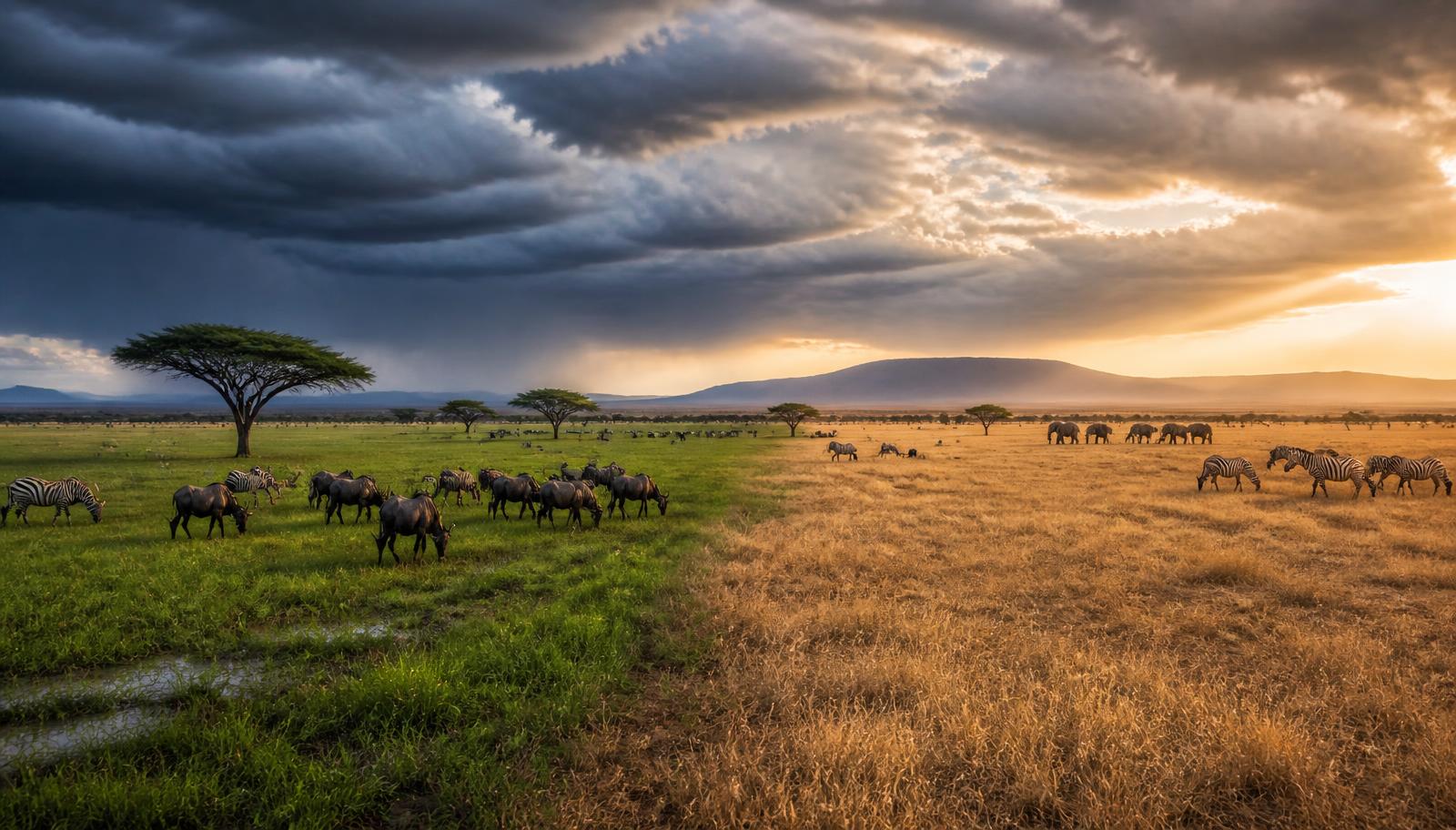
This is what most people picture when they imagine an African safari, and for good reason. Grass is short and pale, so animals are visible at distance. Seasonal waterholes dry up, forcing wildlife to concentrate around permanent rivers and springs in predictable places. Roads are firm, airstrips are reliable, and afternoon storms don't cut game drives short. Malaria risk drops with mosquito activity. And in the northern Serengeti, from late July, the Mara River crossings unfold.
The cost is exactly what you'd expect: this is peak season. Rates run 30 to 50 percent above green-season pricing, popular sightings attract vehicle traffic, and the best camps in the northern Serengeti sell out nine to twelve months in advance. Dust is real by September, and the landscape, while dramatic, is monochrome — bleached gold and grey rather than the vivid greens of the wet months.
The green season (November–May)
The green season is Tanzania's best-kept secret among repeat travelers and photographers. Landscapes turn a startling emerald, skies fill with towering cumulonimbus that make even mediocre photographs look cinematic, migratory birds arrive in enormous numbers, and the parks empty out. Newborn animals are everywhere — not just wildebeest, but impala, warthog, gazelle and zebra. And rates fall dramatically, sometimes by half.
The trade-offs are equally real. Long grass conceals animals. Wildlife disperses because water is available everywhere, so sightings require more patience and a better guide. Some remote camps close entirely in April and May. Black-cotton roads become genuinely difficult after sustained rain. And in April in particular, you should expect at least one day where the weather dictates your plans rather than the other way around.
Tanzania Weather in January
January opens the short dry season, and it is one of my favourite months to be on the southern Serengeti plains. The short rains of November and December have finished, leaving the short-grass country around Ndutu green, lush and carpeted with wildflowers, but the skies have largely cleared. Days are hot — 28 to 31°C on the plains — and nights are mild at 15 to 17°C. You will see brief afternoon showers in the first half of the month, rarely enough to interrupt a drive.
The wildlife story in January is the arrival of the migration on the southern plains. By mid-month the herds have settled onto the mineral-rich short grass of Ndutu and the Salei plains, and the first calves start dropping. Predators know this calendar better than any guide: lion prides, cheetah and spotted hyena move onto the plains in anticipation. Sightings build steadily through the month toward the February peak.
Elsewhere, January is excellent across the board. The Ngorongoro Crater is green and beautiful with clear crater views. Tarangire is quieter than in the dry season but the baobabs are in leaf and the birding is superb. Zanzibar is hot and sunny with flat, warm seas — the best swimming conditions of the year. On Kilimanjaro, January begins one of the two prime climbing windows, with warm days and often spectacular snow on the crater rim.
- Best for: calving build-up, Zanzibar beach time, Kilimanjaro, photography with green foregrounds.
- Watch out for: New Year's premium pricing in the first week; hot midday temperatures.
- Crowd level: Moderate — busy to 5 January, then noticeably calmer.
Tanzania Weather in February
February is the driest, hottest month in southern Tanzania and, in my opinion, the single most underrated month for wildlife. Rainfall on the southern Serengeti plains is minimal, skies are broad and blue with photogenic cloud towers building late in the day, and daytime highs reach 30 to 32°C with nights around 16°C.
This is peak calving season. Roughly 8,000 wildebeest calves are born every day across the Ndutu and Salei plains during a concentrated three-week window, and the resulting predator activity is the most intense wildlife spectacle in East Africa outside the river crossings themselves. Cheetahs hunt in the open on short grass, which makes February the best cheetah-photography month of the year. Lion prides that spread out during the wet months consolidate. Hyena clans are everywhere.
What makes February especially attractive is that this drama happens away from the peak-season crowds. Vehicle numbers around Ndutu have increased over the last decade, but they remain a fraction of what you'll meet at a Mara River crossing in August, and the mobile camps that follow the herds south are excellent value compared with northern Serengeti properties in high season.
Zanzibar in February is at its best: hot, calm, with excellent diving visibility and whale shark season off Mafia Island. Kilimanjaro remains in its warm-and-clear window. The one soft spot is the northern Serengeti, which is quiet in February — the herds are hundreds of kilometres south.
Tanzania Weather in March
March is a month of two halves, and the difference between them is stark. The first ten to fourteen days are essentially an extension of February: hot, largely dry, with the herds still on the southern plains and calving winding down. Rates are still low season in many camps. For travelers who can be flexible, early March is one of the genuine sweet spots in the Tanzanian calendar.
From roughly the middle of the month, the long rains arrive. They do not switch on all at once; they build. Afternoon storms become more frequent and more sustained, humidity rises, and by the last week you are firmly into wet-season conditions. Rainfall totals for March average 90 to 140 mm on the plains, but nearly all of it falls in the second half.
The wildlife responds quickly. Grass grows, the herds begin their slow north-westward drift out of the short-grass country toward the central and western Serengeti, and resident game disperses as water becomes widely available. Photographically, late March is spectacular — the combination of storm light, green foregrounds and moving columns of wildebeest is hard to beat. Practically, it demands patience and a guide who knows which roads hold up.
On Kilimanjaro, the first two weeks of March remain a good climbing window; after mid-month, conditions on the mountain deteriorate quickly and I would not recommend it. Zanzibar begins to get humid and sticky.
Tanzania Weather in April
April is Tanzania's wettest month, and I am not going to soften that. Rainfall on the northern circuit averages 200 to 350 mm depending on location. Storms are heavy, frequent and can last several hours. Temperatures moderate slightly — 25 to 27°C by day — but humidity climbs and everything feels damp. Grass on the plains reaches its maximum height. Some seasonal camps, particularly mobile camps and remote northern Serengeti properties, close for the month to carry out maintenance.
The practical consequences deserve honesty. Black-cotton soil roads in parts of the Serengeti become impassable or very slow. Grass airstrips occasionally close, which can disrupt fly-in itineraries. Game viewing is harder: animals are dispersed, hidden by tall grass, and less predictable in their movements. If you have five days and one chance at seeing a leopard, April is not the month to gamble on.
And yet — every year we run April safaris for people who love them. The landscape is extraordinarily beautiful. Skies are epic. Bird numbers peak, with Palearctic migrants still present and residents in full breeding plumage. Predator sightings, when they come, are often completely private. And rates fall by 40 to 50 percent, which can put a genuinely luxurious camp within reach of a mid-range budget.
Tanzania Weather in May
May is the tail of the long rains, and the month improves week by week. The first two weeks remain wet, with rainfall totals of 120 to 220 mm across the month, but by mid-May storms become shorter and less frequent and by the final week many years feel essentially dry. Temperatures are the mildest of the year — 15 to 27°C on the plains, cooler still in the highlands — and the air is washed clean.
For photographers, late May is one of my top recommendations in the entire calendar. The landscape is at peak green, skies still carry dramatic cloud structure, and the parks are almost empty. Tarangire in May, with its baobabs against a storm sky and elephants moving through long grass, is the kind of scene people spend a career trying to shoot.
The migration in May is building toward the western corridor. Herds gather in enormous columns, the rut is in full swing — the sound of hundreds of thousands of grunting wildebeest carries for kilometres — and the first animals begin approaching the Grumeti. It is a less famous chapter than the Mara crossings but a genuinely impressive one.
Green-season rates typically still apply through 31 May, making it the best-value month in which conditions are actually good. The main caveats: some camps remain closed until June, and Zanzibar is at its wettest and least appealing.
Tanzania Weather in June
June is where the year turns. The long rains have finished, the plains are drying, and the classic safari season begins — but the crowds and the peak rates have not fully arrived yet. Rainfall drops to 20 to 40 mm for the month, humidity falls away, and mornings become genuinely cool: 12 to 14°C at dawn on the Serengeti, colder on the Ngorongoro rim, where you will want a proper jacket and gloves for the descent.
What I love about June is that the grass is still golden rather than grazed and dusty, so the landscape photographs beautifully while visibility is already excellent. The light is clean, the air is clear enough to see Kilimanjaro from a long way off, and the roads are firm.
The migration reaches the western corridor and the Grumeti River during June, producing crossings that are smaller and less predictable than the Mara but far less crowded — sometimes you will have one entirely to yourself. Resident game is beginning to concentrate. Tarangire's elephant numbers start climbing as the seasonal swamps recede.
June is also the start of the most reliable Kilimanjaro climbing window and the beginning of prime season in Ruaha, Nyerere, Katavi and Mahale, all of which reopen and come into their own. If I had to recommend a single month for a first-time visitor who wants excellent conditions without the peak-season premium, it would be June.
Tanzania Weather in July
July delivers the most consistently pleasant weather of the Tanzanian year. Rainfall is effectively zero — 10 to 25 mm across the whole month, and often less. Daytime temperatures settle at a comfortable 24 to 26°C on the plains. Mornings are crisp, typically 13 to 15°C, and the Ngorongoro rim can dip to 6°C before sunrise. Humidity is low, skies are almost cloudless, and the light is clean from dawn until dusk.
Wildlife viewing in July is close to as good as it gets anywhere in the world. Grass is short, water sources are shrinking and predictable, and every species is easier to find than it was two months earlier. Lion, leopard and cheetah sightings all improve markedly. Tarangire's elephant congregations are building toward their September peak. The Ngorongoro Crater is reliably excellent, with clear rim views most mornings.
And in the far north, from mid-to-late July, the first Mara River crossings begin. This is the sequence that appears in every documentary — herds massing on the bank, hesitating for hours, then pouring across through crocodile-filled water. It is genuinely unpredictable: crossings can happen three times in a day or not at all for three days, which is why we recommend a minimum of three nights at Kogatende or Lamai if crossings are your priority.
The downsides of July are entirely about popularity. This is peak season across Tanzania. Rates are at their highest outside Christmas, popular sightings draw vehicles, and camps in the northern Serengeti and Ngorongoro book out very far ahead. If you want July, plan nine to twelve months out.
Tanzania Weather in August
August is nearly identical to July in climate — dry, mild, cloudless — with two differences. First, it is dustier: two months without rain leave the plains and the vehicle tracks powdery, and afternoon light takes on a warm haze that photographers either love or curse. Second, it is the busiest month of the year, driven by European and North American school holidays.
For the migration, August is the peak month. Herds are concentrated in the northern Serengeti between the Mara River and the Kenyan border, and crossing frequency is at its highest. Lion prides in the Lamai wedge and around Kogatende are large, well-fed and highly visible. If seeing a crossing is the single reason you are coming to Tanzania, August gives you the best statistical odds.
Away from the north, August is superb everywhere. Tarangire is excellent. The Ngorongoro Crater is dry and full of game, though the access roads are busy by mid-morning. Ruaha and Katavi are at their extraordinary dry-season best, with wildlife densities on the shrinking Great Ruaha and Katuma rivers that rival anything in Africa. Zanzibar is sunny with a steady breeze — perfect for kitesurfing at Paje and for families who find February too hot.
Tanzania Weather in September
September holds dry-season conditions with slightly warmer afternoons — 26 to 27°C on the plains — and marginally more cloud toward the end of the month. Rainfall remains negligible. The northern Serengeti stays busy with migration traffic, but crowds begin easing after the first week as European school holidays finish.
Wildlife viewing is exceptional. This is the driest point of the year in terms of accumulated deficit, so every remaining water source is a magnet. Predator activity around waterholes and river bends is intense. Tarangire's elephant numbers peak in September, with herds of over a hundred animals moving to the river, and the park's tamarind woodland delivers some of Tanzania's most reliable tree-climbing lion and leopard sightings.
September is also the single best month to climb Kilimanjaro. Summit-night conditions are at their most stable, precipitation risk is minimal, and success rates on the longer routes are at their annual high. If you are combining a climb with a safari, a September climb followed by an early-October safari is close to the perfect sequence.
Tanzania Weather in October
October marks the last full dry month and brings noticeably warmer weather — highs of 28 to 30°C on the plains, occasionally more in the low-lying west and south. The first short-rain showers usually appear in the final week, arriving as brief, dramatic afternoon storms that settle the dust and trigger an almost immediate green flush.
This is one of my favourite months for value. The peak-season crowd has gone home, rates begin dropping at many camps from 1 October or mid-month, and conditions remain excellent. The migration begins its return south, moving through the eastern and central Serengeti in October, so both the north and the centre can produce good herd activity depending on the year.
Tarangire remains outstanding through October. Ruaha, Katavi and Nyerere are at their absolute peak — this is the month for anyone chasing enormous buffalo herds, big crocodile aggregations and the best game density Tanzania's southern circuit offers. Zanzibar is hot and calm, with excellent snorkelling before the rains arrive.
Tanzania Weather in November
November brings the short rains, and I want to be clear about what that actually means, because the word "rains" scares off travelers unnecessarily. The short rains are not the long rains. They arrive as sharp, localised afternoon showers, typically lasting thirty to ninety minutes, often visible as isolated storm cells drifting across the plains while you sit in sunshine. Monthly totals of 100 to 160 mm sound significant but are spread across many short events. Mornings are usually clear.
Temperatures are warm — 28 to 29°C by day, 16 to 17°C at night — and the landscape transforms within days of the first rain. Grass greens, dust vanishes, migratory birds pour in, and the whole country looks like a different place from the bleached plains of September.
Wildlife viewing remains strong. Grass is still short enough not to obscure animals, and resident game has not yet dispersed. The migration crosses into the eastern Serengeti and heads south toward the calving grounds, often producing dramatic large-scale movement across open country.
Combine all this with shoulder-season pricing and low vehicle numbers, and November is, to my mind, the best value month in the Tanzanian calendar — better than April or May because the conditions are genuinely good rather than merely cheap. The exceptions: avoid Kilimanjaro in November, and expect Zanzibar to be humid with occasional heavy showers.
Tanzania Weather in December
December begins wet and ends dry. The short rains fade through the first two weeks, and by around 15 December most of Tanzania has settled into clear, warm, largely dry conditions. Monthly rainfall averages 80 to 120 mm, nearly all of it early. Daytime temperatures climb back to 29 to 30°C on the plains.
The migration completes its return to the southern short-grass plains during December, settling around Ndutu in preparation for calving. Zebra herds arrive alongside them. For anyone who wants to see enormous concentrations of animals on open plains without the crossings crowd, late December is excellent.
The complicating factor is demand. From roughly 20 December through 3 January, Tanzania enters its festive high season, and rates at many camps exceed even August pricing. Availability is extremely limited — we routinely turn away Christmas inquiries in September because there is simply nothing left. If you want festive travel, book ten to twelve months ahead without exception.
Outside those two weeks, early and mid-December is quiet, warm and pleasantly affordable, and it is one of the least-appreciated windows of the year.
Month-by-Month Weather Table
This table summarises rainfall, temperature and conditions across the three altitude bands most travelers move through. Temperatures shown are typical overnight low to daytime high.
| Month | Rainfall | Temperature range | Verdict | What to expect |
|---|---|---|---|---|
| January | Low (40–60 mm) | Serengeti 16–30°C · Arusha 15–28°C · Zanzibar 24–33°C | Excellent | Hot, bright short-dry window. Calving begins on the southern plains. |
| February | Low (40–60 mm) | Serengeti 16–31°C · Arusha 15–29°C · Zanzibar 25–34°C | Excellent | Driest, hottest month in the south. Peak calving and predator action at Ndutu. |
| March | Rising (90–140 mm) | Serengeti 16–30°C · Arusha 15–27°C · Zanzibar 24–33°C | Good early, mixed late | First two weeks feel like February. Long rains arrive from mid-month. |
| April | Highest (200–350 mm) | Serengeti 16–27°C · Arusha 14–25°C · Zanzibar 23–31°C | Challenging | Wettest month. Some camps close, roads and airstrips deteriorate. Deep discounts. |
| May | High early, easing late (120–220 mm) | Serengeti 15–27°C · Arusha 13–24°C · Zanzibar 23–31°C | Green season value | Emerald landscapes, dramatic skies, near-empty parks. Rain tapers after mid-month. |
| June | Very low (20–40 mm) | Serengeti 14–26°C · Arusha 12–23°C · Zanzibar 22–30°C | Excellent | Dry season begins. Grass still golden, cool mornings, Grumeti crossings start. |
| July | Minimal (10–25 mm) | Serengeti 14–25°C · Arusha 11–22°C · Zanzibar 22–29°C | Peak | Best all-round conditions. Mara River crossings begin in the far north. |
| August | Minimal (10–25 mm) | Serengeti 14–26°C · Arusha 12–23°C · Zanzibar 22–30°C | Peak | Prime crossing month. Dusty, bright, busy. Zanzibar sunny with a breeze. |
| September | Low (15–30 mm) | Serengeti 15–27°C · Arusha 13–25°C · Zanzibar 22–31°C | Peak | Crossings continue, big cats highly active, Kilimanjaro's most reliable summit window. |
| October | Low, rising late (30–60 mm) | Serengeti 16–29°C · Arusha 14–27°C · Zanzibar 23–32°C | Excellent | Hot, dry, thinning crowds. Herds begin drifting back south. |
| November | Short rains (100–160 mm) | Serengeti 16–29°C · Arusha 15–26°C · Zanzibar 24–32°C | Very good value | Brief afternoon showers, refreshed landscapes, excellent rates and few vehicles. |
| December | Easing (80–120 mm) | Serengeti 16–30°C · Arusha 15–28°C · Zanzibar 24–33°C | Very good | Rains fade, herds reach the southern plains. Festive weeks are premium-priced. |
Wildlife Calendar
Weather is only half the picture. This calendar tracks where the Great Migration typically sits and what else is worth planning around each month. Treat it as a guide rather than a timetable — the herds respond to rainfall, and rainfall varies year to year by several weeks.
| Month | Migration location | Wildlife highlight |
|---|---|---|
| Jan | Southern Serengeti / Ndutu — calving starts | Newborn calves, cheetah on short grass |
| Feb | Ndutu & Salei plains — peak calving | Highest predator density of the year |
| Mar | Herds begin drifting north-west | Tarangire quiet, Ngorongoro excellent |
| Apr | Central Serengeti / Moru | Birthing antelope, migrant birds, lush plains |
| May | Western corridor build-up | Rutting wildebeest, dramatic column formations |
| Jun | Grumeti River crossings | Crocodile action, fewer vehicles than the Mara |
| Jul | Northern Serengeti — first Mara crossings | Classic crossing photography |
| Aug | Kogatende & Lamai | Peak crossing frequency, big lion prides |
| Sep | Northern Serengeti, herds split | Repeat crossings, clear skies |
| Oct | Return movement south begins | Tarangire elephant congregations peak |
| Nov | Herds cross into the eastern Serengeti | Migrant birds arrive, green flush begins |
| Dec | Southern plains reoccupied | Herds settle on short grass before calving |
Best Months for Every Kind of Traveler
Here is the same calendar cut a different way — by what you actually want out of the trip. This is the table I sketch on a notepad for clients on the phone.
| Your priority | Best months | Why |
|---|---|---|
| Overall wildlife viewing | July – October | Thin vegetation, wildlife concentrated at water, reliable roads and light. |
| Great Migration river crossings | Late July – September | Mara River crossings at Kogatende and Lamai in the northern Serengeti. |
| Calving & predator action | Late January – February | Around 8,000 wildebeest born daily on the Ndutu short-grass plains. |
| Photography | February, June, late March | Dramatic cloud, golden grass, dust-and-light conditions and rich colour. |
| Families | July, August, late December | School holidays, dry roads, easy sightings and low malaria risk on the northern circuit. |
| Honeymoons | June, September, February | Warm days, clear evenings, ideal safari-to-Zanzibar sequencing. |
| Luxury safari | July – September | Every top camp open and fully staffed; peak guiding and best crossings. |
| Budget safari | April, May, November | Green-season rates 30–50% lower, with November offering the best conditions of the three. |
| Bird watching | November – April | Palearctic migrants present, resident species in breeding plumage, wetlands full. |
Wildlife viewing
July through October is the answer for sheer volume and ease of sighting. Thin grass, concentrated water and dry roads combine to make every drive productive. If those months don't work, February is the strongest alternative — the calving concentration delivers density that rivals anything in the dry season, just in a smaller geographic area.
The Great Migration
For Mara River crossings, late July to September, staying in the far northern Serengeti. For calving and predator drama, late January to February around Ndutu. For Grumeti crossings with a fraction of the vehicles, June. The mistake I see most often is people booking the right month but the wrong region — the migration is a location question first and a calendar question second.
Photography
February for wildlife action on clean short-grass backgrounds. June for golden grass, dust and low-angle light. Late March and late May for storm skies and saturated colour. I would generally steer serious photographers away from August, when heat haze and vehicle traffic both work against you. Our Tanzania safari photography guide covers gear, settings and vehicle positioning in detail.
Families
July and August work best, both for school holidays and for practical reasons: short drives between concentrated sightings, dry and comfortable conditions, minimal insect activity, and every family-friendly lodge fully operational. Late December is the other strong window, especially combined with Zanzibar. Whichever you choose, book early — family rooms and connecting tents are the scarcest inventory in Tanzania.
Honeymoons
June, September and February are my picks. All three offer warm, settled weather and clear evenings for private dinners and star-lit decks, and all three sequence beautifully into Zanzibar. September has the added advantage of good crossing odds early in the month. Avoid April and May if a Zanzibar beach finish matters to you.
Luxury safari
July to September, without much hesitation. Every top-tier camp is open and fully staffed, the best guides are working, private-vehicle availability is at its highest, and the northern Serengeti's premium properties are positioned for the crossings. You are paying a premium for it, but this is the season the luxury infrastructure is built around.
Budget safari
November first, then late May, then April. November gives you the best combination of price and actual conditions. Late May offers deep discounts with rapidly improving weather. April is the cheapest but demands the most flexibility. Whichever you choose, the savings on green-season rates often let you upgrade a category of accommodation rather than simply spend less — see our Tanzania safari cost breakdown for the numbers.
Bird watching
November through April is peak birding, when Palearctic and intra-African migrants join over 1,100 resident species and wetlands fill. Lake Manyara and the Ngorongoro Crater's Lake Magadi are outstanding for flamingo in the wet months, and Tarangire's swamps in the green season hold species you will not find in the dry. January and February give you the migrants plus reliable weather, which is the best of both.
Packing Recommendations by Season
Packing for Tanzania is really about packing for altitude change and time of day, not for a season. Every list below assumes neutral colours — khaki, olive, tan, grey — and soft fabrics that don't rustle. Leave black and dark blue at home; they attract tsetse flies in the woodland belts.
| Season | What to pack |
|---|---|
| Dry season (June–October) | Fleece or down jacket for dawn drives, long trousers, 2–3 neutral long-sleeve shirts, t-shirts, buff or scarf for dust, wide-brimmed hat, SPF 50, sunglasses, closed shoes, sandals for camp, lip balm, eye drops, 1 warm hat for the Ngorongoro rim. |
| Short rains (November–December) | Everything above plus a lightweight packable rain shell, a dry bag for cameras, quick-dry trousers, an extra pair of shoes, and insect repellent — mosquito activity rises with the rain. |
| Short dry season (January–mid March) | Lighter layers, breathable long sleeves for sun protection, one light fleece for early mornings, sun hat, strong sunscreen, extra hydration bladder or bottles, swimwear for lodge pools and Zanzibar. |
| Long rains (mid March–May) | Proper waterproof jacket, waterproof boots or trail shoes, more changes of clothing than you think, dry bags for all electronics, insect repellent with DEET or picaridin, and a microfibre towel. |
Soft-sided duffel bags are required on light aircraft transfers, with a strict weight limit of 15 kg per person including hand luggage on most bush flights. Full detail — including camera gear allowances and laundry strategy — is in our complete packing list.
Putting It All Together
If you have read this far, the pattern should be clear. Tanzania's weather is predictable enough to plan around and variable enough to reward good local advice. The dry season buys certainty; the green season buys value, colour and solitude; the shoulder months — June, October and November — sit in a sweet spot that most travelers never consider because they only compare "peak" against "rainy."
The other thing worth saying: in fifteen years I have never had a client come back from a well-planned Tanzania safari disappointed by the weather. I have had plenty come back having seen something they didn't expect because they travelled in an unfashionable month. A private crossing at the Grumeti in June. A cheetah hunt on wet grass in April with not another vehicle in sight. Storm light over Tarangire in May that turned an ordinary elephant sighting into the photograph now hanging in their hallway.
For the wider planning picture — visas, budgets, health, routes and how it all fits together — our ultimate Tanzania travel guide is the companion piece to this one.
Common Questions
Frequently Asked Questions
If you want a single answer, it is July. Rainfall is near zero across the northern circuit, daytime temperatures sit in a comfortable 24–27°C range on the plains, mornings are crisp rather than cold, humidity is low, and the light is clean from dawn to dusk. August and September are almost identical and add the Mara River crossings. The honest caveat is that everyone else knows this too, so July through September carries peak pricing and the best camps are booked out nine to twelve months in advance. If you want the same reliable weather with fewer vehicles, late June and early October give you nearly the same conditions at shoulder-season rates.
Tanzania has two rainy seasons rather than one. The long rains, or masika, run from mid-March through May, peaking in April, and are the only period we regularly advise first-time visitors to avoid. The short rains, or vuli, fall in November and trail into early December; these are brief afternoon showers rather than sustained downpours, and they barely interrupt a safari. Between them are two dry windows: the short dry season from January to mid-March, and the long dry season from June to October, which is Tanzania's classic safari period.
You can, and some travelers love it, but go in with clear eyes. April is the wettest month of the year across most of Tanzania. Expect heavy afternoon storms, black-cotton soil that turns to grease in the Serengeti, some seasonal camps closed for maintenance, and occasional airstrip disruption. What you get in return is real: emerald landscapes, spectacular storm-light for photography, newborn animals everywhere, birdlife at its peak, and rates that can be 40 to 50 percent below July. If you have been on safari before, travel with a good operator, keep your itinerary flexible and prioritize lodges over mobile camps, April can be extraordinary value. For a first safari with limited days, choose another month.
February and June are my two picks, for opposite reasons. February gives you the calving season on the short-grass plains around Ndutu: hundreds of thousands of wildebeest, newborn calves, and the most concentrated predator action of the year, all under big skies with dramatic residual cloud that softens the midday light. June offers the transition into dry season, when the grass is still golden rather than grazed to dust, dust plumes catch the low sun, and the herds are moving through the western corridor. For pure atmospheric drama, late March and early May deliver storm skies that no dry-season month can match — just accept that you will be working around rain.
April and May are the cheapest months by a wide margin, with green-season rates typically 30 to 50 percent below peak. Many camps publish a distinct low-season tariff for roughly 1 April to 31 May, and some add extra value on top such as a free night or a complimentary balloon flight. November is the next cheapest and, in my view, the best value in the entire calendar: the short rains are brief, wildlife viewing stays strong, the herds are heading south and crowds have thinned out. If your budget is fixed, November buys you a materially better trip than April at only a modest premium.
July and August, mainly because they align with northern-hemisphere school holidays and deliver the most forgiving conditions of the year: dry, mild, low malaria risk on the northern circuit, minimal mud, and wildlife concentrated at waterholes so children see animals without long featureless drives. December's second half is the other family window, with the Christmas holidays, calving beginning in the south and warm, largely dry weather that pairs beautifully with a Zanzibar beach extension. Both are high-demand periods, so book family rooms and connecting tents early — the inventory that works for families is the first to go.
It depends which chapter you want. For the Mara River crossings — the sequence most people picture — target late July through September in the northern Serengeti around Kogatende and Lamai. For the calving season, when roughly 8,000 wildebeest are born each day and predators are at their most active, target late January through February around Ndutu and the southern short-grass plains. June and early July catch the Grumeti crossings in the western corridor, which are quieter and often just as dramatic. There is no month with no migration; the herds move continuously, and where you stay matters far more than when you travel.
Warm, yes; uniformly hot, no. Tanzania sits just south of the equator, so daylight hours and average temperatures stay fairly stable through the year, but altitude changes everything. The coast and Zanzibar are hot and humid year-round, typically 28–33°C. The Serengeti and Tarangire, at 1,100–1,800 metres, sit around 26–30°C by day and drop to 14–17°C at night. Arusha and the Ngorongoro Crater rim, at 1,400 and 2,300 metres respectively, are genuinely cool — crater-rim mornings in June and July regularly start at 6–8°C, and every visitor who packed only shorts regrets it. On Kilimanjaro's summit the temperature is below freezing every single night of the year.
Conclusion
Choosing when to visit Tanzania is not about finding the one perfect month. It is about knowing which trade-off you are comfortable making. Certainty and crossings, or solitude and colour. Peak guiding and peak prices, or quiet parks and a bigger room for the same money. Once you decide what you are optimising for, the calendar narrows to two or three weeks very quickly.
There is no bad month to be in Tanzania — only months that suit different travelers. The dry season buys you certainty and crossings; the green season buys you solitude, colour and value; the shoulder months buy you most of both. Once you know which of those matters most to you, the calendar stops being a puzzle and starts being a tool. Tell us what you want to see and we will tell you honestly which weeks give you the best chance of seeing it.
Let's Find Your Month
This is the part we do best. Tell us what you want out of the trip — river crossings, newborn cubs, a honeymoon that ends on a beach, a family holiday that keeps three kids engaged, or the most safari your budget will buy — along with any dates you are locked into, and our Arusha-based specialists will come back with an honest recommendation on timing, a draft route built around it, and itemised costs. No obligation, no pressure, and if the month you were hoping for is the wrong one, we will tell you that too.
Start with a free safari consultation, or browse our safari packages if you would rather begin with a few ideas and work backward from there.
Plan Your Journey
Travel in the month that suits you, not the month everyone else picked.
Licensed, locally based in Arusha, and honest about seasons. Send us your dates and priorities and we'll design a tailor-made Tanzania safari around them.
- TALA Licensed Operator
- 4.9 ★ Guest Rating
- No Booking Fees
Keep Reading
Related Tanzania Safari Guides
Safari Guides
The Ultimate Tanzania Travel Guide: Everything You Need to Know Before You Visit
Safari Guides
Best Tanzania Safari Itineraries: How to Choose the Right Route for Your Days
Safari Guides