Tanzania Safari Guide
Nyerere National Park Guide: Rufiji Boat Safaris, Wildlife and Whether It Belongs in Your Trip
What southern Tanzania's river park is actually like, how boating changes a safari day, what you can realistically expect to see, and how it compares with Ruaha and the Serengeti.

Most travelers meet Nyerere as a suggestion rather than a plan: a few nights in the bush before Zanzibar, or the second half of a southern trip that starts in Ruaha. It works well in both roles, and for a reason that has little to do with wildlife lists. Nyerere is built around a river, and that changes what a safari day feels like.
This guide covers what the park is like on the ground, how boating, driving and walking compare, how many nights it deserves, and when a different park would serve you better. For the wider planning picture, see our complete Tanzania travel guide and the worked itineraries.
The Short Answer
Nyerere is a large park in southern Tanzania whose tourist sector sits along the Rufiji River and a chain of connected lakes. Its strength is variety within a single day: a morning game drive on the floodplain, an afternoon on the water at eye level with hippos and drinking elephants, and — where the camp and current park arrangements allow — a guided walk.
It suits travelers who want a safari that is not only vehicle-based, and it is the easiest bush leg to combine with the coast. It is not a migration destination, and away from the water the wildlife thins out. Three nights is where it starts to make sense; two works if the coast is the main event.
Where Is Nyerere National Park?
The park lies in southern Tanzania, inland from the coast and south-west of Dar es Salaam, in the basin of the Rufiji River. It is one of the largest protected areas in the country, though the part travelers actually use is a comparatively small northern sector around the river and lakes where the camps and drive circuits are.
That distinction matters when you read about the park's size. The headline area describes a vast landscape; your safari happens in a fraction of it. This is not a criticism — the tourist sector is where the water is, and the water is where the wildlife concentrates — but it explains why a stay here feels more contained than the numbers suggest.
Most travelers arrive by scheduled light aircraft from Dar es Salaam or Zanzibar. Road access exists and takes the better part of a day.
Nyerere, Selous and the Name Change
You will still see the park marketed as Selous. In 2019 Tanzania gave the northern photographic sector of the former Selous Game Reserve full national park status and named it after Julius Nyerere, the country's founding president. Areas outside that sector retain reserve status and are managed differently.
For a traveler the practical points are simple: national park status brings the stricter protections and management rules that apply to Tanzania's parks, and when an operator quotes a Selous safari today they almost always mean a photographic trip inside Nyerere. If a quote is ambiguous, ask which area your camp sits in and under which authority, because it affects which activities are permitted.
What Makes Nyerere Different?
Three things set this park apart from anywhere else on a Tanzanian itinerary.
A river at the centre of everything
The Rufiji is not scenery here; it is the organizing principle. Camps sit along it, wildlife comes to it, and the lake system that branches off it holds animals through the dry months. Days are planned around where the water is and what is using it.
Wildlife viewing from water level
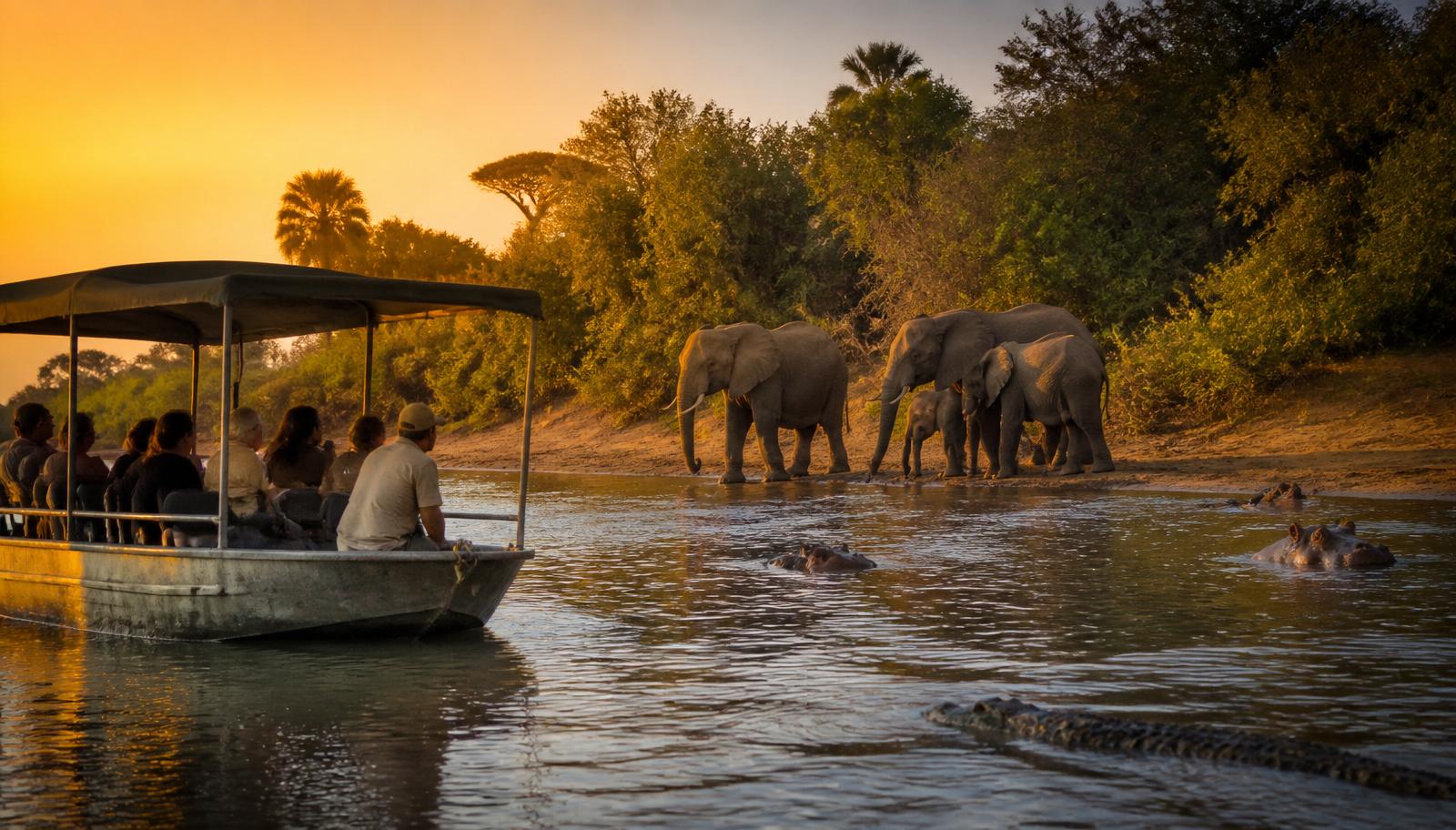
A boat puts you low, quiet and at an angle no vehicle can reach. Hippos are at eye height, crocodiles are close enough to see individually, and animals drinking at the bank usually tolerate a boat better than a vehicle. Photographers notice the difference immediately.
More than one way to spend a day
Southern Tanzania generally permits activities the busiest northern parks do not. Where your camp and the current park arrangements allow it, you can drive, boat and walk on the same stay. That variety is the main reason travelers who have already done the north enjoy this park.
Landscape and Ecosystems
The tourist sector is more varied than the phrase "river park" suggests. The table below covers the zones you move between and what each tends to offer.
| Zone | Character | What you tend to find |
|---|---|---|
| Rufiji River channels | Wide braided river with sandbanks, islands and steep cut banks | Hippo, crocodile, waterbirds, elephants drinking; the setting for boat safaris |
| Lake system | Connected lakes fed and drained by the river as levels change | Concentrated game in the dry months, fish eagles, herons, buffalo at the margins |
| Riverine forest and borassus palms | Green corridor of tall trees and palm stands along the water | Leopard, primates, forest birds; the most photogenic light on the whole circuit |
| Floodplain grassland | Open ground that floods and dries with the seasons | Wildebeest, zebra, impala, waterbuck and the predators that follow them |
| Miombo and mixed woodland | Broad-leaved woodland covering much of the wider landscape | Sable, kudu and woodland birds; sightings are sparser and require patience |
| Sand rivers and hot springs | Dry tributaries and thermal pools in parts of the sector | Game trails, elephants digging for water, distinctive landscape features |
The Rufiji River
The Rufiji is one of Tanzania's major rivers, and in this part of its course it spreads into channels, sandbanks and a set of lakes linked to the main flow. Levels rise and fall through the year with rainfall in the wider catchment, which changes the shape of the water and, with it, where animals gather and which boat routes are usable.
In the drier months the channels narrow, sandbanks emerge, and the lakes become reliable places to find game. In the wetter months the river spreads, some areas become hard to reach by vehicle, and boating becomes the more dependable activity. Asking your camp what the water is doing on arrival is the single most useful question you can ask here.
Wildlife You Can See
The table below reflects general likelihood over a stay of three or four days in the tourist sector during the drier months. It is a planning guide, not a forecast: animals move, and conditions vary.
| Species | Likelihood over three to four days | Where to look |
|---|---|---|
| Hippo | Very high | Rufiji channels, sandbanks and the connected lakes; visible from boats at close range. |
| Nile crocodile | Very high | River margins and lake shores, often hauled out on sand in the middle of the day. |
| Elephant | High in the drier months | Riverine woodland, lake edges and open floodplain; groups come down to drink through the afternoon. |
| Giraffe | High | Acacia and miombo edges across the drive circuits. |
| Buffalo | High | Floodplain and lake margins, in herds that grow as water tightens. |
| Lion | Good over several days | Open ground near the lakes and along game paths; often found by tracking rather than by chance. |
| Leopard | Possible, never a given | Riverine forest and thicket; more likely early and late in the day. |
| African wild dog | Genuinely uncertain | Wide-ranging packs across the wider landscape; movements vary through the year. |
| Waterbuck, impala, wildebeest, zebra | High | Floodplain grassland and open woodland throughout the tourist sector. |
| Greater kudu and sable | Uncommon and area-dependent | Thicker woodland away from the water circuits; usually needs a deliberate drive. |
| Waterbirds and raptors | Very high | River channels, sandbanks, lake shallows and palm-lined banks — best seen from a boat. |
Rhino are effectively absent from the traveler's picture in this landscape. If seeing rhino matters, that is a reason to include the Ngorongoro Crater elsewhere in the trip rather than a mark against Nyerere. For species-by-species depth on East African wildlife, our Serengeti wildlife guide covers behaviour and identification more fully than this page needs to.
Elephants and Large Mammals
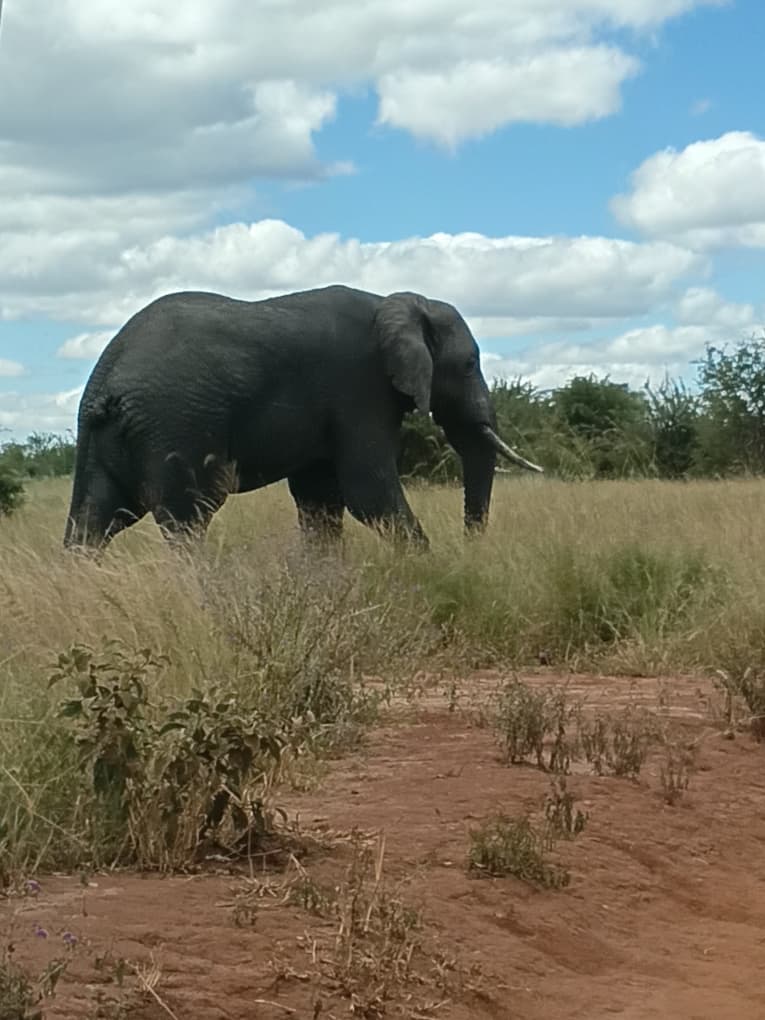
Elephants use the river corridor heavily, and watching a family group come down a cut bank to drink is one of the more reliable set pieces here in the dry months. From a boat you often see them at an angle a vehicle cannot reach, though the animals set the terms and a quiet approach matters.
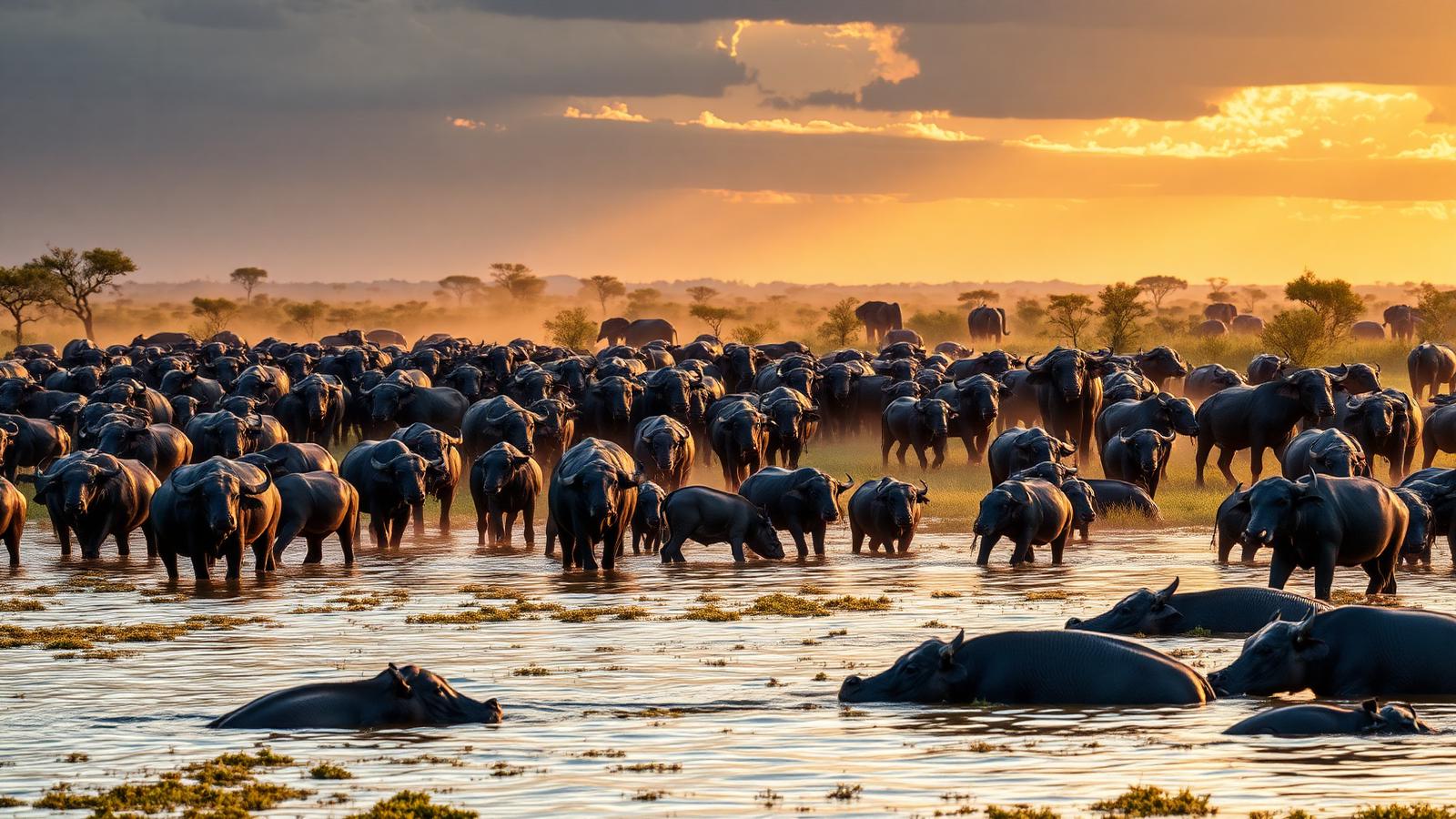
Buffalo gather in large herds on the floodplain and lake margins as water tightens, and giraffe are common through the woodland edges. Waterbuck, impala, wildebeest and zebra fill out the plains game, with numbers varying by area and season. Greater kudu and sable belong to the thicker woodland away from the water and usually take a deliberate drive to find.
Lions and Other Predators
Lions are present and seen regularly over a stay of several days, generally near the lakes and on the more open ground where prey concentrates. Sightings here tend to come from a guide reading tracks rather than from a radio call, which is a different rhythm from the busier northern parks.
Leopards occur in riverine forest and thicket and are a matter of timing and luck, as they are everywhere. Spotted hyena are widespread. Smaller predators such as genet, civet and jackal turn up more often on night drives, where the camp is permitted to run them — availability varies, so ask rather than assume.
African Wild Dogs: An Honest Answer
The wider southern Tanzanian landscape is recognised as important habitat for African wild dogs, and Nyerere is one of the places where looking for them is realistic rather than wishful. That is a genuine reason to come, and it is also where a lot of marketing overstates the case.
Packs cover long distances daily, so whether you see them depends on where they happen to be during your stay. Denning periods hold packs in one area for a while, which can improve local odds, but den locations change from year to year and access is managed to limit disturbance. No camp or operator can change any of this.
Hippos and Crocodiles
These two are the reason a first boat safari sticks in the memory. Hippo pods sit in the channels and lake shallows in numbers, and from a boat you hear them as much as see them. Crocodiles line sandbanks through the middle of the day and slide off as you pass.
Both are dangerous animals and both deserve respect on the water. Guides keep distance for good reasons, and the best sightings come from holding position and letting the animals settle rather than pushing closer. If you are photographing, this is where a longer lens earns its place.
Birdlife
Nyerere is one of the better birding destinations in the country, largely because of the water. Fish eagles, herons, storks, skimmers, bee-eaters nesting in river banks and a long list of waders are all part of a normal day on the boat, and the woodland adds a different set again.
The green months from November through April bring migrants and breeding plumage and are the stronger period if birds are a main interest. Bring binoculars for each traveler; on a boat, sharing one pair is worse than useless.
Activities: How They Compare
The mix of activities is what people remember about this park. What is available to you depends on your camp, the sector it sits in, the season and the current park arrangements — none of which are fixed, so treat the table below as a description of the options rather than a promise about your stay.
| Activity | What it feels like | Practical notes |
|---|---|---|
| Boat safari | Slow, close to water level, quiet approach | Hippo, crocodile, waterbirds and animals coming to drink. Availability and routes depend on water levels and your camp's arrangements. |
| Game drive | Standard safari rhythm, morning and late afternoon | Covers floodplain, lake circuits and woodland. Full-day drives with a packed lunch reach quieter areas. |
| Walking safari | Detail-focused and slower; tracks, plants, birds and smaller signs | Guided with an armed ranger, subject to park arrangements, minimum ages and camp permissions. Not offered everywhere or in every season. |
| Fly-camping or sundowner outings | Occasional add-on rather than a daily activity | Offered by some camps, seasonally and subject to conditions. Confirm before booking on that basis. |
Boat Safaris
A boat safari usually runs in the afternoon, lasting a few hours and finishing near sunset. The boats are small and open, the pace is slow, and much of the time is spent drifting rather than moving. You work the channels, the sandbanks and the lake edges, stopping where there is activity.
What makes it different from a drive is the angle and the quiet. Animals at the bank are often more relaxed with a boat than a vehicle, and being at water level changes every photograph you take. It is also simply more comfortable: no dust, cooler air, and a stable platform for a long lens.
- Take a light layer — it cools quickly on the water once the sun drops.
- A bean bag or folded jacket steadies a long lens better than trying to brace on the hull.
- Ask your guide to cut the engine and drift when you find something; noise, not distance, is what pushes animals off.
- Water levels dictate routes. A channel that worked last month may be closed this month.
Walking Safari Opportunities
Walking here is guided by a qualified guide with an armed ranger, and it is not about approaching big animals. It is about tracks, dung, bones, termite mounds, birds and the smaller detail you drive past all week. Most walks run in the early morning, last two to three hours and cover modest distances.
Availability is the part to check. Walking depends on the camp, the area it is permitted to use, minimum age policies and current park arrangements, and it is not offered everywhere or in all conditions. If a walk is important to you, make it a booking condition rather than an on-arrival request.
Game Drives
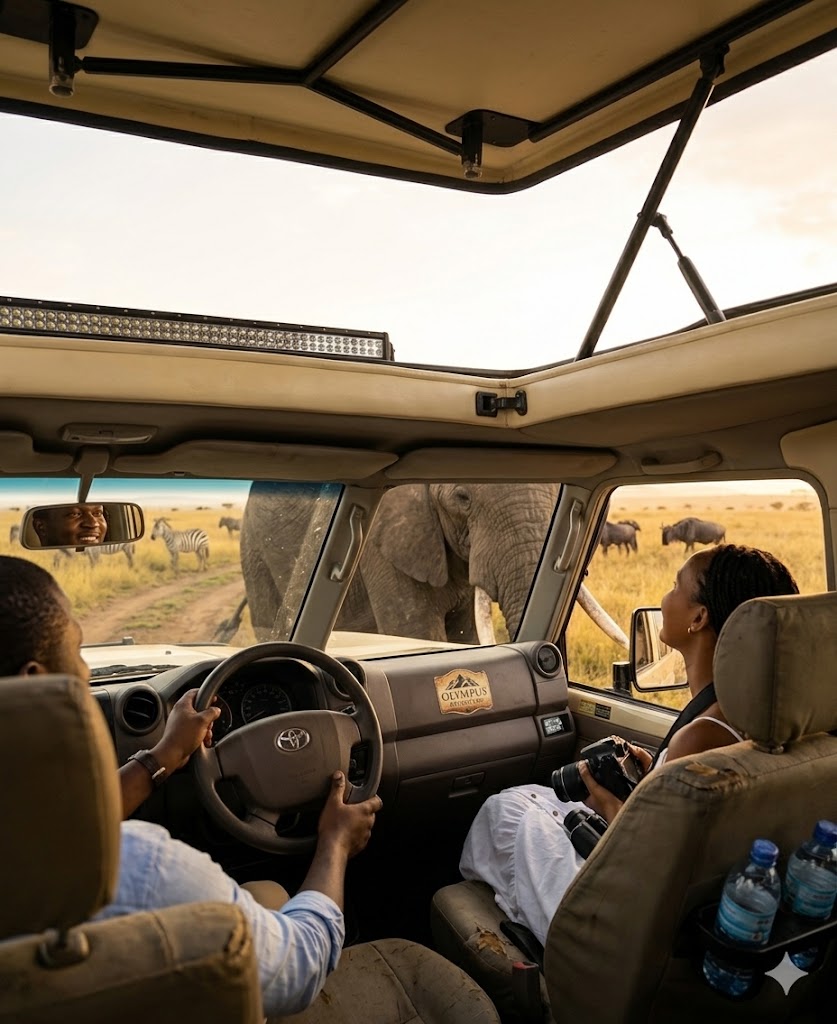
Drives follow the usual rhythm: out early while it is cool, back for a late breakfast, out again in the late afternoon. The circuits work the floodplain, the lake shores and the woodland behind them, and a full-day drive with a packed lunch is the way to reach the further lakes.
Expect fewer vehicles than the northern parks and a slower turnover of sightings. Guiding quality matters more here than the specific circuit you drive. First-time safari travelers sometimes find the pace unexpected; our guide for first-time visitors explains what a game-drive day actually involves.
Best Time to Visit
Rainfall varies year to year, so treat the boundaries below as approximate. For how this lines up with the rest of the country, see our month-by-month timing guide.
| Period | Typical conditions | What it means for your visit |
|---|---|---|
| January – February | Hot and humid, green, showery rather than continuously wet | Strong birding and lush river scenery. Wildlife is dispersed, so drives cover more ground. |
| March – May | Long rains; tracks soften and many camps close | The least practical stretch. Camp openings and access both need confirming well ahead. |
| June – August | Drying out, comfortable temperatures, thinning cover | Reliable drives, good boating conditions and a full range of camps operating. |
| September – October | Hot and dry, water concentrating in the river and lakes | Generally the strongest period for land sightings, and the busiest for camp availability. |
| November – December | Short rains begin; the landscape greens quickly | Quieter camps and excellent birdlife. Boat activity stays consistent when drives slow down. |
Dry Season vs Wet Season
The dry season is the straightforward choice for a first visit: thinner cover, wildlife concentrated near water, firm tracks and every camp operating. The trade-offs are heat late in the season and camps filling early for the strongest months.
The green season is quieter, greener and better for birds, with lower rates at the camps that stay open. The long rains are the genuine caution — access becomes difficult and a number of camps close entirely. Boating often remains the most dependable activity when driving slows, which is one advantage this park has over drier destinations in the same months.
How Long Should You Stay?
| Length of stay | Verdict | What it gets you |
|---|---|---|
| 2 nights | The bush-and-beach minimum | One full day plus partial arrival and departure days. Enough for a drive and a boat, not enough for variety. |
| 3 nights | The sensible standard | Room to rotate drives, boating and — where offered — a walk, without feeling rushed. |
| 4 nights | Better for wildlife-focused travelers | Time to reach the further lakes, repeat a productive area and take a full-day drive. |
| 5+ nights | For repeat visitors and photographers | Worth it if you want to work the river light properly or combine sectors at a slow pace. |
The reason three nights works better than two is the activity rotation. With two nights you effectively choose between a full day of driving and a full day that includes the water. With three you get both, plus a walk where it is offered.
Photography Notes
The river is the draw. Low-angle light on water, palms in silhouette, birds along the banks and elephants drinking give you compositions that plains parks cannot. Boats are a stable platform but they drift, so faster shutter speeds help more than you expect.
Bring a long lens for wildlife and something wider for the river landscape, and keep gear covered against spray and dust on transfers. Our safari photography guide covers settings and kit in detail.
Accommodation Options
Camps here are generally small, and most sit on the river or one of the lakes. Location does more for your experience than category, because it determines how quickly you reach water and how much of the day goes on transfers.
Seasonal tented camps
Light-footprint camps that operate through the drier months and close in the rains. Comfortable tents, communal dining, a bush-camp feel and usually strong guiding.
Permanent lodges and semi-permanent camps
Open for longer through the year, with solid rooms, power and often a pool. These suit families and travelers who want reliability in the shoulder months.
Higher-end small camps
Few rooms, private-guide options, flexible activity timing and more inclusions. The practical benefit is flexibility: being able to stay out through the middle of the day or shift a boat to the morning.
Some properties sit outside the park boundary. They can be good value, but the drive to and from the gate eats into activity time, and their access to boating and walking may differ. Check the position on a map before booking, not after.
How to Get There
Scheduled light aircraft serve airstrips in the tourist sector, with routings that typically connect from Dar es Salaam and Zanzibar and, seasonally, from Ruaha and the northern circuit. Flight times are short by Tanzanian standards, which is one reason the park works so well as a bush leg before the coast. Schedules and operators change, so we confirm current options at the time of quoting.
Road access from Dar es Salaam takes most of a day, with the final stretch on unsealed road that is slower in the rains. It suits travelers on a tight budget with days to spare rather than anyone on a short trip.
Nyerere vs Ruaha
This is the comparison that decides most southern itineraries, and the usual answer is to include both. They complement each other rather than compete.
| Factor | Nyerere | Ruaha |
|---|---|---|
| Defining feature | The Rufiji River and its lake system | Dry country: baobabs, ridges, sand rivers |
| Signature activity | Boat safaris alongside drives and walking | Game drives, with walking where offered |
| Wildlife emphasis | Hippo, crocodile, elephant, waterbirds, wild dog | Elephant, large prides, kudu, dry-country antelope |
| Feel of a day | Varied — water and land in the same day | Longer searching, longer sightings, more space |
| Access | Short flight from Dar es Salaam or Zanzibar | Longer flight, usually via Dar es Salaam or Nyerere |
| Best combined | Works well before or after Ruaha | Pairs naturally with Nyerere on one southern leg |
If you can only visit one, choose Nyerere for water-based activity, variety and an easy link to the coast, and Ruaha for dry-country wildlife and space.
Nyerere vs Serengeti
These are different kinds of safari rather than competing versions of the same one. The Serengeti is a plains ecosystem with high density and the migration; Nyerere is a river system where the interest comes from water, variety of activity and the absence of traffic.
| Factor | Nyerere | Serengeti |
|---|---|---|
| Ecosystem | River, lakes, floodplain and woodland | Open plains, kopjes and riverine belts |
| Wildlife density | Good near water, patchier away from it | Consistently high across the main areas |
| Activities | Drives plus boating and, where offered, walking | Drives, with balloons in some areas |
| Migration | Not part of the migration system | The migration's home ecosystem |
| Vehicles at sightings | Usually few | Can be many in peak areas and seasons |
| Typical first safari? | Good with three nights or more, especially with a beach add-on | The usual and reasonable first choice |
On a first trip with limited days and a wish to see the herds, the north wins. On a second trip, or when the plan ends on the coast, the south usually delivers the more varied experience.
How Nyerere Fits an Itinerary
- Bush and beach, around a week — three nights Nyerere, then four on Zanzibar, flying directly between the two.
- Full southern circuit — three or four nights in Ruaha and three in Nyerere, flying between them and out through Dar es Salaam.
- Southern circuit plus coast — the same two parks followed by several nights at the beach, which most travelers prefer at the end.
- North and south in two weeks — northern parks first, then a southern leg. Ambitious, but workable with enough nights and few internal moves.
Worked routings with night counts sit in our itineraries guide, so this page does not repeat them in full.
Who Is Nyerere Best For?
- Travelers who want a safari that is not only vehicle-based.
- Anyone combining bush with Zanzibar or the coast, where the short flight matters.
- Birders and photographers drawn to water, light and low angles.
- Families with children old enough for the activities, since boats break up the day well.
- Repeat visitors who have already done the northern parks.
- Travelers who value quiet sightings over a high count.
When Another Park Makes More Sense
We would rather set expectations before you book than explain them afterwards.
- Migration-focused trips. The herds are a northern phenomenon; nothing in the south substitutes for them.
- Very short safaris. On four or five days total, the northern parks give more wildlife per day with less flying — start with Tarangire and Lake Manyara.
- Rhino as a priority. Nyerere will not deliver it.
- Travelers uncomfortable on small boats or light aircraft. Both are central to how this park works.
- March to May travel with no flexibility. Camp closures and access make this the hardest window to plan.
What Drives the Cost of a Nyerere Trip
We do not publish prices here, because camp rates, park fees and flight costs move by season and year, and an out-of-date figure is worse than none. The structure of the cost is stable enough to plan around.
- Light aircraft flights, which most travelers use in both directions.
- Park entry and concession fees, charged per day of your stay.
- Camp category, and whether boating, walking and night drives are included or charged separately.
- Position — camps on the water usually cost more and usually save you time.
- Season, with the driest months carrying the highest rates and filling earliest.
- Private vehicle or private boat arrangements, which change how flexible your days are.
Our safari cost guide explains how these pieces combine across a full trip.
Common Planning Mistakes
| Mistake | Better approach |
|---|---|
| Booking a one-night stop from Zanzibar | Two nights is the floor and three is better. A single night is mostly transfers. |
| Assuming boating and walking are automatically included | Both depend on the camp, the sector, the season and current park arrangements. Confirm in writing when booking. |
| Choosing a camp away from the water | Position matters more than category here. A camp on the river or a lake shapes what your days look like. |
| Travelling in the long rains without checking | Many camps close. Confirm openings and access before committing to March through May. |
| Expecting migration-style herds | This is a river ecosystem, not a plains one. Judge it on water-based viewing and variety. |
| Building the trip around wild dogs | Plan for elephants, hippos, birdlife and the river. Treat a dog sighting as a strong day, not the baseline. |
Related Guides
- Ruaha National Park guide — the park Nyerere is most often combined with.
- Serengeti wildlife guide — species detail for the northern ecosystem.
- Tarangire National Park guide — the northern park with the strongest dry-season elephant viewing.
- Tanzania safari itineraries — worked routings and night counts.
- Safari guide for first-time visitors — what a game-drive day actually involves.
- Safari photography guide — gear and settings, including shooting from a boat.
Common Questions
Frequently Asked Questions
For most travelers, yes — provided you know what it offers. Its strength is variety within a single day: game drives on the floodplain, boat safaris on the Rufiji, and walking where the camp and current park arrangements allow. Sightings are usually quiet and uncrowded. It is not a migration destination and wildlife thins away from the water, so judge it on the river experience rather than on animal counts.
In 2019 Tanzania gave the northern photographic sector of the former Selous Game Reserve full national park status and named it after Julius Nyerere, the country's founding president. Areas outside that sector keep reserve status and are managed differently. When an operator quotes a Selous safari today they almost always mean a photographic trip inside Nyerere; if a quote is ambiguous, ask which area your camp sits in, because it affects which activities are permitted.
Usually an afternoon activity of a few hours in a small open boat, ending near sunset. Much of it is spent drifting along channels, sandbanks and lake edges rather than moving. Hippos are at eye level, crocodiles sit close on the sand, and animals coming to drink often tolerate a boat better than a vehicle. Routes depend on water levels, and availability depends on your camp and current arrangements.
No. Some camps include them in a daily activity rotation, others charge separately, and some cannot offer them depending on where they sit and what is currently permitted. Walking also carries minimum-age policies and is guided with an armed ranger. If either activity matters to you, make it a written booking condition rather than an on-arrival request.
Hippo, crocodile and waterbirds are close to certain along the river. Elephant, buffalo, giraffe, impala, waterbuck, wildebeest and zebra are commonly seen, especially in the drier months when water concentrates game. Lions are found regularly over several days, usually through tracking rather than chance. Leopard is possible but never a given, and rhino are effectively absent. No sighting can be guaranteed.
Maybe. Southern Tanzania is recognised as important habitat for wild dogs and Nyerere is a realistic place to look, which is more than can be said for most parks. But packs cover long distances daily, so a sighting depends on where they happen to be during your stay. Denning periods can hold a pack in one area for a while, though locations change year to year and access is managed to limit disturbance. Plan the trip around the river and treat a dog sighting as a strong day.
June through October is the most reliable window: thinning cover, wildlife concentrated near water, firm tracks and every camp operating, with heat building late in that period. November and December bring the short rains, quieter camps and excellent birdlife. The long rains from roughly March to May are the hardest window, with soft tracks and a number of camps closed — confirm openings and access before committing.
Three nights is the sensible standard, because it lets you rotate drives, boating and a walk without rushing. Two nights works when the park is a short bush leg before Zanzibar, but it effectively gives you one full day. Four or more suits wildlife-focused travelers and photographers who want to reach the further lakes and work the river light properly.
Nyerere is a river park with boating, water-level viewing and easy access to the coast. Ruaha is dry country — baobabs, sand rivers and long distances — with game drives as the main activity and a different feel to a day. They complement each other, which is why most southern itineraries include both. If you can only visit one, choose Nyerere for variety and a beach add-on, Ruaha for dry-country wildlife and space.
They are different kinds of safari. The Serengeti is a plains ecosystem with consistently high wildlife density and the migration; Nyerere is a river system where the interest comes from water, activity variety and few vehicles at sightings. On a first trip with limited days and a wish to see the herds, the north is the better choice. On a second trip, or one ending at the coast, the south usually feels more varied.
Yes, and it is the most natural bush-and-beach pairing in Tanzania because scheduled light aircraft connect the park's airstrips with Zanzibar directly. A common shape is three nights in the park followed by several on the island, with the beach at the end. Schedules and operators change, so current routings should be confirmed at the time of booking.
It can be, with the right camp and the right ages. Boat safaris break up the day and hold younger travelers' attention better than long drives. Look for a camp with a pool and family rooms, and check minimum-age policies for walking safaris, which are usually restrictive. For very young children, the northern parks are generally easier because of shorter transfers and road access.
Final Thoughts
Nyerere is worth including when you want more than a vehicle for a week. The Rufiji gives you hippos at eye level, elephants on the bank and birdlife that keeps working when the land is quiet, and the option of walking adds a pace that most safaris never reach.
It is not a migration park, and away from the water it thins out. Give it three nights where you can, choose a camp on the river or a lake, confirm which activities your camp can actually run, and it becomes one of the more varied legs of a Tanzanian trip.
Nyerere rewards travelers who want their days to change shape — a morning tracking on land, an afternoon drifting past hippos and drinking elephants, and the option of walking where conditions and park arrangements allow. Give it enough nights, pick a camp on the water, confirm what your camp can actually run, and southern Tanzania will feel like a different country from the northern circuit.
Plan Your Journey
Planning a southern Tanzania trip?
Tell us your dates, pace and what you most want out of the days, and our team will map a route that works: how Nyerere and Ruaha fit together, which activities each camp can actually offer, how many nights each park deserves, accommodation at your comfort level, private vehicle and boat options, seasonal timing and sensible flight connections. If the northern parks suit your trip better, we will say so — and no one can guarantee wildlife sightings.
- TALA Licensed Operator
- 4.9 ★ Guest Rating
- No Booking Fees
Keep Reading
Related Tanzania Safari Guides
Safari Guides
The Ultimate Tanzania Travel Guide: Everything You Need to Know Before You Visit
Safari Guides
Ruaha National Park Guide: Wildlife, Timing and Whether It Belongs in Your Safari