Northern Circuit Guide
Tarangire National Park Safari Guide
Elephants, baobabs and the swamps that hold the park together — what to expect month by month, how long to stay, and how Tarangire fits into a northern circuit, from our Arusha planning desk.

Introduction
Most itineraries give Tarangire a morning. The vehicle leaves Arusha after breakfast, spends three hours on the tracks nearest the gate, and pushes on to Karatu by mid-afternoon. Guests come away thinking it was pleasant enough. They also never see the part of the park that makes guides want to work here.
Tarangire is about 2,850 square kilometers, and the northern strip near the entrance is the busiest, least interesting fraction of it. An hour south the tracks empty, the baobabs get older and stranger, and the Silale Swamp opens up with buffalo, elephant bulls, and the park's most productive lion country. That contrast is the single most useful thing to understand before you plan a Tarangire National Park safari.
The other thing to understand is timing. Tarangire runs on water. As the surrounding country dries out between July and October, the Tarangire River becomes the only permanent water for a huge area, and elephants arrive in numbers you will not see anywhere else in East Africa. Come in April and the same park is green, quiet, full of birds, and largely empty of those herds. Neither version is wrong. They are just different trips, and you should know which one you are booking.
Where Tarangire sits and how you get there
The park lies southeast of Lake Manyara, about 118 km from Arusha on tarmac most of the way, with a short graded stretch to the main gate near Kwa Kuchinja. Driving takes two to two and a half hours depending on traffic through Makuyuni. There is an airstrip for charter flights, but almost everyone arrives by road because Tarangire is genuinely on the way to everything else.
That location is why it belongs at the start of a northern circuit safari rather than squeezed in at the end. You leave Arusha in the morning, spend the day in the park, and carry on toward Karatu, Ngorongoro or Lake Manyara the next day without doubling back.
What the landscape actually looks like
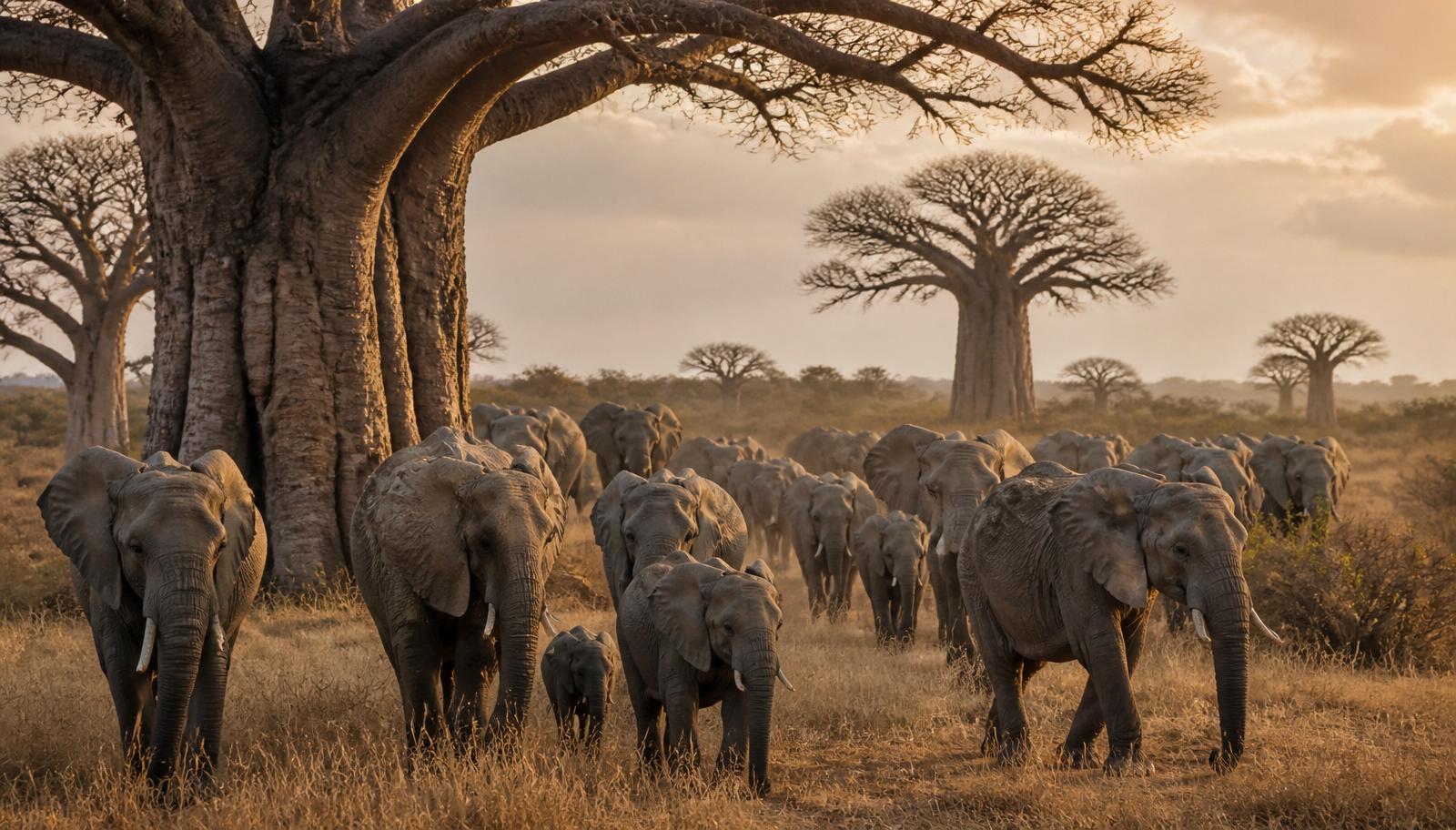
Not open plains. Tarangire is river valley, acacia woodland, seasonal swamp and rolling ridges studded with baobabs — some of them well over a thousand years old, many scarred where elephants have stripped the bark for moisture. The river cuts a broad sandy channel through the middle. In the dry months it looks empty, but elephants dig into the sand with their feet and trunks to reach water below, and that behavior alone is worth an hour of your morning.
Best wildlife to see in Tarangire
The headline is elephants, and rightly so. But the park quietly holds a set of species that most northern-circuit visitors never encounter: fringe-eared oryx, gerenuk browsing on their hind legs, and lesser kudu slipping through the thicket. These are dry-country animals, and Tarangire is the only northern park where you have a realistic chance at them.
Predators are present and often overlooked. Lion do well here — the Silale Swamp prides are large and hunt buffalo — but they are harder to find than in the Serengeti because the vegetation is thicker and there are far fewer vehicles calling in sightings. Leopard sightings happen, usually in riverine trees at first light, and cheetah occur on the southern grasslands where few day visitors bother to drive.
Tarangire wildlife table
Realistic dry-season expectations, based on what our vehicles report across a normal season. Nothing here is a guarantee.
| Species | Chance of seeing | Where to look | Field note |
|---|---|---|---|
| African elephant | Very high (dry season) | Tarangire River, Silale Swamp edges | Herds of 100–300 gather along the river from August. The park's defining sight. |
| Lion | High | Silale Swamp, Kuro area, river terraces | Tarangire prides occasionally rest in trees — less reliable than Manyara's, but it happens. |
| Leopard | Moderate | Riverine woodland, Lemiyon acacias | Best at first light. Fewer vehicles means fewer eyes on the trees, so sightings are luckier here. |
| Cape buffalo | Very high | Swamps, riverbanks | Large dry-season herds; solitary bulls near the swamp edges year-round. |
| Cheetah | Low to moderate | Open southern plains, Gursi area | Requires distance and time; most day-trippers never reach that part of the park. |
| Giraffe & zebra | Very high | Throughout | Zebra numbers swell in the dry months as migratory herds move in from Manyara and the Simanjiro plains. |
| Fringe-eared oryx & gerenuk | Low | Dry southern sectors | Two arid-country specialists you will not find in Serengeti or Ngorongoro. |
| Wild dog | Rare | Southern reaches, wet season | Genuine luck. Never plan a trip around it. |
For how Tarangire fits into a wider Big Five plan — and why rhino means a Ngorongoro day — see our guide to the Big Five in Tanzania.
The elephants
Tarangire holds an estimated 2,500 to 3,000 elephants, and in the late dry season several hundred can be in view along a single stretch of river. What makes it worth slowing down for is not the count. It is the behavior you get to watch when families are relaxed and clustered: calves learning to use their trunks badly, teenage bulls testing each other, matriarchs deciding when the group moves and everyone falling in behind.
Bulls in musth are common here between roughly September and November — temporal glands streaming, walking with a purposeful swagger. A good guide gives them wide berth and switches the engine off rather than trying for a closer frame.
Birdlife
Over 550 species have been recorded, which puts Tarangire among the best birding parks in Tanzania. The swamp margins are the productive ground: herons, storks, and a strong raptor list including bateleur, martial eagle and, in the woodland, pale chanting goshawk on almost every other termite mound.
The park's dry-country endemics are the real draw for birders — yellow-collared lovebird and ashy starling are both near-endemic to this part of Tanzania. Between November and April, Palearctic migrants arrive and the species count climbs sharply. If birds matter to you, the green season is objectively better, whatever the elephant brochures say.
Best time to visit Tarangire
July through October is the strongest general window: the herds are concentrated, the grass is short, the roads are firm, and every sector of the park is reachable. September and October are the peak of the elephant gathering, with October adding dramatic pre-rain skies.
June and early November are the value months — most of the dry-season advantage, fewer vehicles, softer rates. January and February are a reasonable dry break in the middle of the green season, and pair well with calving season on the southern Serengeti plains. Our guide to the best time to visit Tanzania sets all of this against the wider seasonal calendar.
Dry season vs green season
| What changes | Dry season (Jul – Oct) | Green season (Nov – May) |
|---|---|---|
| Elephant numbers | Peak — hundreds along the river | Dispersed across the wider ecosystem |
| Vegetation | Thin, open, easy sightlines | Tall grass, dense green, harder viewing |
| Roads | Firm, dusty, all sectors reachable | Black-cotton soil; southern sectors often closed |
| Birdlife | Good resident species | Exceptional — migrants present Nov–April |
| Crowds | Busy mornings near the gate | Very quiet |
| Rates | Peak pricing, book early | Noticeably lower, more availability |
| Scenery | Dust, baobabs, dramatic light | Green hills, storm skies, wildflowers |
Our own bias, for what it is worth: if this is your first safari and Tarangire is one park among three, come in the dry season. If you have been before, or you are a birder or a photographer who likes weather in the frame, the green season version of Tarangire is the more interesting one and costs less.
Game drives and driving conditions
Tracks in the north are graded and firm year-round. Everything south of the Silale Swamp turns on soil type: black cotton soil holds water, and after heavy rain the southern loops become genuinely impassable rather than merely difficult. Sections are closed in the wettest weeks, and a good operator will tell you that before you book rather than after you arrive.
- Gate hours: 06:00 to 18:00. Night driving is not permitted inside the national park; some private concessions on the boundary allow it.
- Dust: September and October are heavy. Keep camera bodies bagged and change lenses inside the vehicle.
- Tsetse flies: present in the woodland belts. They are attracted to dark blue and black — wear khaki or olive, and see our safari packing list for what actually works.
- Distances: reaching Gursi and the far south is a two-hour drive each way from the main gate. Plan it as a full day with a packed lunch.
How many days to spend in Tarangire
- Half day: better than nothing, but you will only see the northern sector. Common on budget group tours, and the reason Tarangire gets underrated.
- One full day, one night: our standard recommendation. You get a proper morning, the southern swamps, and evening light.
- Two nights: the version we would choose. A full day south to Silale and Gursi, a second morning on the river, and no rushing anywhere.
- Three or more: worth it for photographers, birders and repeat visitors, especially combined with a walking safari on a private concession.
Sample Tarangire itinerary — one full day
| Time | Plan |
|---|---|
| 06:15 | Coffee, then straight out. Lemiyon section first — best light and the coolest hour for cats. |
| 07:30 | Down to the Tarangire River. Elephant families come to drink and dig for water in the sand. |
| 09:30 | Work the river south toward Matete, scanning riverine trees for leopard and the terraces for lion. |
| 11:30 | Bush breakfast under a baobab, away from the picnic sites where vervets and baboons work the crowd. |
| 13:00 | Slow drive toward Silale Swamp — buffalo, elephant bulls, and the park's best lion territory. |
| 15:30 | Birding along the swamp margins; a good hour for raptors and the park's dry-country specials. |
| 17:00 | Return north as the light turns. Baobab silhouettes and elephants crossing the track home. |
Where to stay
Three broad options, and the choice affects your trip more than the star rating does.
Inside the park
Lodges and tented camps on the escarpment above the river, plus seasonal camps further south. You are on the tracks at first light with no gate queue, and you fall asleep to elephants moving through camp. This is where we put guests whenever the budget allows.
Boundary and private concessions
Land bordering the park to the north and east. Slightly cheaper, and the concessions allow night drives and walking safaris that are prohibited inside the national park — a real advantage for second-time visitors.
Karatu, Mto wa Mbu or Arusha
Cheapest, and the most common compromise on group tours. The cost is time: an hour or more of driving before the gate opens, which removes the best wildlife hour of the day. If your itinerary does this, it is worth asking what the saving actually is. Our Tanzania safari cost breakdown shows where that money goes.
Tarangire vs Serengeti
They are not competing for the same slot in an itinerary, and treating them as alternatives is how people end up disappointed with both.
| Tarangire | Serengeti | |
|---|---|---|
| Signature sight | Massed elephant herds and baobabs | Open plains, big cats, the migration |
| Size | About 2,850 km² | Roughly 14,750 km² |
| Drive from Arusha | 2 – 2.5 hours | 7 – 8 hours, or a 1-hour flight |
| Typical stay | 1 – 2 nights | 3 – 4 nights |
| Vehicle density | Lower, especially after 10 a.m. | Higher in Seronera and at crossings |
| Best for | Elephants, birds, landscape, a strong first day | Predators, scale, migration timing |
If you only have days for one, and predators or the migration are what you came for, the Serengeti wildlife guide will help you plan that instead. In practice most seven-day itineraries include both, with Tarangire on day one.
Tarangire vs Ngorongoro
| Tarangire | Ngorongoro Crater | |
|---|---|---|
| Format | Open park, drive where you like | Timed crater descent, fixed floor |
| Landscape | Baobabs, river valley, swamps | Enclosed caldera, short grass |
| Big Five | Four of five; no rhino | All five present, best rhino odds |
| Pace | Unhurried, few time limits | Crowded floor, six-hour descent window |
| Time needed | Full day minimum | One full crater day |
The crater is a concentrated, time-limited, occasionally crowded spectacle; Tarangire is a slow, open park you can drive for hours without meeting another vehicle. Most people want both, and they complement each other well. The Ngorongoro Crater safari guide covers descent timing and permits in detail.
Best for first-time safari visitors
Tarangire is a good opening act for a reason that has nothing to do with the wildlife: it is close. Two hours from Arusha means a jet-lagged group is in the park on day one rather than spending it in a vehicle. Sightings come easily, the guide has time to explain how the day works, and everyone learns to use their binoculars before the pressure of a Serengeti morning.
Families do well here too. Drive distances are manageable, elephant sightings are absorbing for children who find distant antelope boring, and several lodges have pools for the middle of the day. If this is your first trip, read our Tanzania safari guide for first-time visitors alongside this one — it covers pacing, budgets and what a safari day actually feels like.
Photography tips
- Shoot the baobabs wide. A 16–35 mm with an elephant small in the frame tells the Tarangire story better than any telephoto portrait.
- Use the dust. Late afternoon backlight through herd dust is the park's signature image. Expose for the highlights and let the shadows go.
- Get low at the river. Ask your guide to park below the bank so you shoot up at drinking elephants rather than down.
- 100–400 mm covers most of it. Distances are shorter than in the Serengeti; a 600 mm is rarely necessary here.
- Protect your gear. Dry-season dust is fine and relentless. Bean bag on the window frame, lens changes inside a bag.
For settings, gear lists and how to brief a guide as a photographer, see our Tanzania safari photography guide.
Combining Tarangire with the northern circuit
The standard sequence works because of geography, not marketing: Arusha to Tarangire, Tarangire to Manyara or straight up to Karatu, then the crater, then the Serengeti. Everything runs one direction along the same road, and nobody backtracks.
- 5 days: Tarangire (1 night), Ngorongoro (1 night), central Serengeti (2 nights).
- 7 days: add a second Tarangire night or a Manyara half day, and a third Serengeti night.
- Fly-out option: drive the circuit outbound and fly from the Serengeti back to Arusha or on to Zanzibar. It saves a long driving day.
Expert planning tips
- Be at the gate at opening, not after breakfast. The difference between 06:00 and 08:30 is most of your predator chances.
- Drive south. Silale Swamp and beyond is where the park stops feeling busy. Say so on day one so your guide plans the fuel and the lunch.
- Book park-interior camps early. There are few beds inside the park, and July to October fills eight to ten months ahead.
- Bring binoculars per person. Woodland viewing rewards them far more than open plains do.
- Ask about park fees in your quote. Tarangire entry, concession and camping fees are a real line item; a transparent operator itemizes them.
- Consider a boundary concession for night drives. Genets, civets and porcupines are common after dark and impossible to see inside the park.
Common visitor mistakes
| Mistake | What it costs you | Better approach |
|---|---|---|
| Treating Tarangire as a half-day stop | You see the first 15 km of a 2,850 km² park and leave thinking it is small. | Give it at least one full day, ideally a night inside or on the boundary. |
| Visiting in April and expecting the elephant herds | Herds disperse in the rains; the park reads completely differently. | Come August to October if elephants are the priority, or adjust expectations for green season. |
| Staying far away in Karatu or Arusha | You lose the first and last hours of light — the only hours that reliably produce predators. | Sleep inside the park or at a boundary camp with early gate access. |
| Only driving the northern circuit near the gate | Congested tracks and the least interesting habitat. | Push south toward Silale and Gursi; the park empties out within an hour of the gate. |
| Skipping Tarangire to 'save time' for Serengeti | You trade the best elephant viewing in East Africa for one more day of plains. | Keep it as day one — it is on the way, and it eases the group into safari rhythm. |
Frequently Asked Questions
Common Questions
Frequently Asked Questions
Yes, provided you give it more than a passing morning. Tarangire holds the largest dry-season elephant concentrations in East Africa, over 550 recorded bird species, and dry-country animals such as fringe-eared oryx and gerenuk that you will not see in the Serengeti or Ngorongoro. Visitors who leave unimpressed almost always spent three hours near the gate and never drove south.
Tarangire hosts an estimated 2,500 to 3,000 elephants, with dry-season concentrations of 300+ animals gathering along the Tarangire River. It has the highest density of elephants of any Tanzanian park in the dry months.
Two full days (2 nights) is the sweet spot. One day is workable for a taste, but two lets you cover the northern river circuit, the Silale Swamp area to the south, and enjoy both morning and late-afternoon light.
June through October — the dry season — for peak elephant concentrations and predator activity. January and February are excellent for birding and green-season landscapes with fewer vehicles.
Four of the five reliably: elephant, buffalo, lion and leopard. Black rhino is absent from Tarangire — for the full Big Five, combine Tarangire with a day in the Ngorongoro Crater.
Yes — it's one of our top family recommendations. The relaxed pace, close elephant sightings, easy driving distances and welcoming family lodges make it ideal for children aged 6 and up.
Far less than Serengeti or Ngorongoro. Even in peak season, most vehicle traffic stays within the first 20 km of the main gate. Push into the Silale Swamp or Kitibong Hill areas and you'll often have entire sightings to yourself.
Yes — it is the standard northern circuit sequence, and it works because of geography rather than marketing. Most guests travel Tarangire → Lake Manyara → Ngorongoro Crater → Serengeti over 7–10 days, then fly back to Arusha or on to Zanzibar from a Serengeti airstrip. Nobody backtracks.
The northern tracks are graded and firm year-round. South of Silale Swamp the soil is black cotton, which holds water — after heavy rain those loops become impassable and some sections close. In the dry months every sector is reachable, though September and October are extremely dusty.
No one can promise that. Tarangire's seasonal pattern is unusually predictable — receding water pulls herds onto the river between roughly August and October — but it still depends on when the rains stop. Travelling in those months, driving the river early and staying inside the park is what puts the odds strongly in your favour.
In Closing
Final Thoughts
Tarangire rewards patience more than most northern circuit parks. Stay a night or two, be through the gate at six, drive further south than your itinerary suggests, and it stops being the warm-up act on the way to the Serengeti. The elephants along the river in late September are reason enough on their own — but it is the baobabs, the swamp light and the empty tracks that people tend to describe first when they get home.