
Tanzania Safari Guide
Ruaha National Park Guide: Wildlife, Timing and Whether It Belongs in Your Safari
What southern Tanzania's largest park is actually like, what you can realistically expect to see, how long to stay, and how it compares with the Serengeti and Nyerere — from our Tanzanian safari team.

Ruaha comes up late in most planning conversations. Travelers settle the Serengeti and Ngorongoro first, then ask whether there is somewhere quieter worth adding. Ruaha is usually the honest answer to that question — and just as often the wrong answer for the trip they have already designed.
This guide covers what the park is like on the ground, what the wildlife looks like across the seasons, how many nights it deserves, and when a different park would serve you better. For routing and budget across a whole trip, see our Tanzania safari itineraries guide and the breakdown of what a safari actually costs.
The Short Answer
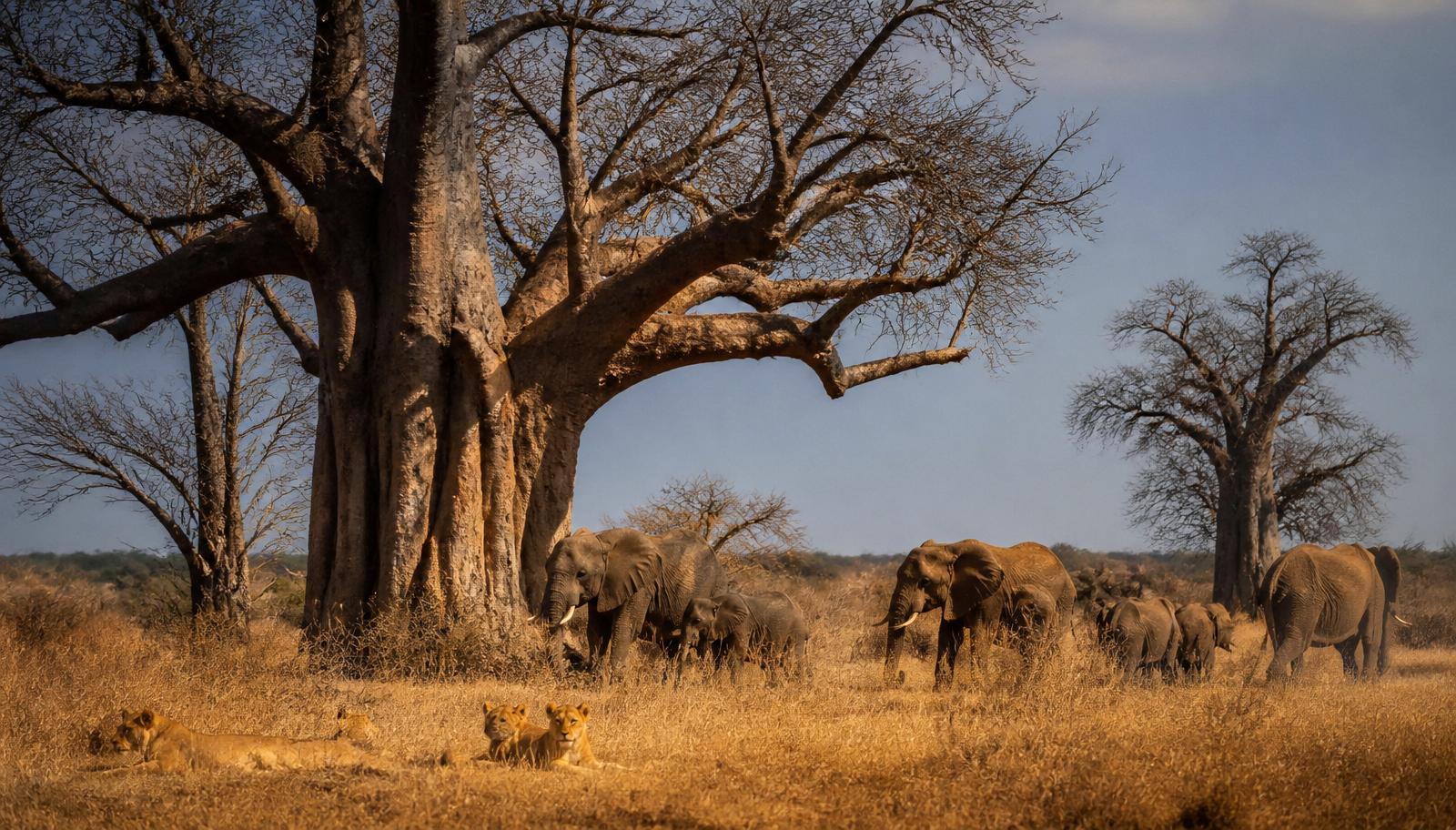
Ruaha is a large, dry, rugged park in southern Tanzania where the wildlife is spread across a lot of country and the vehicles are few. It is strong on elephants, on lions, on dry-country antelope such as greater and lesser kudu, and on landscape — baobabs, rocky ridges and a river corridor that becomes the centre of everything as the dry season deepens.
It suits travelers who would rather sit with one sighting for twenty minutes than tick through six. It is not the easiest first safari, because access is by light aircraft and the park rewards time. Three nights is the point at which it starts to make sense; below that, the flights outweigh what you see.
Where Is Ruaha National Park?
Ruaha lies in southern-central Tanzania, inland and well west of the coast, above the town of Iringa on the edge of the Southern Highlands. It sits in a transition belt where the drier East African savanna meets the miombo woodland that runs south across the region. That position matters more than the map suggests: it is the reason the species list here reads differently from the northern parks.
The park is very large, and only part of it is served by tracks and camps. In practice, a Ruaha safari means the accessible sector around the Great Ruaha River and the woodland behind it, with longer drives into quieter country if you have the nights for it. Nobody covers the whole park in a single visit, and nobody should try.
Almost all travelers arrive by scheduled light aircraft. Road access from Dar es Salaam exists, but it is a long day and rarely a good use of safari time unless you are already travelling overland through Iringa.
What Makes Ruaha Different?
Four things separate Ruaha from the parks most travelers know.
A transition ecosystem
Ruaha sits where southern African and East African species overlap. Greater and lesser kudu occur in the same park, and sable and roan antelope are present in the miombo. That mix is unusual in Tanzania and is the strongest single argument for going, particularly if you have already done the northern parks.
Dry-country drama
As the dry season advances, the Great Ruaha River shrinks to a chain of pools and the surrounding country empties towards it. Elephants dig in sand riverbeds. Predators work the crossings. It is a concentrated, visible version of how dry-season ecosystems function, and it is easier to read here than in wetter parks.
Scale without traffic
The park is far larger than the area travelers actually use, and the camp count is modest. The practical result is that you rarely share sightings. That changes the pace of a day: you stay longer, talk more with your guide, and are not chasing radio calls.
Landscape as a reason in itself
Baobabs on rising ground, granite ridges, broad sand rivers and the deep-green ribbon of riverine trees give Ruaha a look that photographs well even on a quiet game drive. That matters when density is lower — the drive is still worth taking.
Landscape and Ecosystems
Ruaha is not one habitat. The table below covers the zones you move between and what each tends to offer, which is useful when you are discussing the next day's plan with your guide.
| Zone | Character | What you tend to find |
|---|---|---|
| Great Ruaha River corridor | Permanent and seasonal pools below sandy banks | The dry-season heart of the park: elephant, buffalo, lion, hippo, crocodile, waterbirds |
| Sand rivers | Broad dry riverbeds cutting through woodland | Elephants digging for sub-surface water, predators using them as travel routes |
| Baobab and combretum woodland | Open woodland studded with mature baobabs on rising ground | Giraffe, kudu, impala; the landscape most people picture when they picture Ruaha |
| Miombo woodland | Broad-leaved woodland covering much of the park's interior | Sable, roan and specialist birds; sightings are sparser and require patience |
| Rocky ridges and kopjes | Granite outcrops breaking above the tree line | Leopard and klipspringer habitat, and the best vantage points for landscape photography |
| Seasonal grass plains | Open pockets that flush green after rain | Grazers and, occasionally, cheetah in the more open sections |
The Great Ruaha River is the organizing feature. Its flow varies through the year and between years, and in the late dry season much of the bed is sand with pools remaining in the deeper sections. Where water holds, animals gather; where it does not, the country empties out. Ask your camp where water is sitting when you arrive, because it changes the shape of every drive.
Wildlife You Can See
The table below reflects general likelihood over a stay of three or four days in the accessible sector during the drier months. It is a guide to what to plan around, not a forecast for any particular visit — wild animals move, and conditions vary.
| Species | Likelihood over three to four days | Where to look |
|---|---|---|
| Elephant | High through the dry months | Great Ruaha River frontage, sand rivers and baobab country; family groups dig for water in dry riverbeds. |
| Lion | High over several days | River frontage and open miombo edges; prides here are often large, though group size varies by area and season. |
| Leopard | Possible, never a given | Riverine woodland and rocky kopjes; best odds early morning and on night drives where permitted. |
| Cheetah | Occasional | Open grassland pockets rather than the wooded majority of the park. |
| African wild dog | Genuinely uncertain | Wide-ranging packs; sightings depend on where packs are moving and, in denning months, where they settle. |
| Buffalo | High | River margins and open woodland; large herds gather near water as the dry season advances. |
| Giraffe | High | Acacia and combretum woodland throughout the accessible sector. |
| Greater and lesser kudu | Good, kudu being a Ruaha signature | Thicket and dry woodland; lesser kudu is shy and easier to miss than greater kudu. |
| Sable and roan antelope | Uncommon and area-dependent | Miombo woodland away from the main river circuits; usually needs a dedicated drive. |
| Hippo and crocodile | High where water holds | Permanent pools along the Great Ruaha River, which shrink markedly late in the dry season. |
Rhino are not part of the picture here. If seeing rhino matters to you, that is a reason to include the Ngorongoro Crater in the same trip rather than a mark against Ruaha. For a broader species-by-species reference across Tanzania, our Serengeti wildlife guide goes deeper on behaviour and identification than this page needs to.
Elephants
Elephants are the species most travelers remember from Ruaha. They use the river corridor heavily through the dry months, and family groups are often visible from the same stretch of track on consecutive days. Watching them dig in a sand river for sub-surface water is one of the more instructive things you can see on a Tanzanian safari, because the holes they open are then used by other animals.
Numbers and distribution shift with the season. In green months elephants spread widely through the woodland and are seen in smaller groups; as water tightens, they concentrate. Both periods are worth watching, but the dry-season version is easier for a visitor to follow.
Lions and Other Predators
Ruaha has a strong reputation for lions, and prides here are often larger than the ones travelers see further north. Group size varies by area and by year, so treat descriptions of very large prides as possible rather than typical. Over three or four days in the dry season, seeing lions more than once is a reasonable expectation.
Leopard are present in riverine woodland and around rocky ground, but they are leopards — sightings depend on timing and luck, and are more likely early, late, or on a night drive where the camp is permitted to run them. Cheetah occur in the more open pockets and are the least frequently seen of the large cats here, simply because much of Ruaha is wooded.
Spotted hyena are widespread and often visible at kills and around dry riverbeds. Smaller predators — jackal, genet, civet, bat-eared fox in the open sections — turn up regularly, and a night drive is the best way to add them.
African Wild Dogs: An Honest Answer
Ruaha is one of the places in Tanzania where looking for wild dogs is worthwhile rather than fanciful. The species is endangered and range-restricted across Africa, and the wider Ruaha landscape is recognised as important habitat for it. That is a real reason to come here, and it is also the point where a lot of marketing overreaches.
Packs cover very large distances in a day. Whether you see them depends on where they happen to be, and no camp, guide or operator can change that. When packs are denning, they stay tied to one area for a period, which improves the odds locally — but den locations vary year to year and access is managed to avoid disturbance.
Giraffe, Buffalo and Antelope
Giraffe are common in the woodland and are among the easiest animals to photograph against baobabs. Buffalo gather in large herds near water as the dry season advances and are frequently the reason lions are in a particular area.
The antelope are where Ruaha earns its reputation with experienced travelers. Greater kudu are a signature of the park and are seen reasonably often in thicket and woodland edges. Lesser kudu also occur, which is unusual, though they are shy and easy to miss. Impala, waterbuck, bushbuck, reedbuck and dik-dik are all present in their respective habitats.
Sable and roan antelope belong to the miombo rather than the river circuits. Seeing either usually means a deliberate drive into woodland where general game is sparser, so it is a trade worth discussing with your guide rather than assuming.
Birdlife
Ruaha's bird list is long, which follows from the habitat mix: river, woodland, miombo and rocky ground in one park. Raptors are well represented, hornbills and rollers are conspicuous, and the miombo holds specialists that many East Africa lists never include.
The green months from November through April bring migrants and breeding plumage, and are the better period if birds are a main interest. In the dry season, water attracts activity around remaining pools even when the woodland is quiet. Bring binoculars for each traveler — sharing one pair spoils both people's day.
Predator and Prey Dynamics
What makes Ruaha interesting to watch is the way water shapes behaviour. Through the dry months, grazers must come to a shrinking set of pools, often at predictable times of day. Predators know this. Guides position for it, and long sits near water can be more productive than covering distance.
Buffalo herds are central to that system, and lion prides here are often working large, dangerous prey. Elephants complicate it by opening water sources that spread animals out again. None of this happens on schedule, and a quiet morning is normal, but understanding the pattern makes the quiet mornings more interesting than they would be otherwise.
Best Time to Visit
The table below sets out what the year generally looks like. Rainfall varies, so treat the boundaries as approximate rather than fixed dates. For how Ruaha's seasons line up with the rest of the country, see our month-by-month guide to visiting Tanzania.
| Period | Typical conditions | What it means for your visit |
|---|---|---|
| January – February | Warm, green, showery rather than continuously wet | Good birding and dramatic skies. Wildlife is dispersed, so drives cover more ground for fewer sightings. |
| March – May | Wettest stretch; tracks soften, some camps close | The least practical period for a first Ruaha visit. Access and camp availability both need checking well ahead. |
| June – August | Dry and cooler; vegetation thinning, water concentrating | Reliable game viewing begins in earnest. Mornings can be genuinely cold in an open vehicle. |
| September – October | Hot, dry, sparse cover, animals tied to remaining water | The strongest window for predators and elephants along the river, and the busiest for camps. |
| November – December | First rains arrive; landscape greens quickly | A transitional period. Quieter camps, migrant birds, and viewing that changes week to week. |
Dry Season vs Wet Season
The dry season is the straightforward recommendation for a first visit. Cover thins, water concentrates, tracks are firm, and every camp is open. The trade-offs are heat late in the season, dust, and camps filling early for the strongest months.
The wet season is a different park. It is green, the light is better for landscape work, birding is at its peak and camps are quieter. Wildlife is dispersed, some tracks become difficult, and part of the accommodation closes. It suits repeat visitors and photographers more than it suits someone hoping for reliable predator viewing.
How Long Should You Stay?
| Length of stay | Verdict | What it gets you |
|---|---|---|
| 1 night | Not worth the flights | Arrival and departure eat most of the daylight. You see a fraction of one sector and little else. |
| 2 nights | Workable minimum | One full day plus two partial days. Enough for the river circuit, not enough for the park's variety. |
| 3 nights | The sensible standard | Full days in different habitats, a realistic chance at less predictable species, and room for a slow morning. |
| 4 – 5 nights | Best for wildlife-focused travelers | Time to reach areas most visitors skip, follow up on tracks and repeat a productive area on consecutive days. |
The reason Ruaha needs more nights than a compact park is simple: distances inside the park are long, and the wildlife is not standing in one place waiting. Time is the variable that most improves what you see here, more than the camp you choose or the season within the dry months.
The Game Drive Experience
A typical day starts before first light with coffee at camp, then three to four hours out while it is cool. Most camps return for a late breakfast and a break through the hot middle of the day, then head out again in the late afternoon until the park's driving hours end. Some camps run full-day drives with a packed lunch, which is the better option if you want to reach the further sectors.
Expect longer gaps between sightings than in the Serengeti and fewer vehicles when you find something. That trade is the point of coming. It also means the quality of your guide matters more here — reading tracks and knowing where water is currently holding does more for your day than luck.
First-time safari travelers sometimes find the rhythm slower than they expected. Our guide for first-time visitors covers what a game-drive day actually involves, which is worth reading before you decide how many nights to book.
Walking, Night Drives and Other Activities
Southern Tanzania allows activities that the busiest northern parks generally do not, and this is one of the practical reasons to come. Availability depends on the camp, the sector and current park arrangements, so confirm at the time of booking rather than on arrival.
- Walking safaris — guided on foot with an armed ranger, focused on tracks, plants, insects and geology rather than approaching large animals. Minimum ages apply.
- Night drives — offered by some camps under park arrangements, and the best way to see genet, civet, bushbaby and occasionally hunting predators.
- Full-day drives with picnic lunch — the way to reach quieter sectors, and worth doing at least once on a stay of three nights or more.
- Fly-camping or sundowner outings — available at some camps, seasonally and subject to conditions.
Photography Notes
Ruaha suits photographers who like landscape and animal-in-habitat images rather than tight portraits alone. Baobabs, ridgelines and the sand river banks give you foreground and structure that open plains do not. Dust and low sun in the late dry season produce strong backlight in the last hour of the day.
Bring a long lens for wildlife and something wide for the country itself. Because sightings are less crowded, you can usually take time over vehicle position, which matters more than focal length. Our safari photography guide covers gear and settings in detail.
How Busy Does Ruaha Feel?
Ruaha is quiet compared with the northern parks. The camp count is low relative to the park's size, and most visitors use the same river-focused circuits, so even a busy period leaves large areas with almost no traffic. Travelers who have seen a Serengeti sighting with a line of vehicles will notice the difference immediately.
We avoid quoting visitor figures, because published numbers move and are often cited out of date. What we can say from working there is that sharing a sighting is the exception rather than the rule, and that the strongest dry-season months are the ones where you are most likely to see other vehicles at all.
Accommodation Options
Ruaha's camps are small by northern-circuit standards, and most sit near the river or on ridges overlooking it. Broadly, you are choosing between three types.
Seasonal tented camps
Light-footprint camps that operate through the dry months and are taken down in the rains. Comfortable tents, good guiding, communal dining, and the closest thing to a traditional bush camp experience.
Permanent lodges and semi-permanent camps
Open longer through the year, with more solid rooms, power and often a pool. Better for families and for travelers who want reliability in the shoulder months.
Higher-end small camps
Few rooms, private-guide options, flexible drive timings and more activities included. The main practical benefit is flexibility — being able to stay out through the middle of the day changes what you see.
Location within the park matters more than category. A comfortable camp close to productive river frontage usually delivers better days than a smarter one an hour further from the action. We check current camp positions and opening dates each season rather than working from a fixed list.
How to Get There
Scheduled light aircraft serve airstrips in the park, with routings that typically connect through Dar es Salaam and often via Nyerere, and seasonal links from the northern circuit and the coast. Flight schedules and operating carriers change, so we confirm current options at the time of quoting rather than assuming last season's timetable.
The overland route from Dar es Salaam via Iringa is a long day's drive on largely sealed road, with the final approach on gravel. It makes sense if you are travelling through the Southern Highlands anyway, or if you are on a tight budget and have days to spare. On a short trip it usually costs more in lost safari time than it saves.
Ruaha vs Serengeti
These parks are not substitutes. The Serengeti is a plains ecosystem with high wildlife density and the migration; Ruaha is dry woodland and river country where you work harder for fewer, longer sightings.
| Factor | Ruaha | Serengeti |
|---|---|---|
| Landscape | Baobabs, rocky ridges, river corridor, miombo | Open plains, kopjes, riverine belts |
| Viewing style | Fewer sightings, longer looks, more searching | Higher density, faster turnover of sightings |
| Vehicles at sightings | Usually few | Can be many in peak areas and seasons |
| Signature draw | Elephants, big prides, dry-country antelope | Migration herds and plains predators |
| Access | Almost always by light aircraft | Road or air, with far more flight options |
| Typical first safari? | Better as a second trip or a longer first trip | The usual and reasonable first choice |
If you have two weeks, doing both is excellent and shows two very different sides of the country. If you have a week, choose one circuit and do it properly.
Ruaha vs Nyerere
This is the comparison that actually matters for most southern trips, and the usual answer is to include both. They complement each other: Ruaha is dry and rugged, Nyerere is built around water.
| Factor | Ruaha | Nyerere |
|---|---|---|
| Character | Dry, rugged, woodland and river | Water-centred, with the Rufiji channels and lakes |
| Standout activity | Game drives and walking in dry country | Boat safaris on the Rufiji, plus drives and walking |
| Wildlife emphasis | Elephant, large prides, kudu, wild dog | Elephant, hippo, crocodile, wild dog, waterbirds |
| Terrain variety | Ridges, baobabs, sand rivers, miombo | Floodplain, lakes, palm-lined channels, woodland |
| Combining them | Short hop by air between the two | Works either order; most travelers fly in via Dar es Salaam |
| If choosing one | Choose for dry-country wildlife and space | Choose for water-based activity and variety |
For the detail on the other half of the circuit, including boat safaris and the Rufiji, see our Nyerere National Park guide.
How Ruaha Fits an Itinerary
- Southern circuit, around a week — three nights Ruaha, three nights Nyerere, flying between the two and out through Dar es Salaam.
- Southern circuit plus coast — the same safari legs followed by several nights in Zanzibar, which most travelers prefer to take at the end.
- Two-week north and south — northern parks first, then fly south for Ruaha. Ambitious but achievable with enough nights and few internal moves.
- Second Tanzania trip — Ruaha as the main destination with four or five nights, which is where the park is at its best.
Worked routings with night counts sit in our itineraries guide, so this page does not repeat them in full.
Interactive itinerary planner
Pick your travel month, how many nights you have and what matters most. The planner suggests how many nights Ruaha deserves and whether to pair it with Nyerere, the Serengeti, or neither. It reflects how we plan trips — seasonal patterns, not guarantees.
Suggested shape
Southern circuit, 8 nights in July
A natural Ruaha and Nyerere pairing at this length and in this month.
- 1. Ruaha4 nights
Reliable game viewing and cool mornings. Book camps well ahead.
- 2. Nyerere4 nights
Comfortable temperatures, good drives, excellent boat safaris.
Total: 8 nights on the ground, before international flights and any night in Arusha or Dar es Salaam.
Ruaha in July
Reliable game viewing and cool mornings. Book camps well ahead.
Nyerere in July
Comfortable temperatures, good drives, excellent boat safaris.
Serengeti in July
River crossing season begins in the north — timing is never fixed.
- We would build in at least one full-day drive with a picnic lunch in Ruaha to reach the quieter sectors.
- Wildlife sightings are never guaranteed anywhere. These night counts are about giving you the best chance, not a promise.
Want this turned into a real routing with camps and flights? Send us your dates and we will price it, or read the worked itineraries guide first.
Who Is Ruaha Best For?
- Travelers returning to Tanzania who want something different from the northern parks.
- Anyone whose priority is space and quiet at sightings rather than a long species tally.
- Photographers who want animals in dramatic habitat rather than portraits alone.
- Walkers, and travelers interested in night drives and full-day bush outings.
- Birders, particularly in the green months when migrants are present.
- Couples and small groups comfortable with light aircraft and remote camps.
When Another Park Makes More Sense
Ruaha is not right for every trip, and we would rather say so before you book than afterwards.
- Short first safaris. On five or six days, the northern parks give more wildlife per day with less flying. Start with Tarangire, Lake Manyara and the crater.
- Migration-focused trips. The herds are a northern phenomenon. Nothing in the south substitutes for that.
- Rhino as a priority. Ruaha will not deliver it.
- Families with young children. Long flights, remote camps and activity age limits make the northern circuit easier to manage.
- Tight budgets. Air access is a fixed cost in the south, and road transfers eat days rather than dollars.
What Drives the Cost of a Ruaha Trip
We do not publish prices here, because camp rates, park fees and flight costs change by season and year and an out-of-date figure is worse than none. What is stable is the structure of the cost.
- Light aircraft flights, which are effectively unavoidable and scale with the number of hops.
- Park entry and concession fees, charged per day of your stay.
- Camp category, and whether activities such as walking and night drives are included.
- Season, with the strongest dry months carrying the highest rates and filling earliest.
- Private vehicle and guide, which costs more but changes how you use each day.
- Number of nights, since the fixed access cost is spread across your whole stay.
Our safari cost guide explains how these elements combine across a full trip.
Common Planning Mistakes
| Mistake | Better approach |
|---|---|
| Adding Ruaha as a one-night stop | Give it three nights or leave it out. The flights only make sense with time on the ground. |
| Driving in from Dar es Salaam to save money | The road day is long. Price the flight before deciding; the saving often costs two days of safari. |
| Bolting Ruaha onto a Northern Circuit trip | Southern Tanzania works better as its own leg, usually paired with Nyerere. |
| Booking around wild dogs | Plan for elephants, prides and landscape. Treat a dog sighting as a strong day, not the baseline. |
| Choosing March or April without checking | Confirm camp opening dates and track conditions before committing to the wettest months. |
| Expecting Serengeti-style density | Ruaha rewards patience and longer sightings. Judge it on space and quality, not tally. |
Related Guides
- Nyerere National Park guide — the park Ruaha is most often combined with.
- Serengeti wildlife guide — species detail for the northern ecosystem.
- Tarangire National Park guide — the northern park closest to Ruaha in feel.
- Lake Manyara guide — a short, habitat-rich stop on the northern route.
- Tanzania safari itineraries — worked routings and night counts.
- Safari guide for first-time visitors — what a game-drive day actually involves.
Common Questions
Frequently Asked Questions
For the right trip, yes. Ruaha offers dry-country wildlife, large lion prides, strong elephant viewing and very few other vehicles, in a landscape of baobabs, ridges and sand rivers. It suits travelers who value space and longer sightings over a high tally. On a short first safari, the northern parks usually give more per day with less flying.
Elephant, lion, buffalo, giraffe, hippo, crocodile, impala, waterbuck and both greater and lesser kudu are the mainstays. Leopard, cheetah, sable, roan and African wild dog occur but are far less predictable. There are no rhino. What you see varies with season, water levels and where animals happen to be.
The dry months from roughly June to October give the most consistent viewing, as cover thins and animals concentrate near the remaining water along the Great Ruaha River. September and October are typically the driest and most concentrated, and also the hottest. The green months are better for birds, landscape photography and quiet camps, but wildlife is dispersed and some camps close.
Ruaha is one of the genuinely worthwhile places in Tanzania to look for wild dogs, but sightings cannot be promised. Packs range over very large distances, so it depends on where they are during your stay. Denning periods tie packs to one area for a while and can improve local odds, though den locations change year to year and access is managed to limit disturbance.
Three nights is the sensible minimum: it gives full days in different habitats and a realistic chance at the less predictable species. Four or five nights suit wildlife-focused travelers and allow drives into sectors most visitors skip. One or two nights means much of your time goes on arrival and departure.
It is quiet compared with the northern parks. The camp count is low relative to the park's size and most visitors use the same river circuits, so sharing a sighting is the exception rather than the rule. We avoid quoting visitor numbers because published figures date quickly.
They are different experiences rather than alternatives. The Serengeti is an open-plains ecosystem with high wildlife density and the migration; Ruaha is dry woodland and river country where sightings are fewer, longer and far less crowded. If you have two weeks, both work well. With a single week, pick one circuit and do it properly.
Most southern itineraries include both, because they complement each other. Ruaha is dry, rugged and drive-focused; Nyerere is built around the Rufiji River, with boat safaris adding a dimension Ruaha does not have. If you can only visit one, choose Ruaha for dry-country wildlife and space, and Nyerere for water-based activity and variety.
It can be, on a longer trip with enough nights, but it is not the easiest introduction. Access is by light aircraft, distances are long and viewing is slower-paced than most first-time visitors expect. Many travelers enjoy Ruaha more as a second Tanzania trip, after the northern parks.
Almost everyone flies in on scheduled light aircraft to an airstrip inside the park, usually connecting through Dar es Salaam and often via Nyerere, with seasonal links from the northern circuit and the coast. Road access from Dar es Salaam via Iringa is a long day and mainly makes sense if you are already travelling through the Southern Highlands. Schedules change, so we confirm current options when quoting.
Both are offered by some camps, subject to current park arrangements, the sector you are staying in and the season. Walking is guided with an armed ranger and focused on tracks, plants and smaller detail rather than approaching large animals, and minimum ages apply. Confirm availability when you book rather than on arrival.
On short first safaris, on migration-focused trips, when rhino matter to you, for families with young children, and on tight budgets where the fixed cost of flights is hard to absorb. Ruaha is a rewarding park, but it is not essential to every itinerary and we will say so when it does not fit.
Final Thoughts
Ruaha rewards travelers who give it time. The elephants along the river, the prides working buffalo herds, the kudu in the thickets and the baobabs on the ridges add up to a safari that feels older and slower than the northern circuit, with far fewer vehicles in the frame.
It is not the easiest introduction to Tanzania, and it does not need to be on every itinerary. Give it three nights or more, go in the drier months for your first visit, and treat the less predictable species as a bonus rather than the plan.
Ruaha rewards travelers who give it time: elephants working the river, prides shadowing buffalo herds, kudu in the thickets and baobabs on the ridges, with almost no other vehicles in the frame. Plan three nights or more, favour the drier months for a first visit, and treat the harder-to-see species as a bonus rather than the reason you came.
Plan Your Journey
Thinking about southern Tanzania?
Tell us your dates, pace and what you most want to see, and our team will map a southern route that works: whether Ruaha earns a place on your trip, how to combine it with Nyerere, how many nights each park deserves, camps at your comfort level, private vehicle and guide options, seasonal timing and sensible flight connections. If we think the northern parks suit you better, we will say so — and no one can guarantee wildlife sightings.
- TALA Licensed Operator
- 4.9 ★ Guest Rating
- No Booking Fees
Keep Reading
Related Tanzania Safari Guides
Safari Guides
The Ultimate Tanzania Travel Guide: Everything You Need to Know Before You Visit
Safari Guides
Tarangire National Park: Everything You Need to Know Before Visiting
Safari Guides
Ngorongoro Crater Safari Guide: What a Day on the Floor Is Really Like
Safari Guides
Ndutu Migration Guide: Calving Season, Wildlife and How to Plan Your Stay
Safari Guides
Lake Manyara National Park Guide: Wildlife, Timing and Whether It Belongs in Your Safari
Safari Guides