
Safari Planning
Serengeti vs Ngorongoro: Which One Deserves Your Safari Days?
A balanced comparison of Tanzania's two best-known destinations — wildlife, landscape, pace, crowds, cost structure and season — written to help you decide between the Serengeti, the Ngorongoro Crater, or a trip that includes both.

Almost every traveller planning a first trip to northern Tanzania runs into this decision. The Serengeti and the Ngorongoro Crater sit on the same route, they are often sold together, and both are described in superlatives that make them sound interchangeable. They are not. They differ in size, in how wildlife behaves, in how a game-drive day is structured, and in the kind of memory they leave.
This comparison is written from the planning side of the desk in Arusha, where the question usually arrives attached to a real constraint: a fixed number of nights, a travel date already booked, a budget, and sometimes children or a photography kit. The aim here is not to crown a winner. It is to set out the practical differences clearly enough that you can see which one matches your trip — and to be honest about when doing both is the better call, and when it is not.
The Short Answer
If you have four or more nights on safari, include both. Give Ngorongoro one night in the highlands and one full day on the crater floor, and give the rest to the Serengeti. That split reflects how the two places actually work: the crater rewards a single well-timed day, while the Serengeti keeps producing new wildlife and new country for as long as you stay.
If your time is shorter than that, the answer changes. Two or three nights spent chasing the Serengeti by road tends to produce a lot of driving and not much game viewing. In that case a highlands-based trip — the crater plus Tarangire or Lake Manyara — is usually the stronger use of the days. And if wildlife photography or the migration is the reason you are coming at all, the Serengeti takes priority and the crater becomes optional rather than essential.
Quick Comparison
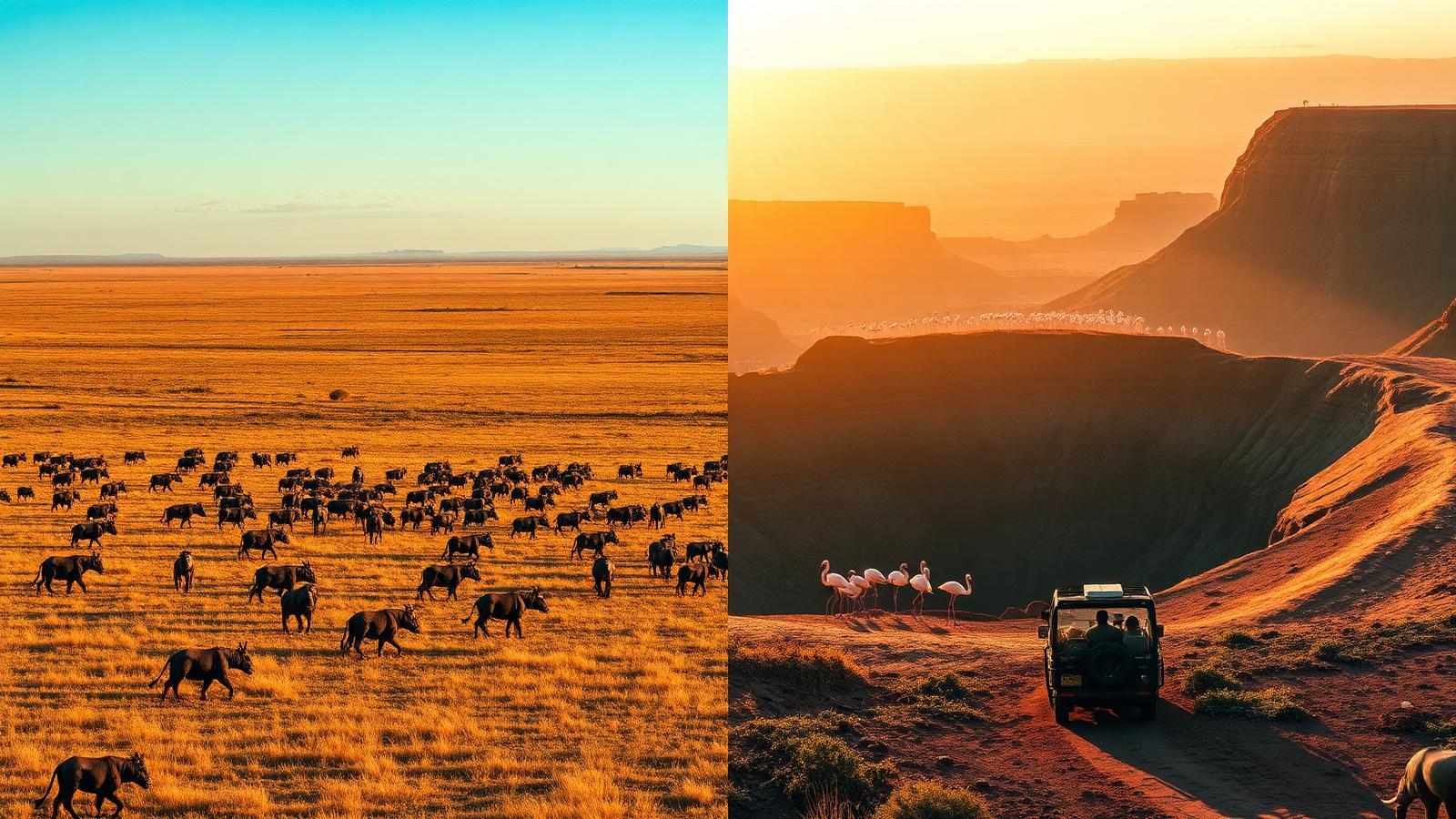
Before the detail, here is the difference in a few lines. The Serengeti is scale: open country, long horizons, wildlife spread across an area larger than some nations, and a migration that moves through it all year. Ngorongoro is concentration: a collapsed volcano with steep walls, a floor you can cross in a morning, and a resident population living inside it.
That single structural difference explains nearly everything else — why the crater is better for a short trip, why the Serengeti is better for photography, why one gets crowded and the other does not, and why the fee structures look so different.
Serengeti vs Ngorongoro Comparison Table
This is the table to read if you only read one. Each row is a practical difference that changes how a trip is planned rather than a marketing distinction.
| Category | Serengeti | Ngorongoro |
|---|---|---|
| Protected status | National park, managed for wildlife with strict land-use limits | Conservation area shared by wildlife and resident Maasai communities |
| Scale | About 14,750 sq km of open ecosystem, larger than several countries | Roughly 8,300 sq km overall; the crater floor itself is about 260 sq km |
| Defining feature | Open plains, granite kopjes and river systems that run for hours in every direction | An intact volcanic caldera with a walled floor several hundred metres below the rim |
| Wildlife pattern | Very large populations spread widely; sightings depend on region and season | Smaller populations concentrated in a small area, largely resident year-round |
| Great Migration | Central to the ecosystem; herd location changes month by month | Not part of the migration route; the crater's grazers stay put |
| Black rhino | Present but scarce and rarely seen by visitors | One of Tanzania's more realistic places to look, though never assured |
| Typical game-drive day | Early starts, long loops, sightings found by reading habitat and movement | One descent, a circuit of the floor on fixed tracks, back up by evening |
| Activities beyond driving | Balloon flights, guided walks in selected areas, some fly-camping | Highland and rim walks, Olduvai Gorge, community visits with licensed guides |
| Accommodation | Deep choice: mobile camps, permanent camps, lodges, private concessions | Mostly rim lodges and camps, plus a larger cluster of options in Karatu |
| Pace | Unfolds over several days; rewards patience | Concentrated into a single strong day |
| Suits travellers who | Want wilderness, predator behaviour, migration and photography time | Want variety quickly, dramatic scenery and a short, manageable safari day |
Two Very Different Places on the Same Road
The Serengeti is a national park inside a much larger ecosystem that continues across the Kenyan border. Land use is managed strictly for wildlife, and there are no permanent settlements inside it. You travel through distinct regions — the southern short-grass plains, the central Seronera woodland and river country, the western corridor towards Lake Victoria, and the rolling north — each with its own character and its own best months.
Ngorongoro is a conservation area rather than a national park, and the legal difference has visible consequences. Maasai families live and graze livestock within its boundaries, so the drive across the highlands passes homesteads, cattle and children walking to school alongside zebra and giraffe. The crater floor itself is the exception: livestock use is restricted, and the enclosed bowl functions almost as a self-contained wildlife area.
Because the road from Arusha runs up through the Ngorongoro highlands and out onto the Serengeti plains beyond, the two are naturally sequential. That geography is the reason most itineraries treat them as stages of one journey rather than alternatives. Our guide to the northern circuit sets out how the whole route fits together.
Landscape Comparison
The Serengeti's signature is horizon. On the southern plains the grass runs flat to the edge of sight, broken only by kopjes — ancient granite outcrops that rise out of the grassland and act as shade, lookout and den for predators. Further north the country rolls into low hills and open woodland, cut by rivers with dense green corridors along their banks. The scale takes a day or two to register properly; photographs rarely convey it.
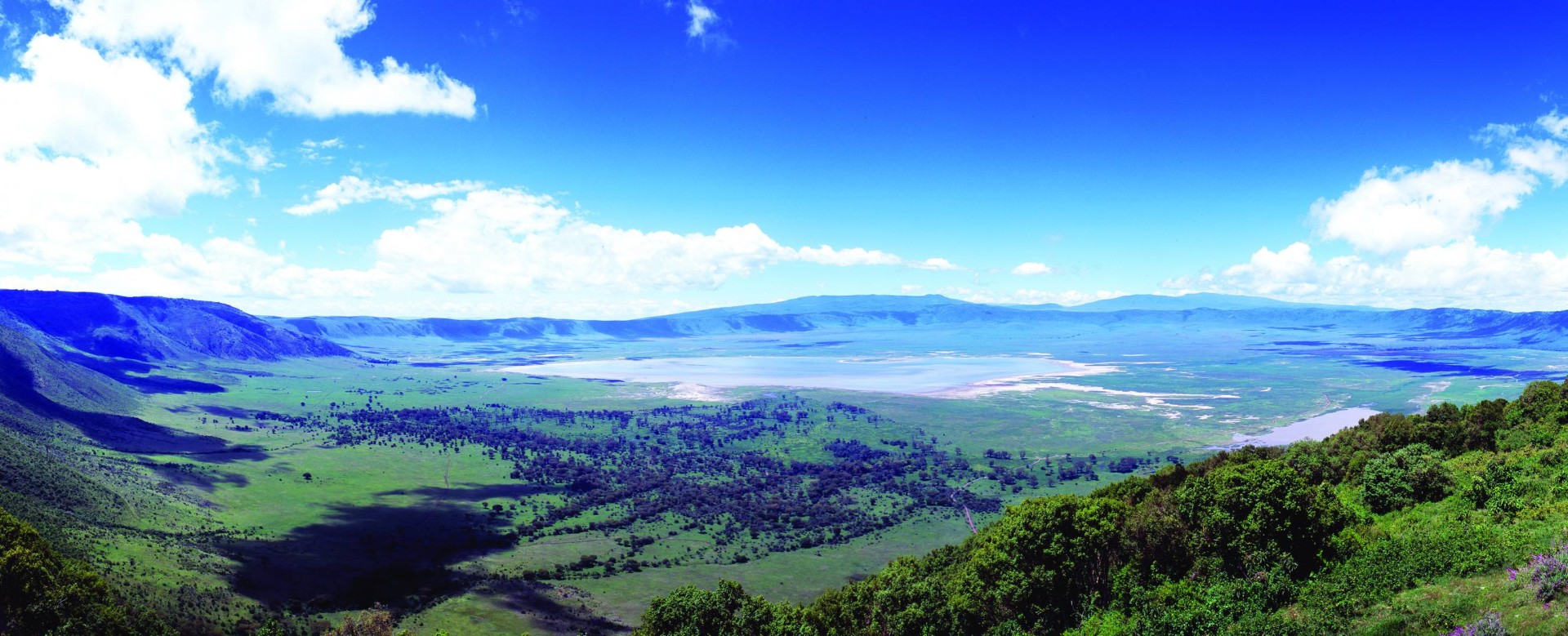
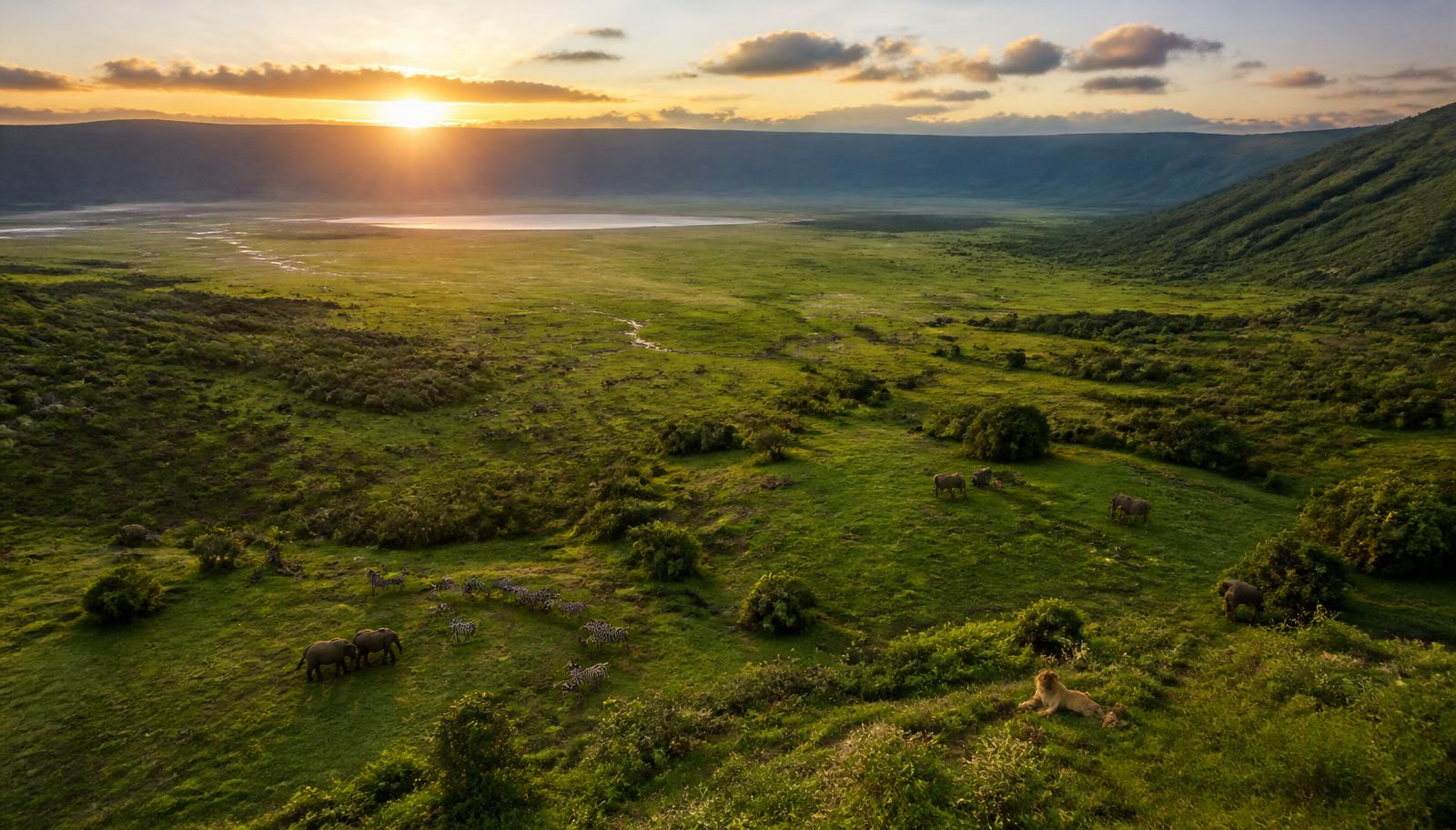
Ngorongoro is the opposite kind of drama. The rim sits high, cool and often wrapped in cloud, with forest along the edge. From the viewpoints you look down on the floor several hundred metres below, and the whole crater is visible at once — grassland, a shallow soda lake, a yellow-barked fever tree forest at the southern edge, swamp near the eastern wall, and cliffs enclosing all of it. Down on the floor the walls stay in view, which gives every sighting a backdrop and every photograph a sense of containment.
Wildlife Comparison
Both places hold the species most travellers hope to see, but the odds and the encounters differ. The table below is written in terms of realistic expectation rather than population figures, because sightings depend on season, region and luck far more than on headline numbers.
| Species | Serengeti | Ngorongoro Crater |
|---|---|---|
| Lion | Widespread across the ecosystem; prides are large and often visible on the plains and around kopjes | A well-studied crater population, frequently encountered on the floor within a short circuit |
| Leopard | Riverine woodland along the Seronera and Grumeti gives the best realistic chances in northern Tanzania | Present in the forested rim and Lerai area, but the least reliable of the Big Five on the floor |
| Cheetah | Open short-grass plains suit them; the southern plains in the calving months are a strong period | Occasionally seen on the crater floor, but not a species to plan a day around |
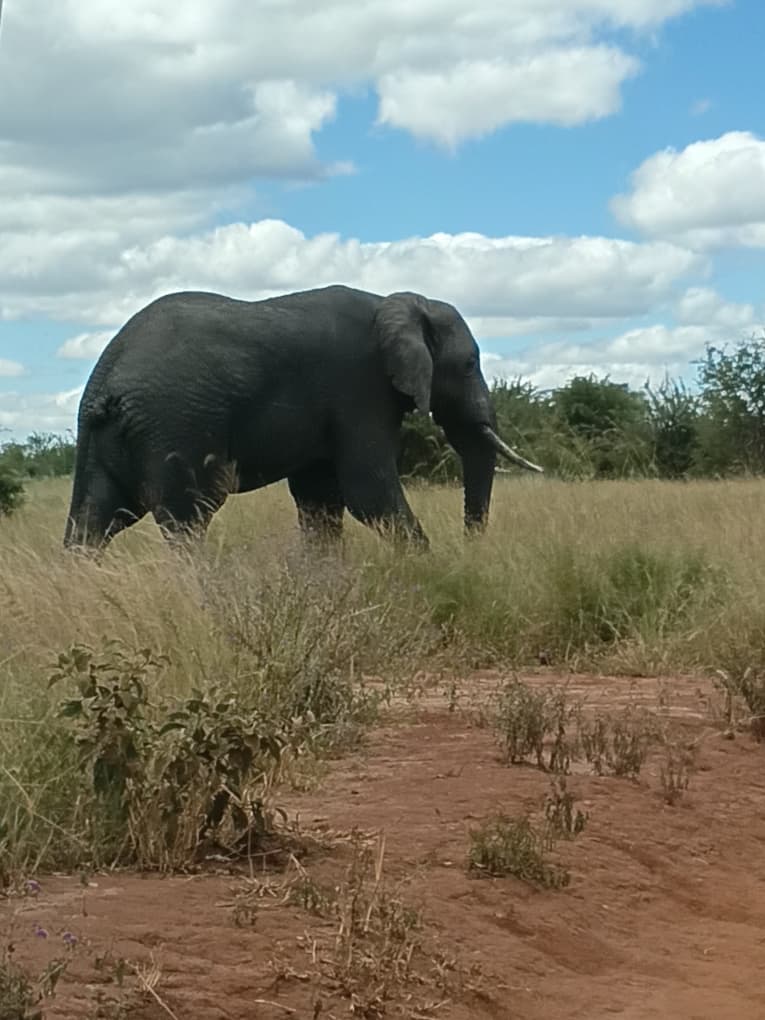
| Elephant | Common in the west, north and around river systems; large breeding herds in places | Bulls with heavy tusks are a feature of the crater floor and Lerai forest; breeding herds less common |
| Buffalo | Widespread, often in large herds near water | Abundant on the floor and in the highland grassland |
| Black rhino | Very limited and rarely part of a normal itinerary | Sometimes visible at distance on the open floor; binoculars matter more than a long lens |
| Wildebeest and zebra | In the millions across the ecosystem, moving with rainfall through the year | Resident populations that stay in the crater rather than migrating |
| Flamingo and waterbirds | Seasonal on soda lakes and floodplains, variable | The crater's soda lake often holds flamingos, with numbers changing through the year |
| Hyena and jackal | Strong populations, and clan behaviour is easy to observe with time | Very visible; the crater is one of the better places to watch hyenas interact with lions |
| Giraffe | Common throughout the woodland edges | Absent from the crater floor — the descent routes are too steep for them |
The practical reading of that table: the crater gives you the widest species list in the shortest time, and it is the more realistic place to look for black rhino. The Serengeti gives you better odds on leopard and cheetah, more predator activity over several days, and the only real chance of seeing the migration herds. If you want the species-by-species detail, our Big Five guide covers where each one is typically found across the north.
Density vs Scale: The Trade-Off That Defines the Choice
The crater's appeal is density. Because the floor is small and the wildlife largely stays there, a single circuit passes through several habitats and usually turns up a long species list without much searching. For travellers with one safari day, that is enormously valuable.
The Serengeti's appeal is scale, and scale works differently. You will have quiet stretches. You will also have mornings where you sit with a pride for an hour with nobody else present, or watch a cheetah work a line of gazelle across open ground. Over three or four days the ecosystem gives you depth that a single concentrated day cannot, but it asks for the days first.
Neither is objectively better. A traveller who values a full checklist quickly and a traveller who values long, uninterrupted observation are looking for different things, and each place is built for one of them.
Great Migration Comparison
This is the clearest distinction in the whole comparison. The migration is a movement of wildebeest and zebra through the greater Serengeti ecosystem, following rainfall and grazing. The crater floor is not on that route, and the grazers inside it do not migrate. A crater day in February looks much like a crater day in August.
The one nuance worth knowing: the Ndutu area, where the herds usually concentrate during the calving months, lies within the southern part of the Ngorongoro Conservation Area rather than inside Serengeti National Park. So the conservation area does have a genuine migration season — but it happens on the Ndutu plains, an hour or more from the crater, and not on the crater floor.
| Period | Serengeti ecosystem | Ngorongoro |
|---|---|---|
| December – March | Herds generally on the southern short-grass plains and the Ndutu area; calving usually peaks around February | The Ndutu plains sit within the wider conservation area, so this is the one season when the region is part of the migration story — though the crater floor itself is not |
| April – May | Long rains; herds usually begin moving north and west, grass is high, some camps close | Green, quiet, occasionally misty on the rim; wildlife on the floor is unaffected by the herd movement |
| June – July | Movement through the western corridor and towards the north; Grumeti river activity possible | Unchanged. A crater day looks broadly similar all year |
| August – October | Northern Serengeti and the Mara River; crossings are possible but unpredictable in timing | Unchanged, but this is the busiest visitor period on the crater floor |
| November | Short rains typically draw herds back south across the central plains | Quieter than the peak months; grass greens up on the floor |
Herd movement varies year to year with the rains, so these are patterns rather than a schedule. If the migration is the reason for your trip, read our overview of how the herds move alongside the month-by-month detail in when to plan for the migration, then choose your Serengeti region before you fix your dates.
Safari Experience Comparison
Two travellers can see the same species in both places and come home with entirely different impressions, because the shape of the day differs so much.
| Aspect | Serengeti | Ngorongoro |
|---|---|---|
| Time in the vehicle | Longer days, with distance covered between sightings | A concentrated day, with the descent and ascent built in |
| Sense of space | You can go long stretches without seeing another vehicle, especially away from the centre | Enclosed and social; other vehicles are usually in view somewhere on the floor |
| Predictability | Higher variance — a quiet morning can be followed by an exceptional afternoon | More consistent; the small area means most drives produce plenty of species |
| Depth of behaviour | Time and space allow you to stay with a hunt, a kill or a pride for as long as it lasts | Sightings are frequent but often shared, so long, quiet observation is harder |
| Physical demands | Rough roads, dust, and longer transfers between regions | Cool rim nights at altitude, a steep descent road, then an easier day on the floor |
| How it tends to be remembered | As a landscape and a rhythm | As a single, very vivid day |
Game-Drive Style and Park Rules
In the Serengeti a typical day is built around light. You leave camp near dawn, work a productive area while it is cool, come back for the middle of the day or carry a packed lunch, then go out again in the late afternoon. Guides read tracks, alarm calls and the movement of vultures, and the freedom to cover ground is part of how sightings are found.
Ngorongoro is more structured. Access to the floor runs within set daytime hours, driving is on designated tracks, and the descent and ascent roads are one-way. Off-road driving is not permitted, and night drives are not part of a crater visit. Those rules are a large part of why the floor stays in good condition despite the number of vehicles, but they do limit how you can position for a sighting.
Regulations, fees and operating hours are set by the managing authorities and are periodically revised, so confirm the current rules for your travel dates when your itinerary is booked rather than relying on figures published elsewhere online.
Travel Time and Access
From Arusha, the Ngorongoro highlands are reachable in a single driving day, usually with a park stop on the way. That accessibility is one reason the crater works so well for short trips and for travellers adding a safari day either side of Kilimanjaro or Zanzibar.
The Serengeti is further. By road it is a long continuation beyond the crater, across the conservation area and out onto the plains, and the surface is unsealed for much of it. Many travellers drive in one direction and fly the other, which converts a full travel day into a short flight and buys back game drive time. Within the Serengeti itself, moving between regions — central to north, for example — is also commonly flown.
Drive times shift with road conditions, rainfall, gate queues and how often you stop, so treat any duration you are quoted as an estimate rather than a fixed number. The routing logic behind these legs is set out in our itinerary planning guide.
Accommodation Comparison
Ngorongoro's accommodation is clustered. Most properties sit on or near the crater rim, with a larger and generally better-value cluster down in the Karatu farmland area outside the conservation gate. Rim properties buy you proximity and the view; Karatu properties usually buy you more room for your money and a warmer night, at the cost of extra driving before the descent.
The Serengeti offers far more variety. Permanent lodges and camps operate year-round in the main regions, while mobile tented camps relocate seasonally to stay near the herds — which is exactly why they suit migration-focused trips. Private concessions on the edges of the park allow activities that are restricted inside it, at a higher price point.
- Short trip, cost-conscious: Karatu for the crater night, then a mid-range camp in the central Serengeti.
- Migration-focused: one highland night, then a mobile camp positioned for the season rather than a fixed lodge.
- Comfort-led: a rim property for the view and an early descent, then a permanent Serengeti camp with a private vehicle.
Availability at the better-known properties moves quickly for peak months, and specific rates change each season, so treat any list as a starting point for a live availability check rather than a guarantee.
Crowds and Privacy
This is where the two diverge most sharply, and it is worth being straightforward about it. The crater floor is small, the tracks are fixed, and every vehicle that descends is looking for the same animals. During the busiest months a notable sighting will draw a queue of vehicles, and the descent road can be slow first thing. The setting is strong enough that most people still rate the day highly, but nobody should arrive expecting solitude.
The Serengeti has busy pockets — the central Seronera area in peak season, and any confirmed river crossing in the north — but the park is large enough that you can leave the traffic behind within half an hour. Northern and western regions are consistently quieter than the centre, and private concessions limit vehicle numbers by design.
If privacy matters to you, the levers are timing and region rather than price alone: travel in a shoulder month, take the earliest possible start, and ask for a Serengeti region away from the central hub.
Photography Comparison
The crater is a compositional environment. The walls give you a background, the light on the floor can be beautiful in the first hours, and animals are often close enough that a mid-range zoom is enough. The constraints are real, though: the day begins after sunrise and ends before the last of the evening light, you cannot leave the tracks to change your angle, and at a busy sighting other vehicles will be in your frame.
The Serengeti suits photographers better for straightforward reasons. Longer usable light at both ends of the day, clean horizons, more time with a single subject, and the option of a balloon flight for an aerial perspective. Over several days you can also return to the same pride or the same river bend, which is how the strongest sequences usually come together.
Kit recommendations, settings and vehicle technique are covered in our safari photography guide. For dust protection and layering — both matter more on the rim than people expect — see the packing list.
How the Costs Differ
Rather than quoting figures that change with each fee revision, it is more useful to understand the shape of the cost, which is stable.
- Ngorongoro charges in two parts. There is a per-person conservation area fee, and separately a per-vehicle charge for descending into the crater. That second charge is why a crater day carries a noticeably higher cost per day than a day elsewhere, and why a second descent is rarely good value.
- The Serengeti charges per person per day with no equivalent vehicle surcharge, but you stay longer — so it usually accounts for the larger share of the total trip cost.
- Both authorities issue permits on a rolling basis from time of entry rather than by calendar day, which can affect how an arrival afternoon is scheduled. Confirm the current terms when booking.
- Accommodation and vehicle costs typically outweigh park fees over a full itinerary, and vary far more between seasons and comfort levels.
Government fees, concession charges and lodge rates are all revised periodically, so any published number should be verified for your travel dates. Our safari cost guide explains how the components fit together and where the real variation sits.
Best Time for Each
Ngorongoro is a year-round destination. The floor drives well in most conditions and the wildlife is resident, so the season affects crowds, light and the greenness of the grass more than it affects what you see. The Serengeti is far more seasonal, because the herds move and because different regions peak at different times.
| Window | Serengeti | Ngorongoro |
|---|---|---|
| January – March | Southern plains and Ndutu; calving season and strong predator activity | Good conditions, green floor, generally fewer vehicles than mid-year |
| April – mid-May | Long rains, tall grass, lowest prices, some seasonal camps closed | Rain and low cloud on the rim; the floor still drives well and is very quiet |
| June – October | Dry season; the north comes into its own from around July | Reliable game viewing but the busiest months on the floor |
| November – December | Short rains, herds generally returning south; shoulder-season value early in the window | Green, photogenic, and quieter until the late-December holidays |
The planning consequence: if your dates are fixed, let them decide the Serengeti region rather than whether to go at all. Full month-by-month detail is in our guide to timing a Tanzania trip.
How Many Days to Spend
Nights on the ground matter more than calendar days, because arrival and departure days rarely deliver a full drive. The table below shows how the split usually works out at different trip lengths.
| Safari nights | Sensible split | What it delivers |
|---|---|---|
| 2 nights | Ngorongoro-led: 1 night near the rim or Karatu, 1 crater day, often with Tarangire or Lake Manyara attached | A genuine safari day with strong variety, but no time for the Serengeti. Suitable as an add-on to a Kilimanjaro climb or a Zanzibar trip |
| 4 nights | 1 night Ngorongoro area + 3 nights Serengeti, usually flying back from the Serengeti | The shortest split that does both places reasonable justice, provided you fly one leg |
| 5–6 nights | 1 night Tarangire + 1 night Ngorongoro area + 3 nights Serengeti | The most commonly booked shape of trip; comfortable pace, one long drive rather than two |
| 7–8 nights | 1–2 nights Tarangire or Manyara + 1 night Ngorongoro area + 4–5 nights Serengeti across two regions | Room to follow the herds within the Serengeti and to have a slow day when the wildlife warrants it |
| 10+ nights | As above, plus a second Serengeti region, a private concession or a coastal finish | Depth rather than more parks. Most travellers get more from extra Serengeti nights than from a second crater descent |
One rule holds across all of them: extra nights are almost always better spent in the Serengeti than on a second crater day. The crater gives you most of what it has in one visit; the Serengeti keeps giving.
Can You Visit Both?
Yes, and it is the normal way these trips are built. The road from Arusha passes the crater on the way to the Serengeti, so including both adds no detour — only nights. The usual order is highlands first, Serengeti second, which front-loads the variety and lets the Serengeti open out over the following days.
Doing both is sensible when you have four or more safari nights and are comfortable with one long transfer day, or willing to fly one leg. It is less sensible when you have three nights or fewer, or when a single interest — migration photography, for example — clearly dominates. In those cases, concentrating your time in one place produces a better trip than spreading it thin.
Best Combination Itinerary
The shape below is the one we build most often. It is deliberately unhurried, with one long transfer rather than two and a flight on the return leg.
- Day 1 — Arusha. Arrive, brief with your guide, and start early the next morning rather than driving on arrival day.
- Days 2–3 — Tarangire or Lake Manyara. A gentler introduction, different habitat, and useful for elephants and birdlife before the highlands.
- Day 4 — Ngorongoro highlands. Transfer up, settle near the rim or in Karatu, and prepare for an early descent.
- Day 5 — Crater day, then on to the Serengeti. Descend at opening, spend the morning on the floor, ascend and continue west. This is the long day of the trip, and worth accepting once.
- Days 6–8 — Serengeti. Three nights minimum, in the region that suits your travel month. Split across two areas if you have more nights.
- Day 9 — Fly back. A short flight from an airstrip to Arusha or Kilimanjaro recovers most of a driving day and leaves margin before an onward flight.
Alternative shapes — shorter, longer, family-paced, photography-led or with a coastal finish — are laid out in our comparison of route lengths, and existing starting points are on the safari packages page.
Which Is Better for First-Time Visitors?
For a first safari with a week or more, both, in that order. The crater day builds confidence quickly — variety arrives early, the setting is unmistakable, and it establishes what a game drive actually involves. The Serengeti then gives the trip its depth once you have found your rhythm with binoculars, dust and early starts.
For a first safari with only two or three nights, the highlands option is the more forgiving choice: less driving, fewer moving parts, and a strong single day. What matters most for first-timers is usually pace rather than park choice. Our first-timer's guide covers the practical side, from vehicle etiquette to what a typical day actually looks like.
Which Is Better for Families?
With younger children, the crater has clear advantages. The day is contained, drive times are short, wildlife appears frequently enough to hold attention, and the highland lodges are generally family-friendly with space to run around. Cooler nights are also easier on small children than hot lowland camps.
The Serengeti works well for families too, but it asks for more tolerance of driving, and some camps set minimum ages or restrict children from certain activities. A workable pattern is one highland night with the crater day, then two or three Serengeti nights at a camp that welcomes children, with deliberately shorter drives and a midday break. Detail and camp criteria are in our family safari guide.
Which Is Better for Couples?
Couples generally get more from the Serengeti. There is more scope for privacy, more choice among small tented camps, the option of a private vehicle so the day runs on your schedule, and space for slow mornings. A balloon flight, where budget allows, is a Serengeti experience.
The crater still earns its night — the rim at sunset is genuinely striking, and a strong single day adds contrast to the trip. The balance that works for most couples is one highland night and the majority of nights in the Serengeti, with the private vehicle prioritised over an upgrade in room category. Our guide for couples goes further into camp style and pacing.
If You Genuinely Can Only Choose One
Sometimes the days simply are not there. In that case:
- Choose Ngorongoro if you have one or two safari days, are travelling with young children or older parents, want the widest variety in the least time, or are adding a safari to a Kilimanjaro climb or beach trip.
- Choose the Serengeti if you have four nights or more, are here for the migration, care about photography, want predator behaviour rather than a species list, or value open country and quiet over convenience.
- Choose both if you have four or more nights and want the trip to feel complete — which is the majority of travellers.
Common Planning Mistakes
These come up repeatedly, and all of them are avoidable at the planning stage.
| Mistake | Why it costs you | Do this instead |
|---|---|---|
| Booking two crater descents | The floor is small and largely resident, so a second day tends to repeat the first — at full fee | Put the second day's budget into an extra Serengeti night or a private vehicle |
| Treating the crater as a Serengeti substitute | It delivers variety quickly, but not the scale, the migration or the long predator sequences | If wildlife is the point of the trip, protect the Serengeti nights first |
| Only two nights in the Serengeti with a road transfer both ways | Most of those days are spent travelling rather than game viewing | Either add a night or fly at least one leg |
| Driving the Serengeti–Arusha leg on the final morning | It is a long day and leaves no margin before an international flight | Fly out of the Serengeti and keep a buffer night or a day room in Arusha |
| Descending into the crater late in the morning | Light gets harsh, animals settle into shade, and the descent road is at its busiest | Be at the gate at opening and take the earliest descent your lodge can arrange |
| Assuming a river crossing or a rhino sighting is included | Both depend on conditions no operator controls | Plan around the season's odds and treat the standout sightings as bonuses |
| Packing for heat only | The Ngorongoro rim sits at altitude and mornings there are genuinely cold | Bring a fleece and a windproof layer for the rim and early drives |
Where to Read More on Each
This comparison stays deliberately at the decision level. For the depth behind each side of it:
- The Serengeti region by region — where wildlife concentrates in the south, centre, west and north through the year.
- Planning the crater day itself — descent timing, the circuit on the floor, and what to expect hour by hour.
- How the migration actually works — the annual cycle, and why timing is a matter of probability rather than schedule.
- The northern circuit as a whole — how Tarangire, Manyara, the highlands and the Serengeti connect.
- Route lengths compared — what three, five, seven, ten and fourteen nights realistically cover.
- Choosing your travel month — seasons, rainfall patterns, prices and crowd levels.
Common Questions
Frequently Asked Questions
Neither is better in general terms — they suit different trips. The Serengeti offers scale, seasonal migration, stronger odds on leopard and cheetah, and the time and space to watch behaviour unfold over several days. Ngorongoro concentrates a wide range of wildlife into one enclosed area, which makes it excellent value for a single, well-timed day. If you have four safari nights or more, include both and give the Serengeti the majority. If you have two or three, a Ngorongoro-led trip usually delivers more than a rushed run at the Serengeti.
Yes, and it is the standard way northern Tanzania itineraries are built. The road from Arusha passes through the Ngorongoro highlands on the way to the Serengeti, so including both adds nights rather than a detour. The usual sequence is the highlands first with one crater day, then three or more nights in the Serengeti, often flying back rather than repeating the long drive.
It depends on what you mean. The crater floor is small and holds a resident population, so a single circuit typically produces a long species list quickly. The Serengeti ecosystem holds far larger populations overall, but they are spread across a very large area and shift with the seasons, so what you see depends on the region and month you visit. Density favours the crater; scale and variety over several days favour the Serengeti.
The Serengeti, mainly because of light and freedom. Days start and end outside the crater's restricted access hours, horizons are open, you can spend longer with one subject, and balloon flights offer an aerial perspective. The crater is very photogenic — the walls give every frame a backdrop — but access is limited to daytime hours, driving is on fixed tracks with no off-road positioning, and busy sightings mean other vehicles in the frame.
The cost structures differ. Ngorongoro charges a per-person conservation fee plus a separate per-vehicle charge for descending into the crater, which makes a crater day expensive on a per-day basis. The Serengeti charges per person per day with no equivalent vehicle surcharge, but because most travellers stay several nights there it usually accounts for a larger share of the total. Fees are revised periodically, so confirm current rates for your travel dates rather than relying on published figures.
Ngorongoro is generally easier with younger children: the day is contained, drive times are short, wildlife appears often enough to hold attention, and highland lodges tend to be family-friendly with cooler nights. The Serengeti works well too but involves more driving, and some camps set minimum ages. A common family pattern is one highland night with the crater day, then two or three Serengeti nights at a camp that welcomes children, with shorter drives and a midday break.
One night in the Ngorongoro area with a single full crater day covers it for most travellers. The Serengeti deserves three nights as a working minimum, four or five if you want to move between regions or follow the herds. Extra nights are almost always better added to the Serengeti than spent on a second crater descent, since the crater floor shows you most of what it has in one visit.
No. The migration moves through the greater Serengeti ecosystem, and the crater floor is not on that route — the grazers inside it are resident and stay year-round. One nuance: the Ndutu area, where the herds usually concentrate during the calving months, lies within the southern part of the Ngorongoro Conservation Area, but it is an hour or more from the crater and a separate experience.
Both hold all five species, but the odds differ. The crater is the more realistic place to look for black rhino and produces buffalo, elephant and lion readily; leopard is the least likely there. The Serengeti gives better chances on leopard, with lion and buffalo widespread and elephant common in several regions, while rhino is rarely part of a normal itinerary. No sighting can be guaranteed in either place.
With a week or more, both, in that order. The crater day introduces variety early and shows you what a game drive involves; the Serengeti then adds depth once you have settled into the rhythm. With only two or three nights, a highlands-based trip is more forgiving — less driving, fewer moving parts, and one strong day rather than a lot of transit.
During the busier months, yes. The floor is small, tracks are fixed, and vehicles tend to converge on the same sightings, so a notable animal can draw a queue. An early descent and travel in a shoulder month both help. The Serengeti has busy pockets in the central area and at confirmed river crossings, but the park is large enough that quieter country is usually within half an hour.
Ngorongoro. A single day on the crater floor gives more wildlife variety than a day spent largely driving toward the Serengeti, and the highlands are reachable from Arusha in one leg. It also pairs well with Tarangire or Lake Manyara if you can add a second day.
Final Thoughts
The honest position after years of planning these trips is that the Serengeti and Ngorongoro are not really competitors. One is a large, seasonal ecosystem that rewards time; the other is a small, enclosed, year-round place that rewards a single well-timed day. The question is not which is better but which fits the nights you have, the month you are travelling, and what you would most regret missing.
If you take one thing away, make it this: decide your number of safari nights first. At four or more, include both and weight the Serengeti. At three or fewer, concentrate rather than spread. And treat the standout sightings — rhino, leopard, a river crossing — as things a good plan makes more likely, never as things anyone can promise.
Decide your number of safari nights first, then split them honestly: at four or more, include both and weight the Serengeti; at three or fewer, concentrate rather than spread. The comparison stops being a contest once the nights are on the table.
Plan Your Journey
Not sure how to split your days? Send us the details and we'll map it out.
Tell us how many days you have, your travel dates, the wildlife you care most about, your budget range, the style of accommodation you prefer, and whether you'd like both the Serengeti and Ngorongoro. Our Arusha team will put together a tailored itinerary and explain the trade-offs behind the split — no cost, no obligation.
- TALA Licensed Operator
- 4.9 ★ Guest Rating
- No Booking Fees
Keep Reading
Related Tanzania Safari Guides
Safari Guides
The Ultimate Tanzania Travel Guide: Everything You Need to Know Before You Visit
Safari Guides
Best Tanzania Safari Itineraries: How to Choose the Right Route for Your Days
Safari Guides
The Northern Circuit: Exploring Tanzania's Most Iconic Wildlife Havens
Safari Guides