
Serengeti & Wildlife
African Elephants in Tanzania: Where to See Them and How They Live
A working guide to Tanzania's elephants — the regions that matter, how families are organized, what moves them through the year, and how to watch them without disturbing them.

Elephants are the animal most travelers underestimate before a safari and talk about most afterward. Part of that is size. Most of it is the fact that an elephant sighting is rarely a single animal doing one thing. It is a family with history — a lead female deciding where to go, older daughters managing calves, adolescents testing limits, and a bull or two on the edge of the group with their own agenda.
This guide is about elephants specifically, not about any single park. It covers where elephants live across Tanzania's safari regions, how family groups are organized, what drives their movement between seasons, how guides approach an encounter, and what responsible viewing actually looks like in the field. For park-by-park logistics, the Tarangire guide and the Ruaha guide pick up where this article deliberately stops.
The Short Answer
Elephants occur across most of Tanzania's major safari areas. In the north, Tarangire is the region most associated with them, particularly in the dry months when animals move toward the permanent river. In the south, Ruaha and Nyerere hold significant elephant country across landscapes big enough that you can spend a morning with a herd and see no other vehicle. The Serengeti has elephants too, mostly in woodland rather than out on the open plains.
Timing matters more for elephants than for many species, because their movement is tied to water. As surface water dries between roughly June and October, families work back toward rivers and swamps and become easier to find. When the rains come, they disperse again, sometimes within days. None of this guarantees anything. Elephants are wild, wide-ranging animals, and what you see depends on the herd, the habitat, the season and a fair amount of luck.
African Elephant Quick Facts
What an African Bush Elephant Is
The African bush elephant is the largest land animal alive, and almost every part of it is adapted to processing enormous quantities of low-quality plant food while staying cool in open, hot country. Males are substantially larger than females and continue growing far longer, which is why an old bull standing next to a family group looks like a different species.
Three features do most of the work. The trunk is a fused nose and upper lip with fine muscular control at the tip; it feeds, drinks, smells, touches, threatens and reassures. The ears are radiators — thin skin over a dense network of blood vessels that dumps heat when the animal fans them. The teeth are conveyor belts: molars move forward through the jaw and are replaced through life, and when the last set is worn down an elephant's ability to feed declines, which is one reason very old animals stay near softer vegetation and water.
Tusks are enlarged incisors, present in both sexes in African elephants, and used for digging, stripping bark, moving obstacles and, in bulls, contests with other males. Individuals vary — some are markedly asymmetrical, some have broken tips, some carry very little ivory at all. Guides use these differences, along with ear notches and vein patterns, to recognize particular animals across seasons.
Where to See Elephants in Tanzania
The useful question is not which park has the most elephants — those figures move, are surveyed at intervals, and rarely predict a given morning — but which habitats concentrate elephants at a time you can visit, and how well you can see into that habitat. Open woodland near permanent water beats a larger population spread thinly across dense bush.
Tarangire
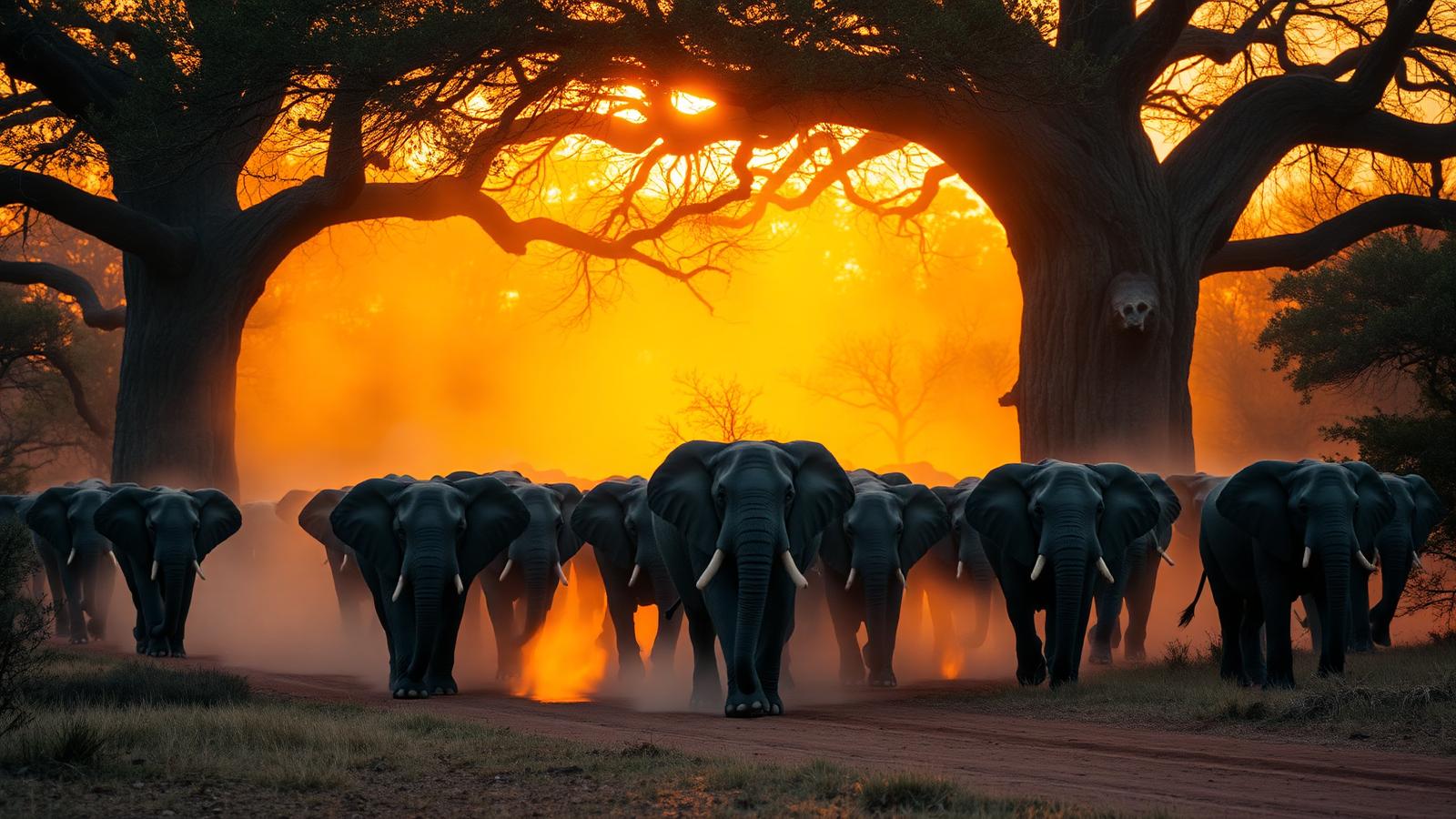
Tarangire is the northern circuit's elephant landscape. The park sits along a permanent river in a much larger ecosystem of community land and open country, and as seasonal water dries out across that wider area, elephants move toward the river and the southern swamps. That movement is the whole story of the park's dry season: baobab-studded woodland, cut riverbanks, and families arriving to drink through the afternoon.
It is also easy to reach — a road drive from Arusha rather than a flight — which makes it the practical choice for travelers who want elephant time without rebuilding the whole itinerary. In the wet months the same park feels different: green, quiet in places, with animals dispersed well beyond the park boundary. Lodges, gates, road loops and seasonal detail sit in the full Tarangire guide.
Ruaha
Ruaha is a southern park on a different scale — miombo woodland, sand rivers, rocky ridges and the Great Ruaha River running through the middle of it. Elephants are one of the park's defining animals, and in the dry season the river and its remaining pools pull game toward predictable places. What sets Ruaha apart is not a number but the absence of pressure: it is normal to watch a herd for an hour and never share the sighting. The trade-off is a flight, longer driving distances and a shorter practical season, all of which the Ruaha guide covers in detail.
Nyerere
Nyerere is enormous and low-lying, built around the Rufiji River and a chain of lakes and channels. Elephants use the water system and the surrounding woodland, and the park's real distinction is how you can watch them: boat safaris put you at water level, which changes the experience of a drinking herd entirely, and walking safaris teach you to read tracks, dung and feeding sign rather than only look for the animal itself. Neither activity makes elephants more likely to appear; both make the encounter you do get more interesting. The Nyerere guide explains the seasons and camp options.
Serengeti
The Serengeti is not primarily an elephant destination, and any guide who tells you otherwise is selling. Elephants are there, but they favor woodland and hill country rather than the short-grass plains most people picture. The acacia woodland along the Seronera drainage, the northern hills toward Lobo and the western woodlands produce most sightings, and bulls in particular are seen regularly around Seronera.
That does not diminish the park. It just means the Serengeti earns its place in your itinerary for other reasons, and elephant time is better built around a different stop. Our Serengeti wildlife guide covers the wider species picture there, and our lion guide explains the predator side of the same ecosystem.
Ngorongoro and the Crater Highlands
On the crater floor you are most likely to see bulls, often around the Lerai fever-tree forest and the marsh edges. Family groups spend much of their time in the forested highlands above the caldera rather than down on the floor, so a crater day is a good chance of a large solitary male in a spectacular setting rather than a chance of a big family gathering. The old bulls seen here are among the reasons the crater keeps its reputation, but they move, they age, and no day guarantees one.
Other Relevant Parks
- Lake Manyara. A narrow park below the rift escarpment with groundwater forest. Encounters can be close and atmospheric, but the vegetation limits how far you can see, so sightings are unpredictable.
- Katavi. Remote western Tanzania, with a short, intense late-dry-season window as floodplains shrink. Superb if the timing and budget align; not a casual add-on.
- Arusha National Park. Forest and crater country on Mount Meru. Elephants occur, but this is a half-day park for scenery, giraffe and colobus rather than an elephant destination.
- Mikumi. Accessible from the road route south, with open floodplain and regular general game. Useful as part of a southern overland trip rather than a target in itself.
Comparing the Elephant Regions
Habitat and access matter more than headline population figures. This table is about what the country feels like and how easily you can see into it.
| Region | Habitat | Elephant viewing character |
|---|---|---|
| Tarangire | Baobab and acacia woodland along a permanent river, with large swamp systems in the south | Strongly seasonal and generally the most consistent elephant country in northern Tanzania during the dry months, when animals from the wider Maasai Steppe move toward permanent water |
| Ruaha | Miombo woodland, sand rivers, rocky hills and the Great Ruaha River in a very large southern landscape | Elephants are a defining feature of the park and are often seen along the river system in the dry season. Distances are long and animals range widely, so sightings feel earned rather than staged |
| Nyerere (Selous) | Rivers, lakes and channels in a huge, low-lying southern wilderness | Elephants use the Rufiji system and surrounding woodland. Boat activities put you at water level, which changes the perspective on a drinking herd more than it changes the odds |
| Serengeti | Open plains, riverine woodland, kopjes and hill country in the north and east | Elephants are present but far less concentrated than in Tarangire or Ruaha. Woodland sectors such as Seronera, Lobo and the northern hills are more productive than the short-grass plains |
| Ngorongoro Crater and highlands | Caldera floor, Lerai fever-tree forest and forested crater rim | Bulls are seen on the crater floor and around Lerai; family groups spend much of their time in the highland forest rather than down on the floor |
| Lake Manyara | Groundwater forest, floodplain and a narrow strip below the rift escarpment | A compact park where elephants are often seen in dense forest at short range. Encounters can be excellent, though the habitat limits how far ahead you can see |
| Katavi | Seasonal floodplains that shrink to a few water sources late in the dry season | Remote western park with concentrated late-dry-season game. Access is by light aircraft and the season is short |
| Arusha National Park | Montane forest, crater and lakes on the slopes of Mount Meru | Elephants occur but are not the reason to visit. Treat any sighting here as a bonus on a short day trip |
Elephant Herd Structure
What people call a herd is usually a family group: related females and their dependent young. Membership is not fixed in the way a lion pride is. Families split for hours or days to feed, then rejoin; related families associate at water and separate again afterward. Watching a large gathering at a river, you are often looking at several families that know each other rather than one enormous unit.
Group size varies with season, habitat and food. Dry-season gatherings near permanent water tend to be larger and more visible; wet-season groups spread out and can be small and hard to find in thick bush. Neither pattern is a rule. The point for a traveler is that a big herd is a product of conditions, not of a park's inherent generosity.
Matriarchs and Family Groups
A family is led by an experienced female, usually the oldest. Her value to the group is memory: where water held out in the last hard year, which routes cross a road safely, which places have caused trouble before. Researchers studying elephants in East Africa have repeatedly found that groups led by older females respond more appropriately to unfamiliar situations, including unfamiliar animals and unfamiliar calls.
You can usually identify her in the field. She sets the direction and pace, she is typically the animal that turns to face a vehicle first, and the rest of the group takes its cue from her. When she relaxes and returns to feeding, the whole family relaxes. When she stands still with her ears out, nobody else moves either.
Male Elephants
Male calves grow up in the family and leave as adolescents, typically over a period of months rather than in a single break. Adult bulls then live independently or in loose associations with other males, joining families when a female is receptive. These bachelor groupings are informal, and older bulls appear to have a settling influence on younger ones.
Bulls behave differently from families on safari. They are often more tolerant of vehicles, more likely to be encountered alone, and less predictable in the specific case of musth. A large bull feeding slowly through open woodland is one of the easier elephant sightings to spend real time with, because there are no calves to protect and no group decisions to make.
Musth and Why It Matters
Musth is a periodic state in adult males, marked by secretion from the temporal glands between eye and ear, urine dribbling, and a marked rise in aggression toward other bulls. It is normal and healthy. It is also the single situation in which guides noticeably increase their distance, because a bull in musth is less predictable and less interested in avoiding conflict.
Calves and Shared Care
Calves are dependent for a long time and stay close to their mother in the first years, gradually widening the distance as they grow. Other females in the family — older sisters, aunts, cousins — take an active role, blocking a calf from wandering, waiting for a slow one, or standing over it while it sleeps. Adolescent females appear to learn calf-rearing this way before they have young of their own.
On a game drive this is the behavior worth waiting for. A family crossing a road with a small calf will often reorganize completely: adults stop, an older female steps into the gap, and the calf is pushed forward between two bodies. It takes two minutes and tells you more about elephants than an hour of static viewing.
Feeding and Water
Elephants eat a lot and digest inefficiently, which means they spend most of their day feeding and cover ground while doing it. Diet shifts with the season: more grass when grass is green and abundant, more browse, bark and roots as the dry season advances. That flexibility is why they persist across such different Tanzanian habitats, from highland forest to miombo woodland to floodplain.
Water is the harder constraint. Elephants drink regularly and also use water and mud for temperature control and skin condition, so permanent water shapes their movement more than food does. This is the practical key to elephant viewing in Tanzania: in the dry season, find the reliable water and you have narrowed the search enormously; in the wet season, water is everywhere and so are the elephants.
They also dig. In dry riverbeds, elephants excavate for sub-surface water, and the holes they leave are used by other species afterward. It is one of the clearest examples of how an elephant population changes the resources available to everything else in the ecosystem.
Elephant Communication
Elephants communicate constantly, and most of it is not the trumpet from the documentaries. Low rumbles carry over distance and coordinate movement. Touch does much of the close-range work — a trunk laid across a calf's back, trunk-to-mouth contact between adults, a reassuring press of the body during a greeting. Posture and ear position broadcast intent to anything watching, including your vehicle.
Smell matters more than most visitors expect. An elephant that raises its trunk toward you is reading the air, and the information it gets is far better than what it can see. This is also why guides think about wind direction when approaching a herd: an unexpected scent from behind a bush is more disturbing to a family than a vehicle they can see.
Seasonal Movement
Elephants move at a scale that ignores park boundaries. Populations in northern Tanzania use land well beyond the gazetted parks during wetter months, and the corridors between protected areas matter as much as the parks themselves. That is why conservation work in this country is so often about land use outside reserves rather than inside them.
| Period | Conditions | Elephant context |
|---|---|---|
| January – March | Warm, with short rains finished and long rains not yet started in most years; scattered surface water | Herds are more dispersed because water is available in more places. Viewing is still good in the north, and calves born through the wetter months are often visible |
| April – May | Long rains in most of the country; some camps close and roads deteriorate | Vegetation is thick and green. Elephants have no reason to gather at rivers, so sightings are less predictable, though the landscape photography is excellent |
| June – August | Cool, dry and stable; the classic safari season | Surface water dries progressively and animals begin working back toward permanent rivers and swamps. Woodland thins out, which improves visibility |
| September – October | Hot, dry and dusty; vegetation at its sparsest | Generally the strongest window for concentrated elephant activity around permanent water in Tarangire, Ruaha and Katavi. Herds tend to be larger and more predictable in their movements |
| November – December | Short rains arrive in most years; the bush greens quickly | Elephants begin to disperse again within days of meaningful rain. Sightings remain good early in the period and become more scattered as the season progresses |
Rainfall varies year to year, and elephants respond to actual conditions rather than to the calendar. A late start to the rains extends the dry-season pattern; an early heavy downpour scatters a gathering within a day. Plan around the tendency, not around a promise. Our month-by-month timing guide sets this against the rest of the safari calendar.
Elephants and Their Habitat
Elephants are not passive residents of a landscape; they rebuild it. They push over trees, strip bark, break branches within reach of smaller browsers, open paths through thick bush and dig for water. In some areas this maintains open grassland that would otherwise close into woodland. In others, particularly where elephants are compressed into a smaller area by surrounding land use, the same behavior can visibly thin mature trees.
Both outcomes are worth understanding before you judge what you see. A stretch of broken acacia is not automatically damage, and a dense stand of trees is not automatically healthier. What matters is whether animals have room to move across a large enough area for vegetation to recover behind them — which is exactly what fragmented habitat takes away.
Interactions With Other Wildlife
Elephants dominate most water sources they visit. Buffalo, zebra and antelope generally give way and return afterward, and it is common to watch a queue form and dissolve around a single pool. The water elephants dig in dry riverbeds is used by baboons, warthog and birds long after the diggers have moved on.
With predators, the relationship is mostly one of tolerance at a distance. Adult elephants are not realistic prey, and families are quick to close ranks around calves. You will occasionally see a family push lions off a shaded spot or move them from a path, which is usually less dramatic and more matter-of-fact than it sounds. For the predator side of the ecosystem, see our guide to Tanzania's lions and the wider Big Five overview.
Elephant Behavior on Safari
Vehicles are part of the landscape in Tanzania's main parks, and most elephants there have grown up with them. That habituation is why encounters can be so close and so calm. It is not universal: animals in less-visited areas, families with very small calves and bulls in musth all behave with less tolerance, and the same herd can be relaxed one week and edgy the next.
The behavior of the people inside the vehicle matters more than the vehicle itself. A stationary car with a quiet engine and passengers who stay seated reads as a single neutral shape. Standing up, leaning out, raising voices or slamming doors breaks that outline, and elephants notice immediately.
Reading Elephant Body Language
| What you see | What it usually means | What should happen |
|---|---|---|
| Ears held out wide, head raised, animal facing the vehicle squarely | A display intended to make the elephant look larger. It is usually a warning rather than a prelude to contact | Stay seated and quiet. The guide will hold position or reverse slowly. Nobody stands up or moves suddenly |
| Head-shaking with a loud ear slap, sometimes with a short forward step | An escalation of the same warning, often from a female with calves nearby | Withdraw. Distance is the only thing that resolves this, and it usually resolves quickly |
| Trunk raised and swaying toward you, ears relaxed | The elephant is scenting the vehicle. Curiosity rather than threat | Remain still. Engine off if the guide judges it safe. This is often how the closest encounters begin |
| Feeding continues, calves stay in the open, adults ignore the vehicle | The herd has accepted the vehicle as part of the landscape | The best possible outcome. Keep voices low and let the herd set the pace of the sighting |
| Temporal gland streaming, urine dribbling, a bull walking with purpose | A bull in musth, with elevated hormones and reduced tolerance | Extra distance, no engine noise near the animal, and no attempt to reposition for a photograph. Guides give musth bulls a wide margin |
| A family bunching tightly, calves pushed to the middle, adults facing outward | The group feels pressure from something — a vehicle, predators, or another herd | Back off and give the group room to reform and move on |
Individual animals differ. Two females of similar age in the same family can have noticeably different tolerance, and a herd that walked past your vehicle yesterday may want more room today. Treat every encounter as new information rather than a repeat of the last one.
Best Time to See Elephants
If elephants are your priority, the later dry months — roughly August through October — give the most favorable conditions in Tarangire, Ruaha and Katavi: thin vegetation, concentrated water and more predictable movement. June and July are cooler and still good, with less dust. The wetter months are not a write-off; they are simply a different proposition, with dispersed animals, thick green cover, fewer vehicles and lower rates.
Consider what else you want from the trip before optimizing for one species. Migration timing, calving season, Kilimanjaro plans and beach extensions all pull against each other, and a well-designed Tanzania itinerary is usually a compromise rather than a maximum on any single axis.
The Daily Rhythm of a Sighting
| Window | Conditions | What to expect |
|---|---|---|
| 06:00 – 09:00 | Cool, soft light, herds usually already moving | Feeding and travel. Families move between night browsing areas and daytime shade, which is when you see herd order most clearly |
| 09:00 – 11:30 | Heating quickly | Steady feeding, often in more open ground. Bulls may be encountered alone, walking with no obvious urgency |
| 11:30 – 15:00 | Hottest part of the day | Shade, dust-bathing and rest. Family groups often stand in loose clusters under a single tree, calves sleeping between adult legs |
| 15:00 – 17:00 | Heat easing | Movement toward water in the dry season. This is when several separate families may converge at a river and interact |
| 17:00 – sunset | Falling light, cooler air | Drinking, mud-wallowing and social contact, then a slow move out to night feeding ground. The best combination of behavior and light |
Elephant Photography
Elephants are one of the few large subjects that usually look better with space around them. A family crossing open ground under a big sky says more than a tight head-and-tusk crop, and the wide frame is also the safer choice when you cannot get closer.
- A mid-range zoom around 24–105mm covers herd-in-landscape work; a 100–400mm handles portraits, detail and animals at distance. You will change lenses less than you think.
- Support the camera on a bean bag on the window frame or roof edge rather than a tripod. Turn the engine off if the guide is happy to.
- Expose for the highlights in dusty backlight. Late-afternoon dust around a moving herd is the strongest light you will get, and it clips easily.
- Shoot the interactions, not just the animals: a trunk on a calf's back, an ear position, two bulls testing each other. Behavior dates better than portraits.
- Give up frames you cannot get without repositioning the vehicle in front of a herd. That move is the most common way tourists disturb elephants.
Gear lists, settings and light are covered properly in our safari photography guide, and the packing list covers dust protection, power and storage in the field.
Responsible Elephant Viewing
Responsible viewing is mostly about restraint, and it does not reduce the quality of the sighting. In practice it comes down to a short list that experienced guides follow without discussion.
- Keep a respectful distance and let the animals decide how close the encounter gets.
- Never position the vehicle between a female and her calf, or across a herd's route to water.
- Stay seated, keep voices down, and keep arms and equipment inside the vehicle.
- No flash, no calling out to animals, no engine revving to make an elephant turn its head.
- Stay on the designated tracks. Off-road driving damages habitat and pushes animals away from areas they use.
- Limit time at a single sighting when other vehicles are waiting, and leave if the group shows stress signals.
- Follow your guide's instructions immediately, including instructions to leave. There is always a reason.
The same principle applies to how you choose experiences before you travel. Wild elephant viewing from a vehicle, a boat or on foot with a trained guide is a legitimate way to see the animal. Riding, touching and hand-feeding attractions are not, and they are not part of a Tanzanian safari.
Conservation and Threats
Two pressures dominate. The first is poaching for ivory, which hit East African elephant populations hard in the past and remains a live enforcement issue rather than a solved problem. The second, and increasingly the more structural one, is habitat loss and fragmentation: farmland, settlement, fencing and infrastructure expanding into land that elephants have used for generations.
Fragmentation is the harder problem because it does not look dramatic. A corridor between two protected areas closing over a decade produces no single headline, but it reduces the range available to animals that need to move seasonally, concentrates them into smaller areas, and increases contact with people. Much of the meaningful conservation work in Tanzania is therefore about land use, corridors and community agreements outside the parks.
Tourism is part of this picture, imperfectly. Park fees and concession payments fund protection and give conservation land an economic value that competes with conversion to other uses. That is a real contribution, and it is not a complete answer on its own. Our safari cost breakdown shows how much of a typical trip goes to park and conservation fees.
Human-Elephant Conflict
Where farms sit along elephant routes, crop raiding is a serious problem for the people living there. A family group can move through a smallholding in one night, and the loss falls on households with little margin. Retaliation and injury on both sides follow from that, and no amount of enthusiasm from visitors changes the arithmetic for a farmer.
Mitigation work in Tanzania and neighboring countries has focused on low-cost deterrents, better early warning, corridor protection and compensation or benefit-sharing schemes so that communities near wildlife areas gain something concrete from them. Understanding this is part of understanding elephants here: their future depends less on what happens inside the parks than on what happens along the edges.
How Guides Help Protect Wildlife
A guide's role in conservation is unglamorous and continuous. It includes keeping to tracks and speed limits, reporting injured animals, snares and suspicious activity to park authorities, managing the number of vehicles at a sensitive sighting, and telling guests no when a request would disturb animals. Guides also carry the practical knowledge of where particular families move, which is information rangers and researchers use.
Building an Itinerary Around Elephants
Elephants should shape a trip, not consume it. In practice that means choosing one or two regions where habitat and season work in your favor, giving them enough nights, and letting the rest of the itinerary cover other interests.
| Shape | Typical length | Notes |
|---|---|---|
| Northern circuit with a proper Tarangire stay | 6 – 8 days | Two or three nights in Tarangire rather than a half-day stop, then Ngorongoro and the Serengeti. The most straightforward way to build a first safari around elephants without narrowing the rest of the trip |
| Southern circuit | 7 – 9 days | Ruaha and Nyerere, both reached by light aircraft. Fewer vehicles, longer distances, a stronger sense of wilderness, and boat and walking options in Nyerere |
| North and south combined | 11 – 14 days | The widest range of elephant habitat in one trip, from acacia parkland to miombo and river systems. Requires internal flights and a realistic budget |
| Short northern trip | 4 – 5 days | Tarangire and Ngorongoro, with Manyara if time allows. Workable, but the shorter the trip the more weather and animal movement decide your experience |
If this is your first time in Tanzania, read our first-timer's guide before fixing dates — it explains how a safari day is actually structured, which changes how many parks people want to include.
Common Planning Mistakes
| Mistake | Why it hurts | Better approach |
|---|---|---|
| Booking a single night in Tarangire | One night usually means one afternoon and one morning drive, and elephant movement does not run to that schedule | Two nights minimum, three if elephants are the priority |
| Expecting the Serengeti to be the elephant park | The Serengeti is extraordinary for other reasons, but elephants there are more scattered than in Tarangire or Ruaha | Keep the Serengeti for what it does best and add elephant-focused days elsewhere |
| Travelling only in the wet season and expecting dry-season concentrations | Water everywhere means elephants have no reason to gather at rivers | If large gatherings matter to you, target the later dry months and accept the trade-offs in heat and dust |
| Sharing a vehicle when photography is the goal | A shared vehicle moves on someone else's timetable and seat position is fixed | Budget for a private vehicle if you want to stay with a herd for an hour |
| Treating elephants as a checklist item | The interesting part of an elephant sighting is the family behavior, which takes time to read | Plan fewer parks and more time in each |
Related Guides
- Tarangire National Park Safari Guide — seasons, routes and lodges in the northern circuit's elephant landscape.
- Ruaha National Park Guide — how the southern park works and when to go.
- Nyerere National Park Guide — boat and walking safaris along the Rufiji.
- Serengeti Wildlife Guide — the wider species picture across the plains.
- Lions of Tanzania — the predator side of the same ecosystems.
- Tanzania Safari Photography Guide — gear, light and field technique.
Frequently Asked Questions
Common Questions
Frequently Asked Questions
Elephants are found in every major Tanzanian safari park. The strongest populations are in Nyerere (formerly Selous), Ruaha, Tarangire, Serengeti and the Ngorongoro Crater. Tarangire is the most reliable park for high-density sightings during the dry season, when herds of 200 or more gather along the Tarangire River. Ruaha and Nyerere hold the largest absolute numbers but are more remote. For a first Tanzania safari, a 2-night Tarangire stop delivers the elephant experience most travelers dream of.
Tarangire National Park has the highest-density herds in northern Tanzania, particularly from July through October when up to 3,000 elephants concentrate around the Tarangire River. For total population, Nyerere National Park holds the largest elephant population in Tanzania — around 15,000 individuals — followed by Ruaha with around 12,000. Serengeti has around 7,000 elephants but they are dispersed across a much larger area, so day-to-day sightings feel less dense than Tarangire's.
The dry season — June through October — is the best time to see elephants in Tanzania. As seasonal waterholes disappear, herds concentrate around permanent water sources like the Tarangire River, Rufiji River (Nyerere) and Great Ruaha River. In Tarangire specifically, sightings peak in September and October when the migration of elephants from surrounding Maasai Steppe brings enormous breeding herds into the park. The green season (November–May) still has excellent elephant viewing but herds disperse across greater distances.
Elephants are generally peaceful but they are the second most dangerous animal in Africa to encounter on foot (after hippos). From a stationary safari vehicle they almost never see you as a threat, and encounters at close range — even a bull walking right past the vehicle — are safe when handled by an experienced guide. The genuine risks are: never positioning a vehicle between a matriarch and her calves, never blocking a herd's path to water, and never approaching a solitary bull in musth (a hormonal state marked by temporal gland secretion and fluid dribbling from the sheath). Trained Tanzania guides read all these signs instinctively.
Tanzania park rules require vehicles to maintain a minimum distance of 25 meters from elephants — but the animals themselves often close the gap. A relaxed breeding herd will frequently walk within a few meters of a stationary vehicle, and it is the safest and most powerful way to observe them. What matters is that the vehicle stays still, the engine stays off, and no one stands up or extends limbs outside the vehicle. Guides read body language constantly: ears flared, head-shaking, trumpeting or a mock charge means back off immediately.
Absolutely — elephants are among the most rewarding safari animals for children. They are large, easy to see, and their family behavior (calves suckling, adolescent bulls play-fighting, matriarchs leading the herd to water) is genuinely captivating for younger travelers. Tarangire is particularly good for families because sightings are frequent, the driving distances are short, and lodges like Tarangire Sopa and Sanctuary Swala have family suites and pools. Most Tanzanian lodges accept children from age 6, and some accept younger with private-vehicle arrangements.
A 100–400mm zoom is the most versatile lens for elephant work — it covers close portraits and mid-distance behavior. Add a 24–70mm for herd-in-landscape shots (elephants are one of the few subjects that look better in wide compositions than tight crops) and a 70–200mm f/2.8 for low-light dawn and dusk work. A bean bag on the vehicle window is more stable than a tripod. For video, ensure your camera has in-body stabilization — even a stationary vehicle vibrates enough to matter at 400mm.
For pure elephant density, a 7-day northern circuit with 2–3 nights in Tarangire (during July–October) followed by Ngorongoro Crater and Serengeti is unmatched. For enormous, wilder herds without the vehicles, a 9-day Ruaha + Nyerere southern circuit is exceptional and pairs naturally with a Zanzibar beach extension. For the ultimate elephant safari, a 12-day itinerary combining Tarangire, Serengeti, Ruaha and Nyerere delivers the full range — from northern circuit dry-season concentrations to southern circuit wilderness populations. Tell our team elephants are your priority and we'll build the itinerary around known herd movements.
Final Thoughts
Tanzania holds around 60,000 African elephants — the second-largest population on the continent — spread across some of the wildest landscapes left on earth. From the baobab-studded riverbanks of Tarangire to the miombo woodlands of Ruaha and the palm-fringed channels of Nyerere, the elephant is the animal that defines what Tanzania feels like. Watching a matriarch lead her family to water at dusk, listening to the low subsonic rumbles pass between generations, and understanding that these are the same family lines that have used the same waterholes for a century — that is the elephant experience Tanzania offers, and nowhere else quite matches it.
Plan Your Journey
Ready to explore Tanzania?
Let our Arusha-based safari specialists craft a private, tailor-made itinerary around you — no middlemen, no templates, just your perfect journey.
- TALA Licensed Operator
- 4.9 ★ Guest Rating
- No Booking Fees
Keep Reading
More Tanzania Wildlife Guides
Wildlife
The Great Wildebeest Migration in the Serengeti: Complete 2026 Guide
Safari Guides